Boureima Amadou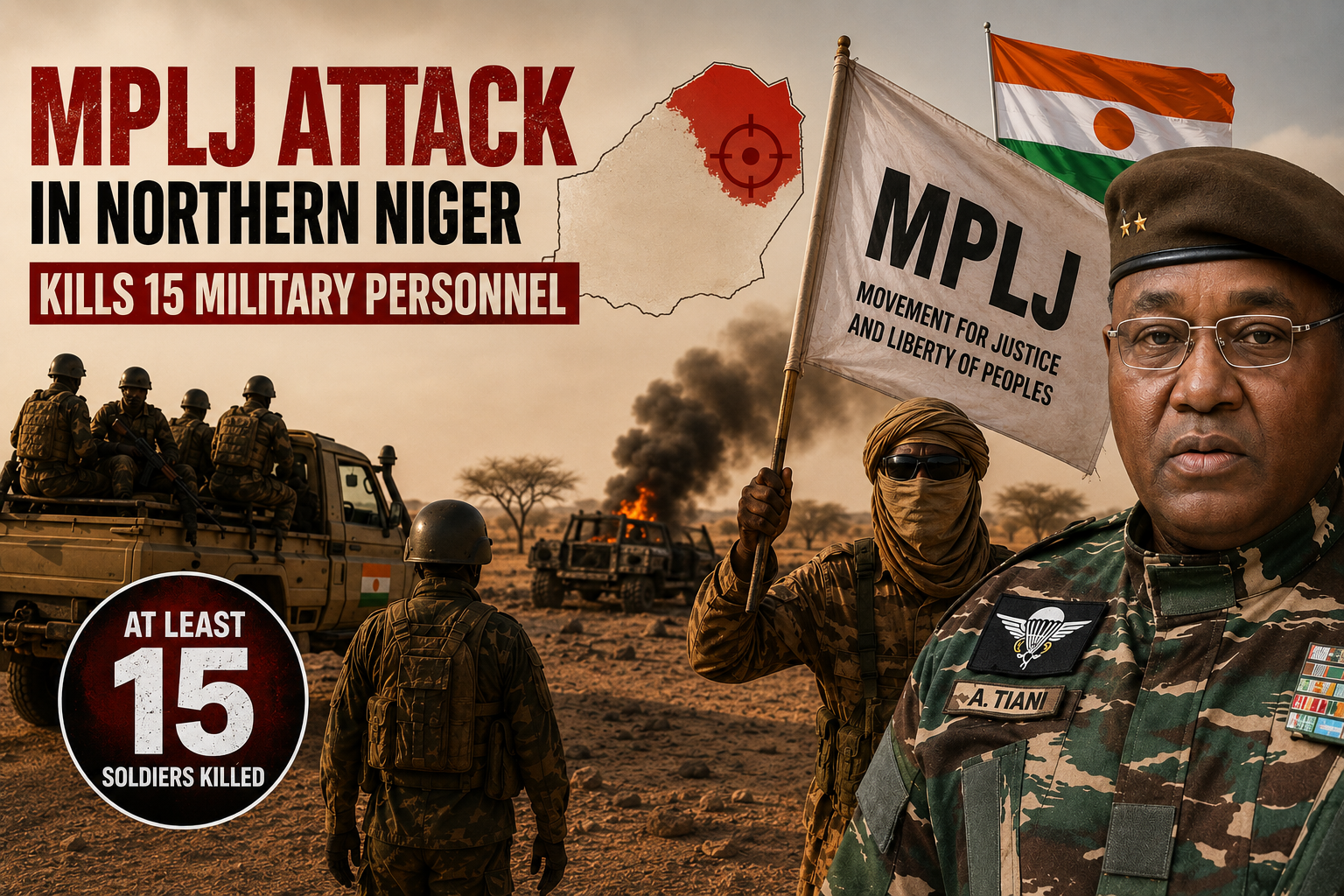
Northern Niger is once again thrust into the spotlight as a fresh wave of violence shatters the military junta’s claims of restored sovereignty. The latest assault, attributed to the Movement for Justice and People’s Freedom (MPLJ), has left at least 15 soldiers dead, underscoring a harsh truth: the regime led by General Abdourahamane Tiani is failing in its most basic duty—protecting its citizens and securing its territory.
An expanding security void
The attack is not an isolated incident but a symptom of a broader crisis. Niger’s vast desert and border regions present immense challenges for military control, with porous frontiers shared with neighboring states already grappling with armed threats. These unmonitored zones have become fertile ground for militant groups, allowing them to regroup, strike, and vanish before authorities can respond.
The MPLJ’s ability to carry out such an operation highlights critical gaps in Niger’s security strategy. While the junta has prioritized immediate military responses, experts argue that sustainable security demands more: reliable intelligence networks, consistent administrative presence, cross-border cooperation, and proactive measures to prevent militant infiltration.
Diplomatic isolation and shifting blame
Since seizing power in July 2023, the military leadership has built its legitimacy on promises of breaking away from past security policies, emphasizing sovereignty and rejecting foreign interference. Yet, for citizens in conflict zones, these declarations ring hollow. The question now is: where will the regime direct its next wave of accusations? After severing ties with regional blocs and former allies, the junta’s list of scapegoats appears exhausted. Will Algeria, a critical neighbor, be targeted next? Or will the regime reassess its new strategic partners?
The pattern of deflecting blame reveals structural weaknesses in the current approach. The junta’s narrative has centered on geopolitical posturing, yet the reality on the ground tells a different story—one of unchecked insecurity in border territories.
Sovereignty beyond rhetoric
True sovereignty is not measured solely by diplomatic defiance or shifting alliances. It is defined by a government’s ability to enforce its authority, safeguard its borders, and ensure the safety of its people. The recurring attacks in remote regions serve as a litmus test for the military’s governance. Each incident erodes public trust further, forcing Nigeriens to question whether the changes implemented since 2023 have delivered tangible improvements.
Alliances in question
The pursuit of new partnerships is not inherently flawed. When strategically sound, such alliances can bolster national defense capabilities. However, a mere change in partners does not equate to a new security doctrine. What matters are outcomes: timely intelligence, preemptive action, civilian protection, and sustained state presence in vulnerable areas.
Niger’s diplomatic isolation from some regional partners may also hinder its counter-terrorism efforts. Militant groups exploit transnational spaces, making cross-border collaboration essential. Strained relations with neighboring countries risk weakening these critical mechanisms, leaving Niger more exposed.
Beyond battlefield losses
Every military setback cannot be laid solely at the feet of frontline troops. Their effectiveness depends on a complex interplay of factors: intelligence quality, logistics, command structure, air and ground capabilities, and long-term strategic planning. The recent losses should prompt a thorough review of the entire security apparatus—not a futile search for external culprits.
In a country where institutional order has been upended without delivering promised security, national stakeholders must confront uncomfortable truths. Restoring stability and protecting citizens will require more than populist rhetoric. It demands robust institutions, a clear national strategy, pragmatic regional cooperation, and an administration capable of reaching even the most distant communities.
The MPLJ’s attack is far more than another violent episode in the Sahel conflict. It is a stark reminder that sovereignty is meaningless when a state cannot guarantee the safety of those under its protection. The junta’s survival will hinge on delivering results—not just words.

 theafricantribune