
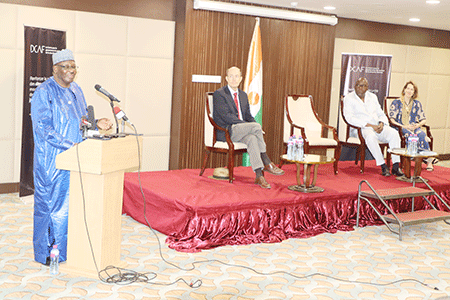
The National Human Rights Commission (CNDH) Chairperson, Mr. Maty El Hadj Moussa, inaugurated a two-day regional conference in Niamey focused on human rights protection mechanisms within the Sahel’s heightened insecurity context, particularly along the tri-border zone shared by Burkina Faso, Mali, and Niger. The event drew participation from senior government officials, including the Deputy Secretary-General of the Ministry of Justice, the DCAF Africa Director, the German Ambassador to Niger, and other distinguished delegates.
conference goals and stakeholder engagement
The primary objectives of this regional gathering include raising awareness among key stakeholders about best practices in human rights protection, enhancing their capacity to utilize prevention mechanisms and tools to curb rights violations, and fostering improved governance and rule of law. By strengthening both internal and external oversight institutions, the conference aims to empower them to fulfill their critical roles effectively.
addressing human rights violations amid crisis
In his opening address, Mr. Maty El Hadj Moussa highlighted the severe human rights violations plaguing the tri-border region of Mali, Burkina Faso, and Niger. He underscored that these abuses stem not only from unidentified armed groups terrorizing communities but also from certain elements within defense and security forces. “In this area, peaceful populations endure the horrors of asymmetric warfare and unprecedented violence. The enemy operates within communities, making any accusation a potential death sentence,” he noted.
Mr. Moussa emphasized that the ongoing crisis calls for urgent, collective action from human rights defenders to devise solutions that address citizens’ aspirations for peace, security, and stability.
collaboration and international support
The Deputy Secretary-General of the Ministry of Justice, Mr. Moussa Sahirou Tchida, stressed the need for unified efforts among all stakeholders to implement these initiatives effectively. “The support of partners, particularly European Union member states—evident in their backing for this conference—reinforces our commitment to stabilizing the tri-border zone,” he stated. He reaffirmed the government’s readiness to collaborate on initiatives aimed at restoring security and upholding human rights.
Ms. Anne Benette, DCAF Africa Director, highlighted how political, social, humanitarian, health, and environmental crises in the Sahel exacerbate governance challenges. She noted that escalating insecurity, armed conflicts, transnational crime, and community tensions have led to widespread human rights abuses and eroded social cohesion. “This conference is vital as it provides a platform to exchange best practices, identify challenges, and collectively enhance our response to the security threats undermining the rule of law and human dignity,” she explained.
The German Ambassador to Niger, Mr. Herman Nicolai, echoed these concerns, pointing out that the Sahel is experiencing a surge in violence unmatched by any other region in Africa. “Extremist groups and transnational criminal networks have perpetrated thousands of civilian and military casualties and displaced countless individuals over the past decade,” he remarked.


More Stories
Burkinabè journalists in exile recount escape from Traoré regime
Burkinabè journalists in exile: life after fleeing traoré’s regime
Bénin’s legal reform commission sets new standards for legal security