Mariama Hamani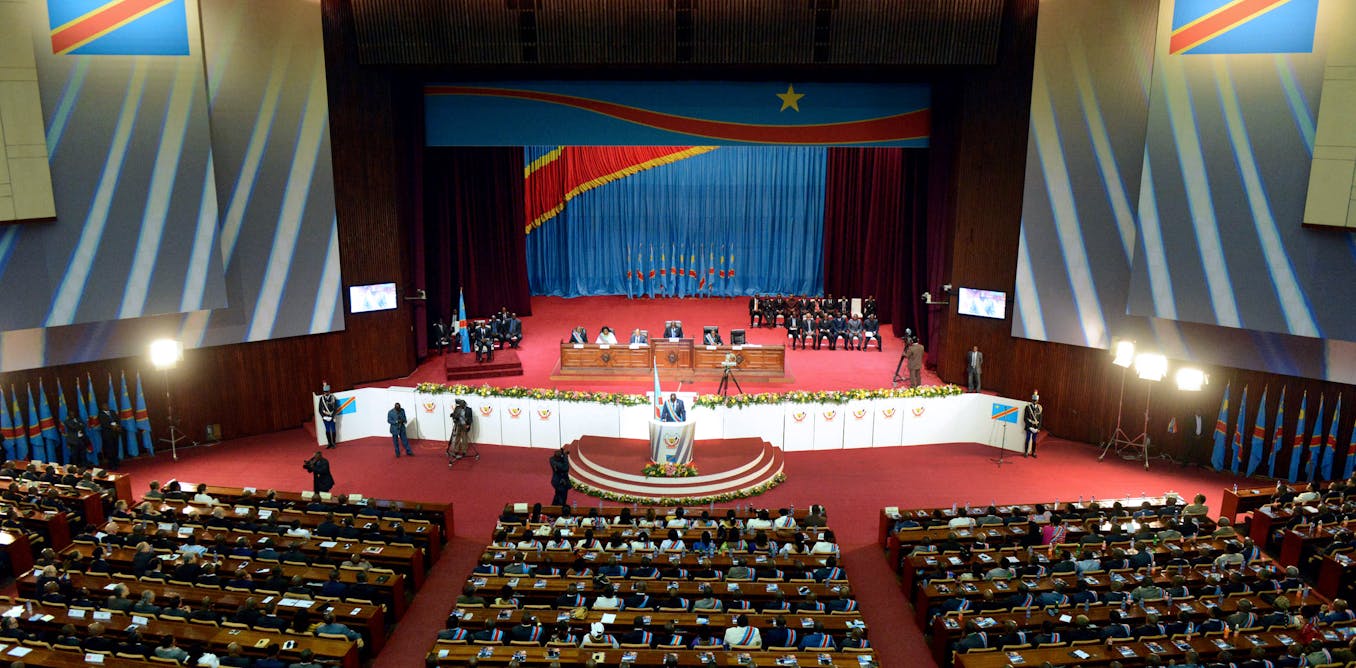
On May 15, 2026, a disturbing scene unfolded in the heart of the Democratic Republic of the Congo’s National Assembly. As Micheline Mpundu, a national deputy, concluded her address from the podium, the session’s presiding officer, Second Vice-President Christophe Mboso, publicly commented on her appearance. Standing at the rostrum, he remarked, ‘Thank you, colleague, she is very beautiful… isn’t she?’ before continuing in Lingala, ‘Look at her yourselves,’ gesturing with his hands to mimic the contours of her body. His words, ‘God made her this way’ and ‘these are another man’s things,’ were met with laughter and applause from the chamber, as if the incident were merely a casual remark.
It wasn’t until public outrage from political figures, civil society leaders, and human rights activists, coupled with internal pressure from his superiors, that Mboso eventually issued a belated apology—days later. No formal disciplinary action was taken. This incident raises a critical question: when will African parliaments, particularly the Congolese one, cease to be hostile environments for the very women they are meant to represent?
My doctoral research in political science delves into the dynamics of masculinity within legislative bodies in the Democratic Republic of the Congo. From a comparative African perspective, this incident is not an isolated lapse in judgment but a manifestation of systemic issues. The gap between the commitments made on paper by Congolese authorities and the lived realities of female legislators remains stark.
a systemic issue transcending borders
The sexist outburst in the National Assembly is part of a broader pattern of violence faced by women in politics across the continent. Long before Mboso’s remarks went viral in Kinshasa, similar incidents had been documented, underscoring the severity of the problem and its role in limiting women’s full participation in decision-making processes at all levels.
The late 1980s and early 1990s brought waves of democratization to Africa, sparking hope that unprecedented numbers of women would enter legislative chambers. Between 1990 and 2010, the number of female legislators tripled—a statistic that initially seemed promising. Yet, this surge in representation quickly collided with deep-rooted structural resistance. Many male colleagues, regardless of political affiliation, viewed women’s presence as a challenge to the established order. Some openly asserted that politics was a man’s domain, where women did not belong.
The Inter-Parliamentary Union, a global body of national parliamentarians established in 1889, has extensively documented this phenomenon. In its 2016 global survey of female parliamentarians from 39 countries across five continents, over 65.5% reported experiencing repeated verbal abuse and insults during their mandates. These figures are alarming, yet they reveal the harsh realities of parliamentary life. The study also highlights how society evaluates female legislators not on their political contributions but on their appearance, marital status, or adherence to traditional roles as caregivers or mothers.
Sexism does not merely linger at the threshold of parliaments; it permeates and sometimes festers from the podium itself, as seen in the Democratic Republic of the Congo. A joint regional study by the Inter-Parliamentary Union and the African Parliamentary Union, conducted in November 2021, confirmed that this issue persists with insufficient progress toward genuine political inclusion for women.
The applause that followed Mboso’s remarks is far from trivial. It underscores that the problem extends beyond one individual—it reflects a system that enables and tolerates such behavior. Philosopher Kate Manne describes this as a mechanism of control that reinforces women’s subordination, even in democratic institutions. This control is not always physical; it operates through gestures, language, and laughter—what scholar Mona Lena Krook terms ‘semiotic violence.’ These acts serve as constant reminders to female legislators that, in the eyes of some colleagues, they remain bodies first and lawmakers second. Mboso’s gesture, mimicking Mpundu’s form, epitomizes this dehumanizing dynamic.
The concept of gender coloniality, developed by feminist scholar María Lugones, sheds light on this paradox. Despite being elected under the same constitutional frameworks and by the same electorate as their male counterparts, female parliamentarians in the Democratic Republic of the Congo face patriarchal systems that strip them of their legislative identity. Equality on paper does not translate to equality in the chamber.
parallel realities across Africa
Mboso’s actions evoke memories of other African nations where female legislators have faced similar indignities. In Senegal, Deputy Amy Ndiaye, pregnant at the time, was slapped and kicked in the stomach during a 2022 session broadcast on national television. In Nigeria, Senator Natasha Akpoti-Uduagha was suspended in 2025 not for professional misconduct but for publicly naming the sexual harassment she endured from the Senate President.
These cases—Ndiaye in Senegal, Akpoti-Uduagha in Nigeria, and Mpundu in the Democratic Republic of the Congo—are not isolated incidents. They reveal a troubling pattern across African parliaments: while women’s voices may be heard, their dignity remains unprotected. The system tolerates their presence but refuses to respect their humanity.
Congo’s chronic struggle with parliamentary misogyny
This issue is not new to the Democratic Republic of the Congo. On April 30, 2020, former Senate President Thambwe Mwamba publicly shamed Senator Bijoux Ngoya during a plenary session aired on national television. He disclosed private meetings, alleging that Ngoya had approached him to solicit his support for her candidacy as Quaestor of the Senate. His implication that she had made unwanted advances sparked chaos in the chamber, leaving many legislators outraged.
On July 15, 2021, during a constitutional debate, Deputy Christelle Vuanga dismantled her male colleague’s arguments with precision. Her counterpart, Nsingi Pululu, interrupted her with a single phrase in Lingala: ‘You are a woman.’ The implication was clear—her gender alone diminished her capacity to engage in substantive political discourse.
The Mboso incident is not an anomaly; it is a symptom of a persistent failure. The Democratic Republic of the Congo has ratified international conventions, enacted laws, and signed commitments to gender equality. Yet within the halls of the National Assembly, little has changed. The disconnect between legal frameworks and real-world practice is well-documented. What is new is the collective refusal to acknowledge it.
a call for accountability and systemic change
French feminist Simone de Beauvoir’s assertion in 1949 that women are defined as ‘the other’ resonates in the halls of the Congolese Parliament in 2026. Female deputies continue to be reduced to their bodies rather than recognized for their political contributions. These incidents reveal how patriarchal systems erode democracy from within. As long as sexist behavior goes unpunished—evidenced by the unchecked applause in Mboso’s video—parliament will remain a misogynistic space, despite its obligation to represent half of the population. Women hold just 13% of the seats in a chamber where they constitute 51% of the country’s population. Their underrepresentation is no justification for tolerating such behavior.
Other parliaments have taken steps toward change. Campaigns like #NotTheCost and #NotInMyParliament have demonstrated that cultural shifts are possible through concrete sanctions and victim protection. The Democratic Republic of the Congo has progressive laws, such as the 2025 Senate bill on violence against women. However, a law without enforcement is merely a wish. Silence is no longer an option. Failing to sanction Mboso sends a clear message to Congolese women considering a political career: their dignity is negotiable.

 Boureima Amadou