Mariama Hamani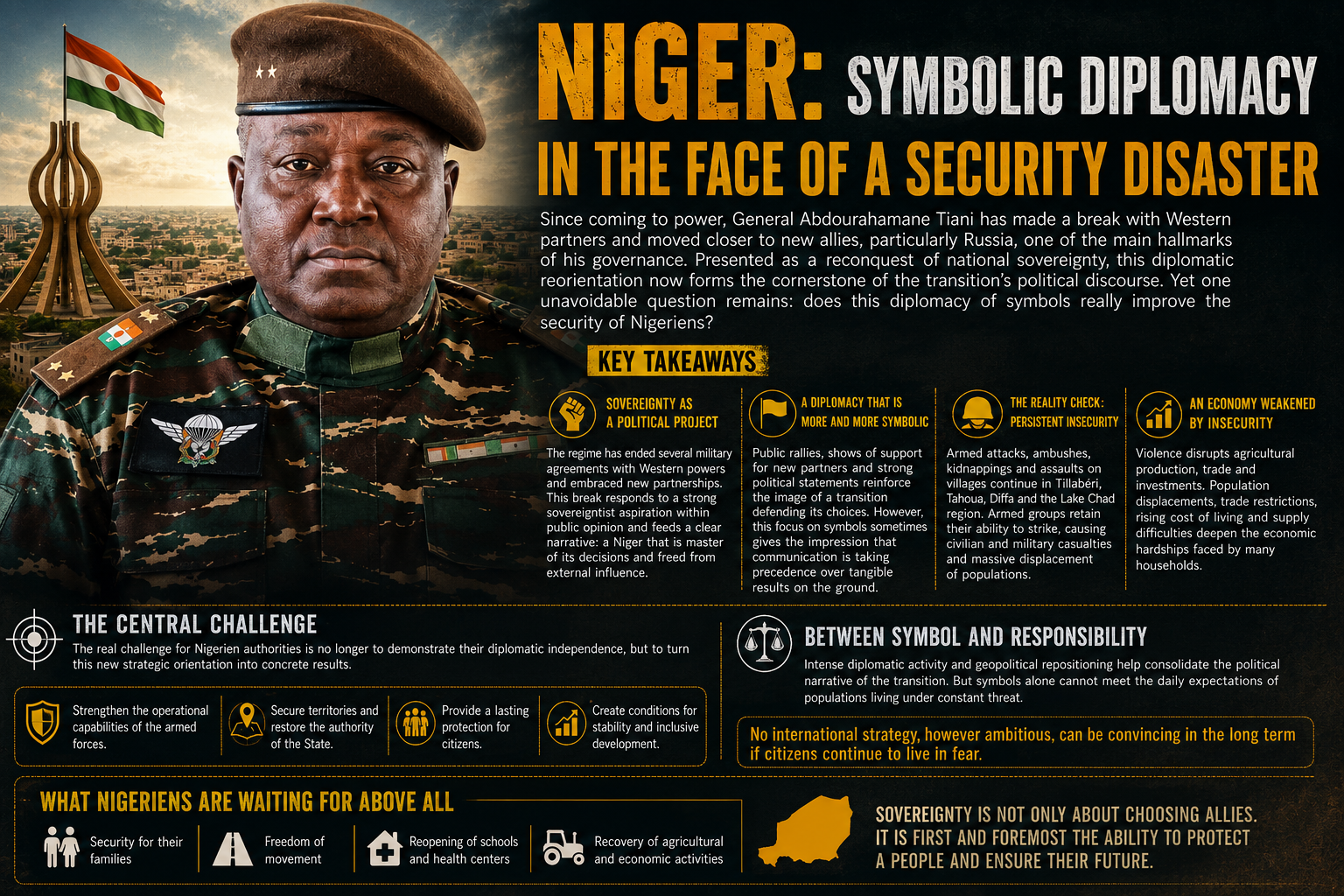
The transitional leadership under General Abdourahamane Tiani has prominently embraced a diplomatic realignment, distancing itself from traditional Western partners while forging closer ties with emerging allies such as Russia. This strategic pivot, framed as a reclaiming of national sovereignty, now underpins the official narrative of the military-led administration. However, as the government asserts its newfound diplomatic independence, a critical question lingers: does this symbolic diplomacy translate into tangible improvements in security for the people of Niger?
Sovereignty as a guiding political principle
The National Council for the Safeguard of the Homeland (CNSP) has pursued a deliberate break from past military cooperation agreements with Western nations, opting instead for fresh alliances. This shift resonates with a significant segment of public opinion, which has long advocated for greater autonomy in national decision-making.
The administration’s approach is anchored in a coherent political vision: one of a Niger that asserts its autonomy, free from external pressures, and capable of determining its own priorities. Joining the Alliance of Sahel States (AES), deepening relations with Moscow, and launching initiatives to showcase this geopolitical reorientation are all part of this effort to forge a distinct diplomatic identity.
Proponents of the transition argue that this break from decades of reliance on foreign military and political support marks a historic step toward restoring national dignity. The official discourse emphasizes the necessity of ending what it describes as decades of dependency, positioning the country to build a future aligned with its own interests.
The limits of symbolic diplomacy
Yet this reorientation, while symbolically powerful, occasionally appears to prioritize form over substance. Frequent public campaigns celebrating new international partnerships, rallies in support of cooperation with Moscow, and political declarations dominate the government’s communications strategy. These displays of diplomatic solidarity strengthen the narrative of a resolute leadership but raise questions about where priorities truly lie.
For citizens, the most pressing concerns remain immediate and practical: personal safety, freedom of movement, and the restoration of normalcy in daily life. While the government invests heavily in projecting its new international stance, the underlying security situation continues to deteriorate in many regions.
The harsh reality of persistent insecurity
The security landscape offers little cause for optimism. Despite the flurry of diplomatic announcements and new military partnerships, armed groups continue to carry out attacks across vast areas of the country.
Regions such as Tillabéri, Tahoua, Diffa, and parts of the Lake Chad basin remain hotspots of violence, where civilians, security forces, and public infrastructure are routinely targeted. Ambushes, abductions, village raids, and mass displacements have become recurring features of life in these areas, perpetuating a climate of chronic insecurity.
Military operations persist, yet armed factions retain significant operational capacity. Civilian and military casualties continue to mount, underscoring that the security crisis remains far from resolved. For those living in the most vulnerable areas, abstract geopolitical debates offer little comfort when their daily existence is defined by the constant threat of violence.
Economic strain in the shadow of insecurity
Beyond the human toll, the prolonged violence has exacted a heavy economic price. Displacement disrupts agricultural production, trade routes remain perilous in several regions, and investment flows have slowed amid pervasive uncertainty. The economic disruptions following recent political shifts have further strained households, with rising living costs, supply shortages, and shrinking economic opportunities deepening hardship for many families.
Without a meaningful improvement in security, the anticipated benefits of new international alliances may prove elusive for the majority of the population.
Transforming alliances into tangible outcomes
The true test for Niger’s leadership lies not in the strength of its diplomatic symbolism but in its ability to convert new alliances into real-world results. The success of these partnerships will be measured not by the frequency of official ceremonies or political statements but by their effectiveness in bolstering the operational capacity of the armed forces, securing territories sustainably, and restoring state authority.
Sovereignty, in its truest sense, is not merely about choosing one’s partners; it is about a state’s capacity to protect its citizens, safeguard its borders, and offer stability to its people.
The gap between diplomacy and lived reality
The stark contrast between Niamey’s active diplomatic engagements and the harsh realities faced by communities in conflict zones grows ever more apparent. While the government’s communications reinforce the narrative of a determined transition, they cannot, in isolation, address the immediate needs of a population living under the shadow of armed groups.
The legacy of this military-led transition will ultimately be judged not by the strength of its sovereignist rhetoric or the scale of its diplomatic maneuvers, but by its ability to deliver measurable improvements in security, stability, and development. No international strategy, no matter how ambitious, can sustain credibility if citizens continue to live under the perpetual threat of violence. True leadership is measured first and foremost by its capacity to ensure peace and protection for its people.

 theafricantribune
 Boureima Amadou