Mariama Hamani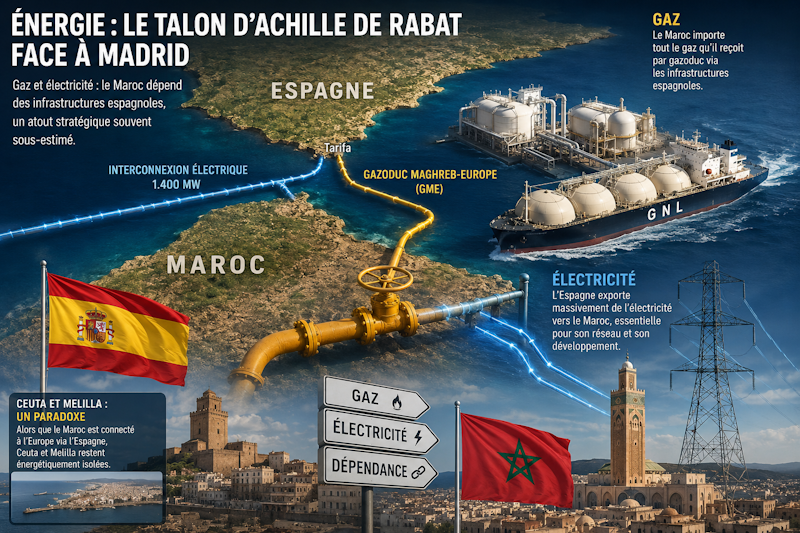

Gas pipelines, electricity grids, and critical infrastructure: behind the recurring tensions between Morocco and Spain lies a less visible but strategically crucial energy dependence. While Rabat asserts its geopolitical ambitions regarding Ceuta and Melilla, its energy system remains heavily reliant on Spanish-controlled networks.
The geopolitical tug-of-war between Madrid and Rabat is often framed through migration, security cooperation, and territorial disputes. Yet energy emerges as a silent yet powerful lever, placing Spain in a dominant position in this delicate balance.
Morocco currently imports all its piped gas from Spanish infrastructure, while its electrical grid depends on interconnections with the Iberian peninsula for stability and flexibility. This creates a paradox: despite periodic challenges to Spanish sovereignty over Ceuta and Melilla, Rabat’s energy security remains intertwined with Madrid’s systems.
Reversal of the Maghreb-Europe gas pipeline
The rupture in Morocco’s energy supply became evident after the rupture with Algeria. In 2021, Algiers terminated the Maghreb-Europe Gas Pipeline (GME) agreement, which had allowed Algerian gas to transit through Morocco to Spain. The diplomatic fallout transformed this infrastructure entirely.
The pipeline reversed direction. After initially receiving Algerian gas via the Medgaz pipeline and importing liquefied natural gas (LNG) through regasification terminals, Spain began supplying Morocco through the GME. The system that once enabled Morocco to benefit from Algerian gas transit became a channel for importing gas via Spanish infrastructure.
Official data indicates Morocco received approximately 10.3 TWh of gas in 2025, valued near €400 million—equivalent to about a quarter of Spain’s total gas exports that year.
Rabat’s push for energy diversification
Moroccan authorities are acutely aware of this vulnerability. Recent energy projects reflect efforts to reduce dependence on Spanish systems. The Nador West Med LNG terminal stands as a key initiative, designed to enable direct maritime gas imports and injection into the Maghreb-Europe pipeline. This project aims to gradually reduce reliance on Spanish terminals.
Another pillar of Morocco’s strategy is the Nigeria-Morocco gas pipeline, a massive project intended to connect West African gas resources to northern markets. If realized, it could fundamentally reshape the regional energy landscape.
However, these solutions require significant time and investment. Until then, Spain remains Morocco’s indispensable energy partner—both for gas and electricity.
Electricity interconnections: Spain’s strategic edge
The energy interdependence extends beyond gas. Two undersea cables link Spain’s electrical grid to Morocco, with a combined capacity of 1,400 MW.
In 2025, Spain exported a net 3,743 GWh of electricity to Morocco—a 47.5% increase from the previous year and the highest level since 2017. Approximately three-quarters of this capacity flows from Spain to Morocco.
This connection serves Morocco’s growing energy demands, supporting industrial expansion and renewable energy development. Plans for a third undersea cable are already underway to further enhance exchange capacity.
The Ceuta and Melilla paradox
Energy ties reveal another striking contrast. While Morocco has been connected to Europe’s power grid via Spain for nearly three decades, the Spanish enclaves of Ceuta and Melilla historically operated as isolated energy systems.
Ceuta will finally break free from this isolation in 2026 with a new undersea cable linking it to mainland Spain at a cost of €300 million, securing its energy supply.
Melilla, however, will remain disconnected due to geographical constraints—an ironic twist given Morocco’s own integration into Spain’s energy network.
Energy interdependence: a new geopolitical factor
These networks have long been viewed through an economic lens. Yet rising tensions in the Mediterranean and North Africa add a geopolitical dimension to their significance.
Spain cannot easily weaponize its energy infrastructure without facing severe economic, diplomatic, and legal repercussions. Yet this interdependence creates structural vulnerabilities—and potential influence.
Historically, Morocco has held advantages in areas like migration control and security cooperation. Energy introduces a new dynamic, shifting leverage toward Spain.
Madrid’s strategic advantage
Morocco is actively diversifying its energy sources through projects like Nador West Med and the Nigeria-Morocco pipeline. But these alternatives cannot immediately replace Spanish infrastructure.
Spain’s position remains unmatched: it is both the primary entry point for Morocco’s piped gas imports and the gateway linking Morocco’s electrical grid to Europe’s continental network.
In a climate of heightened tensions over Ceuta and Melilla and growing geopolitical competition in the western Mediterranean, this energy reality could become a decisive factor in the balance of power between the two kingdoms.

 Boureima Amadou