
 Boureima Amadou
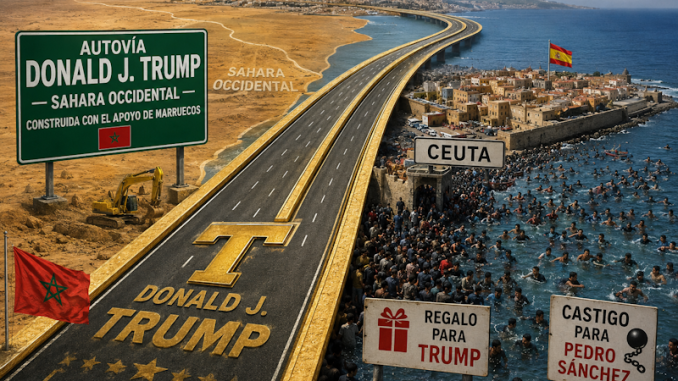
Rabat is deploying a dual strategy to secure decisive support from Washington on the Western Sahara dispute, combining symbolic diplomacy with strategic pressure. The newly renamed ‘Trump Highway’ in southern Morocco serves as a tribute to the U.S. president’s 2020 recognition of Morocco’s sovereignty over the territory, while a sudden surge of migration through Ceuta has exposed Spain’s vulnerability on its northern African frontier.
The summer of 2026 has marked a period of intense diplomatic maneuvering between Morocco, the United States, and Spain. As Donald Trump returned to the White House, Moroccan authorities intensified efforts to lock in American backing for their position on Western Sahara—a conflict that traces its roots to Spain’s withdrawal in 1975.
Symbolic highway carries political weight
In a move rich with symbolism, King Mohammed VI ordered the renaming of the 1,055-kilometer Tiznit-Dakhla highway to honor Donald J. Trump. The announcement, made through the official MAP news agency, framed the gesture as a tribute for the U.S. president’s historic recognition of Morocco’s sovereignty over Western Sahara in 2020.
The highway, described by the monarch as ‘Africa’s longest road infrastructure’, stretches from southern Morocco to Dakhla, passing through Laâyoune in the heart of Western Sahara. Its strategic value lies in connecting Europe to the African continent and uniting the kingdom’s northern and southern regions.
Trump responded swiftly on Truth Social: ‘What a tremendous honor! I look forward to driving this great highway one day—hopefully soon!’
Ceuta’s migrant surge: a calculated pressure tactic
Yet it is not the highway that cuts through Ceuta—it is the flow of people. At the end of July, nearly 60,000 migrants crossed into the Spanish enclave in a matter of hours, triggering a humanitarian and diplomatic emergency. Spanish authorities reported at least 57 deaths, mostly from drowning or trampling, while Moroccan officials confirmed 11 fatalities, attributing the deaths to the chaotic crossing.
Ceuta, one of only two land borders between the European Union and Africa, has long been a flashpoint in Spanish-Moroccan relations. Morocco has never recognized Spanish sovereignty over Ceuta and Melilla, viewing them as ‘occupied territories’.
History repeats itself
This is not the first time Morocco has used migration as leverage. In May 2021, a similar crisis—when 8,000 people entered Ceuta in a single day—forced Madrid to reconsider its stance on Western Sahara. Spain abandoned its long-standing neutrality to endorse Morocco’s autonomy plan after hosting Polisario leader Brahim Ghali for medical treatment.
‘Spain initially believed its support for Morocco’s autonomy proposal would suffice, but Rabat seeks full recognition of sovereignty,’ said Carlos Ruiz Miguel, director of the Western Sahara Studies Center at the University of Santiago de Compostela.
The timing of the current crisis is significant. It erupted just days after Spanish Prime Minister Pedro Sánchez visited Algiers in an attempt to repair ties with Morocco’s regional rival. The message from Rabat was clear: Madrid’s outreach to Algiers would not go unanswered.
A three-pronged diplomatic offensive
Analysts describe Morocco’s approach as a calculated three-part strategy:
- Symbolic diplomacy with Washington: The ‘Trump Highway’ serves as a tangible reminder of U.S. support for Morocco’s position on Western Sahara.
- Migratory pressure on Spain: By allowing a massive influx into Ceuta, Rabat underscores Spain’s dependence on Moroccan cooperation to control migration flows.
- Securing U.S. backing: With UN-led negotiations on Western Sahara stalled, Morocco is pushing for stronger U.S. support to break the deadlock.
Washington’s unwavering stance
U.S. officials have made no secret of their backing for Morocco. Secretary of State Marco Rubio recently reaffirmed that ‘the United States recognizes Morocco’s sovereignty over Western Sahara’. Trump himself has called Morocco’s autonomy proposal ‘the only viable foundation for a just and lasting solution,’ dismissing alternative approaches as prolonging an unacceptable status quo.
Washington has also criticized Spain’s migration policies, with a White House spokesperson warning that Madrid risked ‘undermining its own stability’ through its handling of the crisis.
Europe’s growing unease
The Ceuta crisis has sent shockwaves through the European Union. Italy temporarily suspended its Schengen agreements with Spain, followed by Finland and Denmark. Belgian MR party leader Georges-Louis Bouchez went further, calling for Spain’s partial suspension from the Schengen Zone.
‘Morocco has repeatedly demonstrated its willingness to use migration as a tool of retaliation against Spain, especially given Madrid’s exposure through its North African enclaves,’ noted Paul Melly, a researcher at Chatham House.
Clear message to negotiators
The message is unmistakable: Morocco holds key leverage over Europe’s southern border. By combining symbolic gestures toward Washington with targeted migratory pressure on Madrid, Rabat is weaving a diplomatic web designed to strengthen its position on Western Sahara. European and Spanish negotiators are now acutely aware of the stakes—and the risks.


 Mariama Hamani




