Mariama Hamani
Obo strike: how a discarded US missile resurfaced in the hands of Russian mercenaries
In the remote Haut-Mbomou region of the Central African Republic, a single artillery strike has exposed the lingering hazards of a long-abandoned military outpost. Last week, mercenaries from the Russian Wagner Group fired a surface-to-surface missile from the town of Obo, sending it hurtling across the border into the Democratic Republic of the Congo.
From US counter-LRA mission to Wagner’s arsenal
The missile’s journey began during Operation Observant Compass, a US-led multinational effort from October 2011 to April 2017. Tasked with dismantling the Lord’s Resistance Army (LRA) and its infamous leader Joseph Kony, American special forces—primarily Green Berets with Afghanistan and Pakistan experience—established forward operating bases in Uganda, South Sudan, and the Central African Republic. Obo, a small town near the Congolese frontier, housed one of these installations, complete with surveillance cameras and reinforced perimeters.
After nearly six years of pursuit, US forces withdrew in 2017, leaving behind not only an unfinished manhunt but also a stockpile of equipment. Local accounts indicate that containers of supplies, including at least one surface-to-surface missile, remained in Obo. The Central African Armed Forces (FACA) subsequently took over the site, until Wagner Group mercenaries arrived, ousting FACA troops and seizing control of the facility.
Wagner’s test fire — and a message across the border
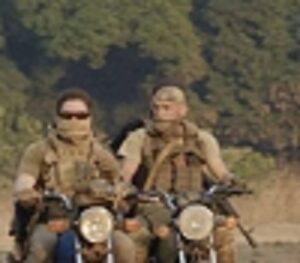
On the evening of 26 February, Wagner operatives transported heavy weaponry to Obo’s football pitch, an open area in the town centre. They positioned the missile launcher, ignited the projectile, and fired it toward the Congo. The rocket soared over Mboki and Zemio before landing near the village of Zapay, approximately five kilometres inside Congolese territory. No immediate casualties have been reported.
The trajectory was deliberate. By aiming south rather than north, the mercenaries ensured the missile would not fall near Bambouti, a Central African town roughly 125 kilometres away. Instead, the Congolese jungle provided a deliberately remote impact zone. Residents of Zapay, including Central African refugees who fled Wagner’s operations in the CAR, described a night of dread, fearing the strike was a deliberate warning.
Locals confirmed that only Wagner fighters possess the expertise to operate such heavy weaponry. The absence of any other armed group capable of launching a cross-border projectile underscores their role. Eyewitnesses watched as the mercenaries loaded, aimed, and fired the missile, leaving no doubt about their involvement.
Unchecked arms caches fuel regional instability
The incident highlights the persistent risk posed by abandoned military stockpiles across the Central African Republic. With porous borders and limited oversight, discarded ordnance continues to circulate, falling into the hands of armed factions. In this case, a missile meant for counter-insurgency operations has been repurposed, escalating tensions between the CAR and its neighbours.
As night fell in Zapay, families kept vigil, unsure whether another projectile might follow. The strike serves as a stark reminder that the remnants of past conflicts can resurface with dangerous consequences.

 Boureima Amadou