Boureima Amadou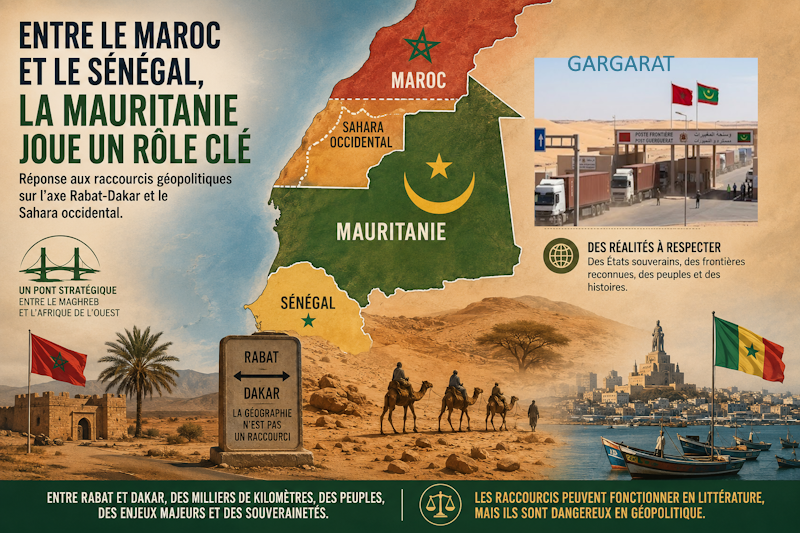

A July 2026 diplomatic flare-up in Dakar has once again exposed the delicate tightrope Mauritania walks in the Western Sahara dispute. Between official neutrality, economic imperatives, and the defense of its territorial sovereignty, Nouakchott’s strategic ambiguity has become both its signature approach and a necessity to avoid alienating Morocco.
The incident unfolded during a high-profile event at the Moroccan embassy in Senegal’s capital. Former Senegalese foreign minister Cheikh Tidiane Gadio sparked immediate controversy when he suggested in a speech that Morocco’s historical borders—pre-colonial in nature—were practically indistinguishable from Senegal’s, effectively erasing Mauritania’s existence as a sovereign nation. His remarks prompted an abrupt intervention by Mauritania’s ambassador to Senegal, Mohamed Ould Abdellahi Ould Ethmane, who condemned the comments as an attempted historical falsification.
Though Moroccan ambassador Hassan Naciri quickly stepped in to mediate the dispute, the fallout revealed the precarious position Mauritania occupies. The country finds itself caught between attending events that celebrate Morocco’s claims to Western Sahara while simultaneously insisting on its own strict neutrality in a conflict now entering its sixth decade.
The public reaction in Mauritania was swift and uncompromising. Former Mauritanian foreign minister Isselmou Ahmed Izidbih took to social media to demand Gadio be declared persona non grata across Mauritania’s land, sea, and airspace, declaring: “As a Mauritanian citizen, I urge that Cheikh Tidiane Gadio be banned from Mauritania’s territorial waters, airspace, and soil.”
Nouakchott’s diplomatic tightrope
This diplomatic episode encapsulates the contradictions inherent in Mauritania’s official stance. While the country formally recognized the Sahrawi Arab Democratic Republic (SADR) in 1984 and maintains regular dialogue with the Polisario Front—aligning itself with Algeria, a key security partner—it stops short of granting the SADR embassy status in its capital. Such a concession would risk severe repercussions from Rabat, which views any recognition of SADR sovereignty as an unacceptable provocation.
By participating in Moroccan state commemorations and diplomatic forums, Mauritania signals respect to its northern neighbor—provided Morocco refrains from reviving historical ambitions, such as the “Greater Morocco” concept, that once claimed Mauritania as part of its territory.
Guerguerat: the economic lifeline
Beyond symbolism, Mauritania’s balancing act is driven by hard economic realities. The Guerguerat border crossing—situated at the intersection of Western Sahara and Mauritanian territory—has become the economic jugular connecting Morocco to West Africa. Daily convoys of Moroccan trucks pass through this zone, supplying essential goods—from agricultural products to manufactured items—to markets across Mauritania, Senegal, and Mali.
For Nouakchott, blocking this trade would be economic suicide. By keeping its borders open and securing this route, Mauritania tacitly endorses Morocco’s de facto control over the territory, even as it refuses to grant it de jure recognition.
The high stakes of neutrality
Regional analysts argue that Mauritania’s “both sides at once” strategy is not indecision but calculated survival. Trapped geographically between an economically assertive Morocco and a geopolitically sensitive Algeria, Nouakchott cannot afford to openly side with either power without risking retaliation—whether in the form of economic sanctions or border instability.
The fallout from Gadio’s remarks serves as a reminder: Mauritania’s neutrality, however carefully calibrated, remains fragile. Whenever its national identity or territorial integrity is perceived as threatened by neighboring ambitions, Nouakchott reacts swiftly to reassert its indispensable—and sovereign—role in maintaining regional stability.


 Mariama Hamani