Boureima Amadou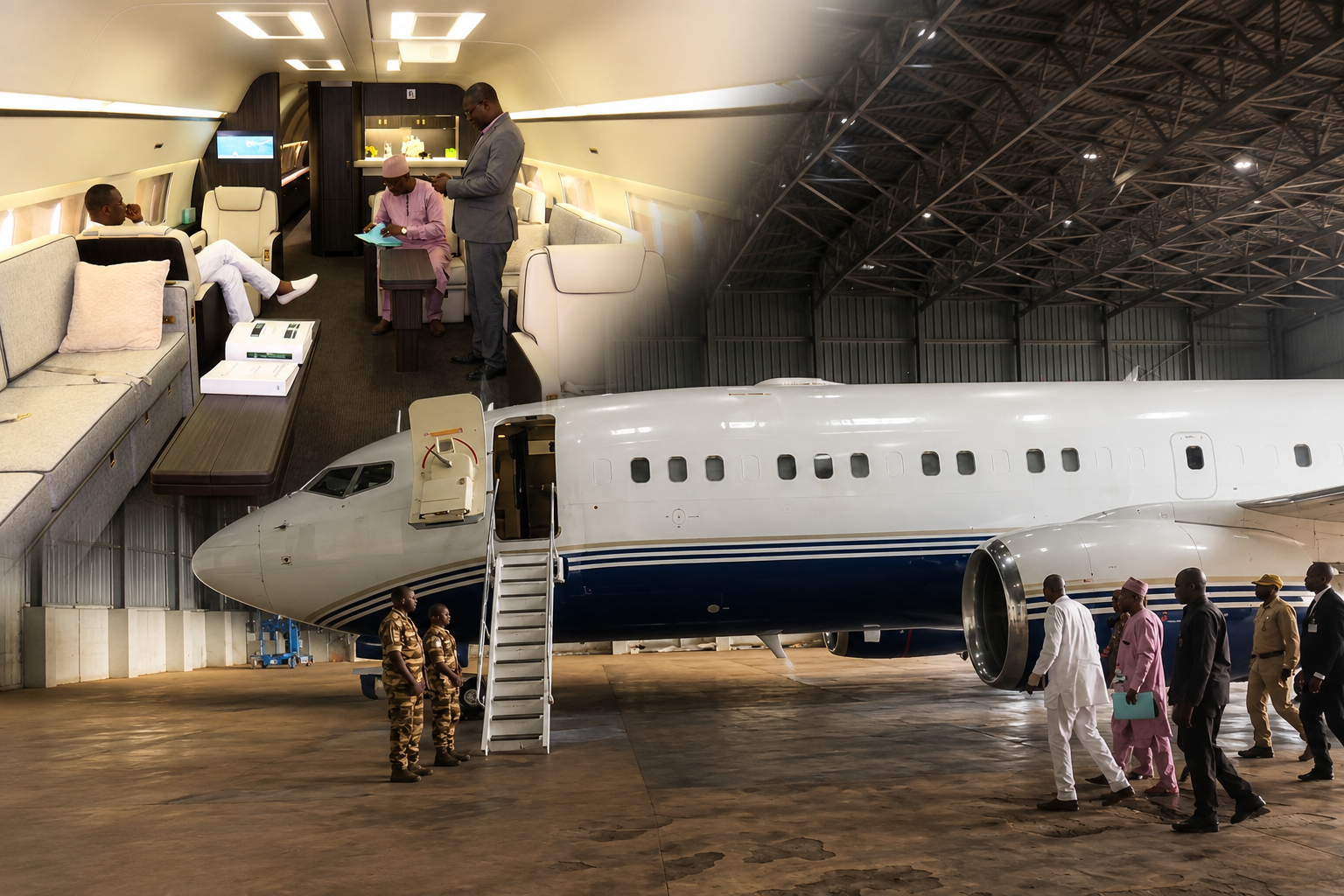
The unveiling of Mali’s latest presidential aircraft
On Wednesday evening, viewers of ORTM witnessed the ceremonial unveiling of Mali’s newest presidential aircraft—a Boeing 737 earmarked for the official travel of Colonel Assimi Goïta and other senior officials. The government framed the acquisition as a financially prudent move, citing a gross cost of 15.6 billion West African CFA francs, which would be reduced to approximately 6 billion after accounting for insurance payouts and the sale of parts from the decommissioned plane.
The timing of the announcement raises concerns
While authorities have repeatedly called for national sacrifice, resilience, and patriotism, the timing of this announcement has sparked controversy. The unveiling of a state-of-the-art presidential jet amidst a deteriorating security landscape conveys an impression of prioritizing prestige over the immediate needs of the Malian people.
Across multiple regions, insecurity remains an everyday reality. Military outposts continue to face attacks, roads are frequently ambushed, and civilians continue to bear the brunt of violence. Many areas remain inaccessible, and the state struggles to restore its presence in regions it once controlled.
Security challenges remain unresolved
Three years after territorial recovery was declared a top priority, the Transition government still grapples with formidable security challenges.
In northern Mali, the Cadre stratégique permanent, which includes the Front de Libération de l’Azawad (FLA), maintains significant operational capacity and contests control over key zones. Meanwhile, in central and southern regions, the Jama’at Nusrat ul-Islam wal-Muslimin (JNIM) has intensified its activities, targeting military forces, state infrastructure, and civilian authorities. Several major road arteries remain perilous, disrupting trade, transportation, and economic activity.
This stark reality starkly contrasts with the image of authority the regime seeks to project.
Budgetary priorities under scrutiny
Even as officials emphasize the financial efficiency of the deal, critics argue that billions of francs could have been redirected toward more pressing needs, including:
- Enhancing the operational capabilities of the Malian Armed Forces;
- Procuring armored vehicles, communication systems, and protective gear;
- Improving intelligence and aerial surveillance capabilities;
- Supporting wounded soldiers and the families of fallen servicemen;
- Addressing the plight of internally displaced persons and reconstructing war-damaged infrastructure.
The controversy extends beyond financial calculations—it strikes at the heart of the government’s decision-making hierarchy.
A contradiction in governance messaging
Since assuming power, the Transition authorities have sought to establish legitimacy by distancing themselves from the perceived excesses of prior administrations. Their rhetoric has emphasized sobriety, patriotism, and national interest. Yet the acquisition of a high-capacity presidential jet undermines this narrative, reinforcing perceptions of a leadership more concerned with symbolism than substance.
The timing is particularly jarring given persistent economic hardships: rising living costs, strained public finances, unmet social needs, and sluggish economic activity.
Diplomatic utility versus domestic reality
Proponents of the new aircraft argue that it enhances diplomatic mobility, official missions, and Mali’s international representation. However, critics counter that a nation’s credibility is measured not by the modernity of its presidential fleet but by its ability to secure its territory, protect its citizens, and maintain functional institutions.
To many, sovereignty is not defined by the quality of a leader’s transportation but by the state’s capacity to govern effectively and ensure stability.
A polarizing symbol
Within opposition circles and among skeptics, the acquisition has fueled broader political interpretations. Some view it as evidence that the regime prioritizes the mobility of its leaders over the functioning of the state. Others speculate that a long-range jet could serve as an escape mechanism in the event of a severe deterioration in security—though such claims remain unproven.
Regardless of intent, the move has deepened public distrust in the government’s decision-making processes.
The deeper question: what defines effective governance?
The arrival of the new Boeing 737 transcends a mere procurement decision. It forces a reckoning with the Transition’s strategic priorities.
As security threats persist, attacks continue unabated, and economic hardships strain households, every expenditure perceived as symbolic is increasingly scrutinized. For many Malians, true sovereignty is not demonstrated through the modernization of an executive aircraft but through the state’s ability to protect its people, restore territorial integrity, and improve daily living conditions. Until these fundamentals are addressed, investments in prestige risk widening the gap between official rhetoric and public expectation.

 theafricantribune