
How the JNIM is reshaping Mali’s conflict landscape through strategic adaptation
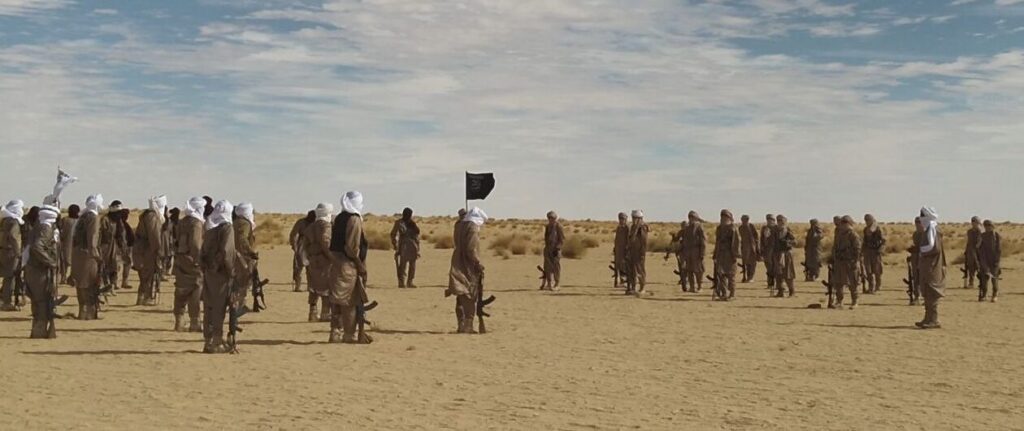
The northern and central regions of Mali are no longer merely battlegrounds for sporadic attacks. For years now, communities have endured an unrelenting cycle of violence and exhaustion. Recent offensives by the Group for the Support of Islam and Muslims (JNIM) and the Azawad Liberation Front (FLA) against military outposts, convoys, and critical road infrastructure signal a significant strategic shift in their approach.
These armed factions are no longer focused solely on capturing towns or staging high-profile attacks. Instead, their tactics aim to gradually render vast areas beyond government control, systematically pushing the military junta into increasingly isolated positions around Bamako.
This transformation is critical because it shifts the conflict’s core objective. The battle is no longer just about territorial control; it has expanded to determining who can still move people, goods, fuel, administrators, or public services across the country.
Targeting mobility: The new frontline of the conflict
Over recent months, attacks on major roadways and military convoys have intensified. In some regions, even administrative travel has become nearly impossible without armed escorts, severely undermining both the Malian army and the state’s ability to function outside major urban centers.
The JNIM appears to have mastered a crucial insight: in a nation already weakened by years of institutional, economic, and security crises, erosion can be a more effective political tool than direct confrontation.
This strategy is not only less resource-intensive than traditional territorial conquest but also spreads the adversary’s forces thin, increases security expenditures, and perpetuates a climate of perpetual insecurity. Most damagingly, it fosters collective fatigue—military exhaustion, economic strain, and social disillusionment.
In many rural areas, the issue is no longer just the presence of armed groups. It is the gradual disappearance of stable governance, leaving communities without administrative structure or reliable services.
The failure of a purely military solution
The Malian military leadership has staked its political legitimacy on restoring security since the successive coups. The withdrawal of French forces and the growing influence of Russian military cooperation were framed as a restoration of sovereignty.
But sovereignty cannot be measured solely by the capacity to conduct military operations. It must also encompass the ability to maintain territorial, economic, and administrative continuity.
A paradox emerges: intensified military action does not guarantee lasting stabilization. In some regions, it coexists with the growing fragmentation of rural spaces.
The prevailing security logic relies heavily on offensive operations, airstrikes, and troop deployments. Yet it struggles to rebuild durable administrative presence—schools, healthcare, local justice, infrastructure, or economic circulation.
As public services vanish, communities increasingly rely on parallel systems for protection, dispute resolution, and survival. This creates a dangerous feedback loop where the absence of the state becomes self-sustaining.
The Sahel: A rapidly shifting armed landscape
The Malian crisis is no longer confined to Mali. The entire Sahel belt is experiencing rapid realignment among armed actors, local alliances, and clandestine economic networks.
The porous borders between Mali, Burkina Faso, and Niger facilitate the movement of armed groups. Yet state responses remain largely national, while insurgent dynamics transcend borders. Despite forming a politico-military alliance, these three countries have proven unable to support one another effectively. The recent offensive by the JNIM and FLA exposed the fragility of this coalition and the isolation of the Malian junta, which now depends almost exclusively on the Africa Corps mercenaries for support.
This asymmetry favors groups with rapid adaptability. The JNIM leverages its territorial flexibility, local anchoring in certain zones, and integration into informal economic networks.
This does not mean it permanently controls all territories it traverses. But it consistently imposes a high security cost on the state, draining resources and morale.
The Sahel conflict has evolved into a war of political endurance. Armed groups are less interested in administering entire countries than in preventing states from functioning normally over the long term.
What the Malian crisis reveals
The Malian case also exposes the limitations of a strictly counterterrorism lens on the Sahel. Reducing the crisis to a military confrontation overlooks its social, economic, and territorial dimensions.
In many rural areas, frustrations tied to state abandonment, land disputes, intercommunal rivalries, and structural poverty create enduring vulnerabilities. Armed jihadist groups do not always create these fractures but know how to exploit them.
The central challenge is political: how can state legitimacy be rebuilt in territories where the government appears intermittently, primarily in military form?
The future of Mali may hinge not on a single decisive battle but on the ability—or inability—to restore stable public presence beyond security operations.
A war of attrition does not merely destroy military positions. It erodes roads, economies, administrations, social bonds, and ultimately, the very idea of a governed territory.
Mourad Ighil


More Stories
Life under blockade in central Mali: survival, fear and forced compliance
JNIM’s strategic shift reshapes Mali’s security landscape
Sénégal : Ousmane Sonko mise sur le dialogue à condition qu’il soit “responsable”