Mariama Hamani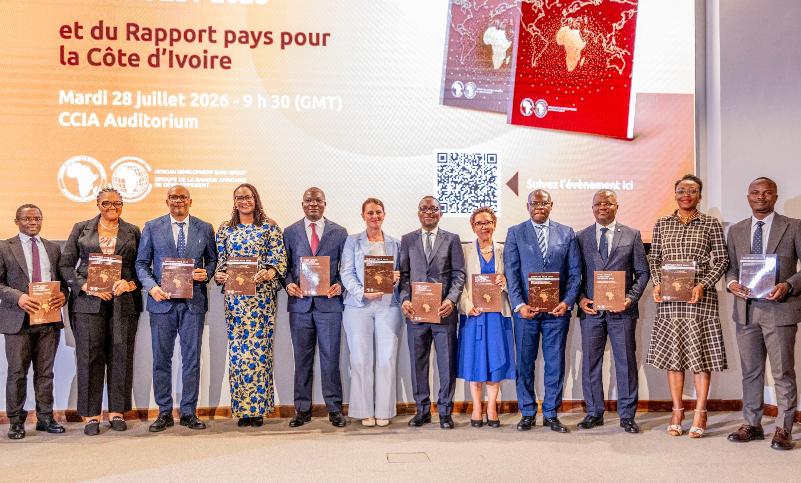
The Ivory Coast’s strategic vision for economic transformation took center stage this week as the government presented its approach to large-scale resource mobilization at a high-profile event in Abidjan. Dr Souleymane DIARRASSOUBA, representing the Minister of Planning and Development, was joined by Pr Loesse Jacques ESSO, Cabinet Director, to preside over the launch of two critical reports: the 2026 Country Report for Côte d’Ivoire and the West Africa Economic Outlook, both produced by the African Development Bank (BAD). The gathering, themed “Scaling up financing for African development in a fragmented world,” brought together financial institutions, private sector leaders, and government officials to discuss pathways to sustainable growth.
Côte d’Ivoire’s economic roadmap aligns with continental priorities
Under the leadership of President Alassane Ouattara, the Ivorian government has positioned resource mobilization as a cornerstone of its development strategy. This commitment is embedded in the National Development Plan (PND) 2026-2030, which aims to accelerate structural transformation through increased public and private investment. The event highlighted how this plan reflects broader continental aspirations, including the African Union’s Agenda 2063, which sets ambitious growth targets for member states.
The discussions underscored Côte d’Ivoire’s strong economic performance, with growth projected at 6.5% by 2025—well above the continental average of 3.9%. This momentum positions the country as a regional leader in economic resilience and a model for other African nations pursuing similar transformation agendas.
Challenges and opportunities in funding national ambitions
The PND 2026-2030 requires an estimated 114,838.5 billion FCFA (approximately $209 billion) to achieve its goals. Addressing this funding gap was a key focus of the event, particularly in light of the successful June 2026 Consultative Group meeting, which mobilized $80 billion (47,820 billion FCFA) in commitments. This unprecedented support demonstrates international confidence in Côte d’Ivoire’s development trajectory and its ability to attract significant financial flows.
Pr Loesse Jacques ESSO emphasized that while the Ivorian case is unique, the challenges and solutions discussed resonate across Africa. The continent’s focus remains on unlocking domestic resources, leveraging private capital, strengthening financial systems, and deepening regional integration through initiatives like the Pan-African Payment and Settlement System (PAPSS) and the African Continental Free Trade Area (AfCFTA).
Call for collective action to shape development financing
In his closing remarks, Pr Loesse Jacques ESSO urged participants to engage deeply with the findings of the two reports, describing them as vital tools for policymakers and development partners. He called for enriched discussions that address the shared responsibilities of governments, the private sector, financial institutions, and civil society in crafting more effective development financing strategies—both in Côte d’Ivoire and beyond.

 Boureima Amadou