Mariama Hamani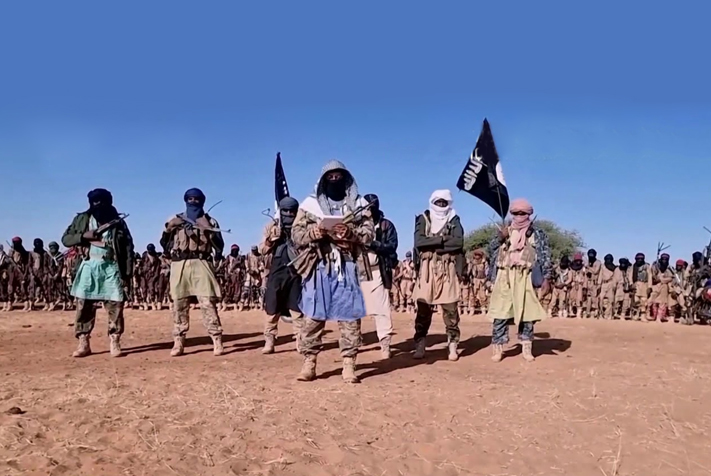
The Islamic State in the Sahel Province (ISSP), formerly known as the EIGS, continues to exert a significant presence in Mali’s northeastern regions. While much of the public’s focus has shifted toward the Jama’at Nusrat al-Islam wal-Muslimin (JNIM), the ISSP remains a formidable force in key areas.
Strategic strongholds of the ISSP in Mali
The group maintains a strong foothold in the Gao and Ménaka regions, particularly in the Ansongo circle and the infamous “3T” localities—Talataye, Tin-Hama, and Tessit—as well as Labbezanga. These areas serve as the operational core of the ISSP, where it not only exercises territorial control but also exerts relentless pressure on local communities.
Its leadership, currently under Abou Al-Bara—who took over after the 2021 death of Adnan Abu Al-Walid Sahraoui—has shifted tactics since 2020. Instead of relying on high-profile executions and mass terror, the ISSP has adopted a more subtle approach, focusing on localized governance and community infiltration. This strategic pivot allows the group to embed itself within populations while minimizing media attention.
Ongoing military pressure and operational adaptations
Despite these adaptations, Malian forces have not relented in their counterterrorism efforts. In a recent operation conducted between May 14 and 15, 2026, the Malian Armed Forces (FAMa) neutralized a key ISSP operative during an airstrike in Bara, Ansongo circle. The strike also resulted in the elimination of several affiliated fighters, underscoring the military’s sustained pressure on the group’s bastions.
The ISSP’s operational reach extends along the Mali-Niger axis, where it targets critical localities such as Talataye, Tin-Hama, Tessit, Labbezanga, and Ménaka. By controlling the movement of people and goods, the group reinforces its dominance over these regional corridors while exerting influence over local armed factions.
Contrasting strategies: ISSP vs. JNIM
The rivalry between the ISSP and JNIM remains a defining feature of Sahel’s security landscape. While JNIM has gained visibility through high-profile attacks, including coordinated strikes near Bamako in April 2026, the ISSP’s strategy diverges sharply. The latter prioritizes discreet territorial control, community coercion, and securing strategic routes over dramatic, media-centric operations.
Initially, defections from JNIM contributed to a relative lull in direct confrontations, but this fragile truce has eroded since 2020. Recent offensives by Malian forces have temporarily redirected the focus of both groups toward a common adversary, though no formal peace accord has been established. The ISSP’s ability to regroup along porous borders and maintain its logistical networks ensures its resilience.
Mounting threats and evolving tactics
Data from the Armed Conflict Location & Event Data Project (ACLED) as of May 15, 2026, reveals that 86% of Islamic State activities in the first quarter of 2026 occurred in Africa. The ISSP has escalated its tactics, deploying armed drones, motorized attacks, and economic pressures to tighten its grip on urban and rural areas.
Targets have included critical infrastructure along the Ménaka-Ansongo-Tessit axis and Labbezanga, where the group exploits local weaknesses to enforce its de facto rule. A January 2026 attack on a civilian convoy near Gao—just 35km from the city—demonstrates the group’s audacity. International security cooperation has led to the neutralization of high-profile figures, such as Abu-Bilal Al-Minuki, who was killed in a May 2026 operation involving Nigerian and U.S. forces in the Lake Chad basin. Yet, the ISSP’s threat persists unabated in Mali’s northeast, particularly in the “3T” localities and Labbezanga, where its territorial control and influence over local armed groups remain intact.
The path forward: addressing an entrenched threat
The ISSP’s ability to thrive amid shifting security dynamics highlights its deep-rooted presence in Mali. By capitalizing on the media’s focus on JNIM and other factions, the group continues to consolidate its influence, control populations, and challenge state forces. Strengthening counterterrorism efforts in strategic zones—especially along the Niger-Mali border—remains essential to curbing its expansion and restoring stability.

 Boureima Amadou