
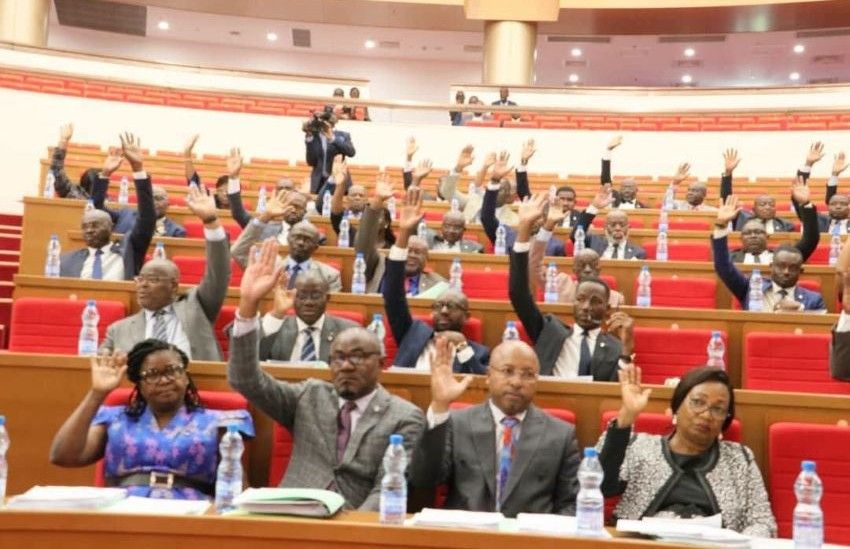
Libreville — In a decisive move to modernize the nation’s governance, the National Assembly of Gabon unanimously passed eighteen bills during a single plenary session. This massive legislative action serves as a powerful political signal, marking a significant acceleration in the institutional overhaul currently underway under the 5th Republic.
The new legislative framework addresses critical areas such as digital technology, nationality, land ownership, media regulation, and administrative modernization. These reforms are designed to fundamentally reshape the Gabon state architecture while enhancing legal security and economic attractiveness.
Presided over by Michel Régis Onanga M. Ndiaye at the Palais Léon-Mba, the session saw deputies meticulously examine and adopt the government’s entire legislative package. Beyond the technical specifics, the sheer volume and coherence of these reforms are noteworthy. It is a rare occurrence for the Parliament to address so many fundamental pillars of public governance in such a concentrated timeframe.
A new generation of structural reforms
Lawmakers have greenlit a significant reform of the High Authority for Communication (HAC). This institution is now positioned to play a more robust role in an evolving media landscape increasingly defined by digital expansion and the rapid circulation of information.
Another focal point of the session was the ratification of a updated Nationality Code. As global issues regarding identity, mobility, and national belonging become more complex, this reform provides the state with a vital legal tool to manage these modern challenges.
Furthermore, the ratification of the land ownership regime represents a major economic milestone. In emerging economies, securing land rights is a prerequisite for attracting investment, ensuring controlled urban development, and fostering wealth creation.
Strengthening the rule of law
The unanimous support for these texts reflects a shared institutional commitment to reinforcing the rule of law through a modernized legal framework. Both the government and the National Assembly have demonstrated a clear consensus on the need to adapt Gabon‘s legal instruments to meet contemporary economic, social, and technological demands.
This legislative drive is also a matter of international competitiveness. Global investors prioritize regulatory stability, clear procedures, and legal certainty. By strengthening its normative arsenal, Gabon aims to improve its standing in an international environment where the quality of institutions is a primary factor in attracting capital.
Government officials present at the hemicycle praised the depth of the debates and the sense of responsibility shown by the deputies. This collaboration highlights a unified approach to the structural reforms that have been in development for several years.
The path toward implementation
While this legislative milestone is a major step forward, it transitions the country into a more demanding phase: execution. The success of these laws will ultimately depend on the ability of administrations, courts, and economic stakeholders to apply them effectively on the ground.
As the current ordinary session nears its end, eight additional bills remain under review within parliamentary committees. Their eventual adoption will further complete a legal structure that has already been significantly bolstered.
Through this unanimous vote, the National Assembly confirms its central role in building the country’s new institutional framework. This period marks a turning point where legal modernization serves as a primary tool for economic, social, and administrative transformation, pushing Gabon toward a development model fueled by continuous reform.



More Stories
Cédric Itten évoque l’équipe de Suisse et son transfert au Werder Brême
Young entrepreneurs in Burkina Faso unite for stronger local economy
Accountability eludes Togo’s child victims of state violence