Mariama Hamani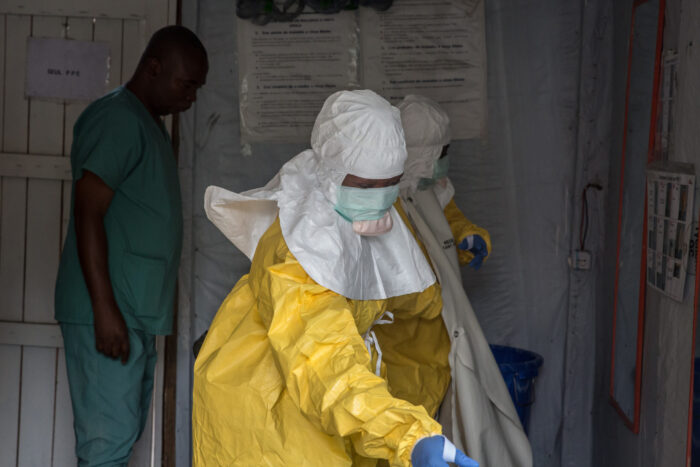
Exclusive report / Global health watch
Ebola outbreak in DRC tests global health response amid crises
-

Fatou Élise Ba
Researcher at IRIS, Head of Human Security Program
On May 17, 2026, the World Health Organization declared the Ebola outbreak in eastern Democratic Republic of Congo—and its persistence in Uganda—an “international public health emergency,” followed the next day by the Africa CDC. By June 5, both institutions had launched a joint six-month response plan and appealed for $518 million in funding. Caused by the rare Bundibugyo strain, for which no vaccine or approved treatment exists, this 17th outbreak is striking a region already devastated by conflict and destabilized by shifting U.S. aid policies. How will this epidemic deepen the security and humanitarian vulnerabilities in eastern DRC while complicating access to healthcare for local populations? What risks does it pose to regional stability in Central Africa? And what does the resurgence of Ebola reveal about the international community’s ability to respond to major health crises? We examine these questions with Fatou Élise Ba, researcher at IRIS and Head of the Human Security Program.
Ebola in a fractured region: when health crises collide with armed conflict
This latest Ebola wave arrives in a zone already reeling from multiple overlapping crises. While the Democratic Republic of Congo has faced 17 outbreaks since 1976 (when the virus was first identified in Yambuku), this is the first time the Bundibugyo strain has emerged—one that kills up to half of those infected. The eastern provinces of North Kivu, South Kivu, and Ituri are particularly vulnerable to epidemic spread. Last year, the UN reported one of the worst cholera outbreaks in 25 years. Since 2020, Mpox has spread rapidly, with a surge beginning in September 2023. Ituri, the epicenter of the current crisis, is one of the most unstable provinces in DRC: poorly connected by roads, plagued by armed group violence, and home to nearly a million displaced people living in overcrowded camps. The health emergency now overlaps with an existing humanitarian and security crisis.
The region’s chronic instability has intensified since the M23 offensive in 2023. Daily life is marked by regular displacement and extreme overcrowding in camps—conditions that accelerate pathogen transmission. Years of systemic violence, particularly targeting women and children, have eroded social cohesion and healthcare systems, leaving local populations dangerously dependent on external aid. The arrival of a major epidemic only compounds these challenges, further destabilizing an already fragile security environment.
Healthcare under siege: the strain on eastern DRC’s medical system
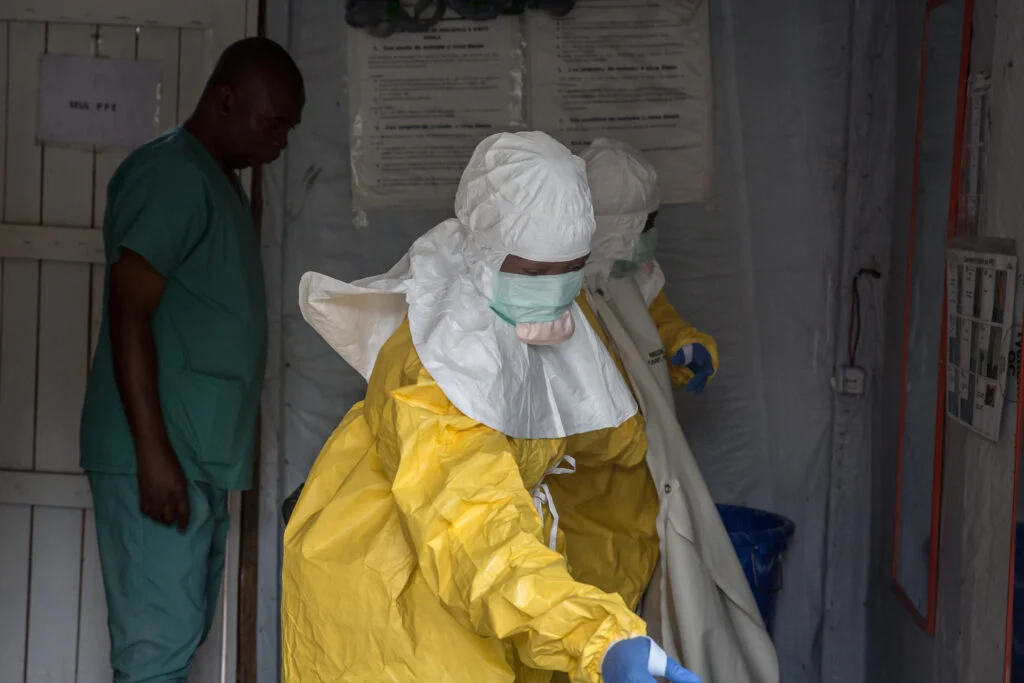
The Congolese Health Minister, Samuel-Roger Kamba Mulamba, called Ebola an “absolute emergency.” As of May 31, 2026, there were 282 confirmed cases and 42 deaths, including 19 new positive tests recorded that day. By June 1, the WHO reported 349 suspected cases under surveillance—mainly in Ituri province, particularly in Bunia, Rwampara, and Mongbwalu health zones. Bunia’s main hospital quickly became overwhelmed, forcing the establishment of peripheral and rural treatment centers. Yet hope persists: four infected healthcare workers have recovered. By June 5, however, pressure on the healthcare system intensified further, with local reports indicating that six health centers in Bunia were temporarily closed for disinfection—reducing the city’s already limited capacity and leaving pregnant women, patients with other conditions, and emergency cases without proper care.
The real challenge lies in the lack of coordinated response from Kinshasa, especially in areas partially controlled by the M23—a proxy force linked to Rwanda—and overrun by armed groups exploiting mineral resources. The Congolese government has yet to coordinate its epidemic response with these armed factions, leaving the risk of uncontrolled spread intact. While negotiations may be underway, no framework for unified health action has been established. Territorial fragmentation prevents a cohesive national response. Two Ebola treatment centers are reportedly being set up in Goma, the provincial capital under M23 control, but with limited capacity. The rebel group claims to have implemented contingency plans, yet the virus continues to spread in their areas of influence.
Community resistance further complicates containment efforts. During the 2018–2020 outbreak, mistrust of health teams led to violent protests, including the incineration of a suspected Ebola victim’s body in Rwampara. In eastern DRC, funeral rituals—including washing and physical contact with the deceased—are sacred. Yet these practices are also major transmission vectors for Ebola. The refusal to return bodies to families is seen as a profound cultural violation, fueling resentment and conspiracy theories. This suspicion stems from decades of state neglect and external interventions perceived as extractive, turning health responses into tools of control rather than care.
Cross-border spillover: how Ebola threatens regional stability in Central Africa
Eastern DRC’s instability has already strained relations with neighboring countries, particularly Rwanda—though Uganda and others are also affected. When an epidemic spreads in a state where parts of the territory lie beyond central control, a coordinated national response becomes nearly impossible. A trans-regional or continental approach is essential. The Africa CDC, the AU’s operational arm for epidemic detection, has warned that ten vulnerable countries could be impacted: South Sudan, Rwanda, Kenya, Tanzania, Ethiopia, Republic of Congo, Burundi, Angola, Central African Republic, and Zambia—on top of the already affected DRC and Uganda, which recorded seven cases. However, health system capacities vary widely. Kenya and Ethiopia have relatively robust systems and have begun setting up quarantine facilities, while Central African Republic remains one of the continent’s most fragile states, heavily reliant on external aid. South Sudan, already grappling with internal strife and spillover from Sudan’s war, faces compounded risks.
Epidemics ignore borders. According to the WHO, imported cases from Ituri have reached North Kivu and Kampala, Uganda, where two travelers returning from DRC tested positive—one of whom died. A case was also reported in South Kivu, with the M23 claiming the patient had traveled from Kisangani in Tshopo province. These developments have triggered unilateral border closures and diplomatic tensions, with severe economic consequences. Uganda suspended passenger flights and transport with DRC on May 21, 2026; Rwanda closed its border with Goma. Such measures, though understandable, have further strained already tense bilateral relations.
The East African Community has called on member states to activate laboratory networks and strengthen border surveillance. Ministers met in an extraordinary session on June 1–2, 2026, pledging to harmonize sanitary controls at entry points without closing borders, create a regional technical working group to coordinate surveillance, and bolster diagnostic capacities and healthcare worker protection. Yet the crisis continues to escalate in areas like Goma and Bukavu—captured by M23 in early 2025—raising fears of a regional conflagration. Health has become another battleground in the Kinshasa-Kigali rivalry, with the M23 de facto assuming a public health role in the territories it controls.
Global health in crisis: the limits of international aid after U.S. funding cuts
The outbreak coincides with a critical shift in U.S. aid architecture. In January 2025, Washington implemented “quadripartite” cuts: withdrawal from WHO, dissolution of USAID, reductions to CDC funding, and decreased health aid to DRC and Uganda—weakening systems vital for epidemic response. Experts warn these cuts may have delayed outbreak detection. Today, DRC has signed a bilateral agreement with the U.S. under an “America First” strategy. Part of health funding has been transferred to the State Department, which pledged $900 million over five years—tied to extractive conditions and a shift from multilateralism to transactional bilateralism. Yet this realignment has left the response framework unclear. With the U.S. no longer part of WHO, the organization’s emergency fund (CFE) is operationally fragile, and other donors have been unable to fill the gap.
Against this backdrop, the response must rely on national institutions in the most affected countries, supported by WHO and NGOs—despite reduced capacities and hostile security environments. WHO, acting within its mandate, declared the outbreak a Public Health Emergency of International Concern (PHEIC) and is coordinating the response. The European Centre for Disease Prevention and Control (ECDC) has issued risk assessments to support coordination, particularly with Africa CDC. On the ground, medical NGOs like Doctors Without Borders and ALIMA have deployed care teams, while the Red Cross of DRC mobilizes volunteers for safe burials, risk communication, and community engagement. Still, the humanitarian response remains inadequate to curb the epidemic.
At the continental level, Africa CDC and WHO launched a joint six-month response plan on June 5, 2026, covering June to November and seeking $518 million to support early detection, prevention, and containment. The plan, based on the principle of “one plan, one budget, one team,” aims for coordinated action led by affected countries. So far, only $315.8 million has been pledged—falling short of even a single coordinated framework. This hybrid approach—where African states sign bilateral agreements with the U.S. while coordinating multilaterally—raises questions about long-term effectiveness.


 Boureima Amadou