Mariama Hamani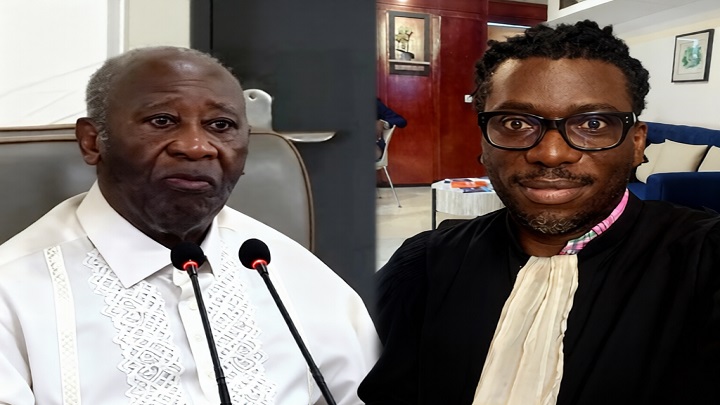
The recent decision by Laurent Gbagbo to remain at the helm of the Parti des Peuples Africains – Côte d’Ivoire (PPA-CI) has reignited debates about the permanence of political figures in Côte d’Ivoire. Following the party’s first ordinary congress in Abidjan, lawyer Ange Rodrigue Dadjé argued that criticism of President Alassane Ouattara’s continued political involvement is no longer valid.
« We can no longer criticize President Ouattara for deciding to stay in politics after announcing his retirement, » Dadjé stated on May 15, 2026, a statement that has sparked significant discussion both in political circles and on social media.
Gbagbo’s unexpected about-face
The timing of Gbagbo’s decision is particularly noteworthy. Just months before the PPA-CI’s congress, the former president had publicly expressed his intention to step back from active politics. In an October 2025 interview with journalist Alain Foka on AFO Media, Gbagbo declared, « There is no retirement in politics, but I will refrain from holding political office, whether within my party or in the state. I have given enough. » At 81 years old and following his 2021 acquittal by the International Criminal Court (ICC), many assumed he would gradually pass the torch to a younger generation of PPA-CI leaders.
However, the party’s congress on May 14–15, 2026, took a different turn. Under pressure from militants and party officials, Gbagbo reversed course, declaring, « I remain for the struggle, » a statement met with thunderous applause. This unexpected decision has once again thrust the issue of political longevity into the spotlight, particularly regarding Ouattara’s own extended tenure.
Ouattara’s contested legacy
Ouattara’s political future has been a recurring subject of debate. In 2020, his decision to seek a third term—despite earlier pledges to step aside—drew sharp criticism from opposition figures, including Gbagbo’s PPA-CI. The move was widely condemned as a breach of trust, with opponents arguing that the president had betrayed his word for personal ambition.
By July 2025, Ouattara officially declared his candidacy for the October 2025 presidential election, framing his decision as a necessity to ensure national stability amid regional security and economic challenges. « This decision is carefully considered and a duty, » he stated, emphasizing that it was made in the « supreme interest of the Nation. » At 83, his bid for a fourth term further fueled discussions about the ethical and practical limits of political longevity in Côte d’Ivoire.
Implications for Côte d’Ivoire’s political landscape
Gbagbo’s renewed leadership at the PPA-CI’s helm has reshaped the political narrative. Observers now see it as a reflection of the powerful influence exerted by party militants and grassroots realities, even when leaders like Gbagbo had previously signaled their intent to retire. The question looms large: Can historic political figures ever truly leave the stage when their supporters continue to demand their leadership?
Ange Rodrigue Dadjé’s remarks underscore a growing acceptance that political figures, once entrenched, often find it difficult to disengage—regardless of prior commitments. As Côte d’Ivoire grapples with this reality, the debate over leadership, legacy, and the cyclical nature of politics shows no signs of abating.


 Boureima Amadou