Mariama Hamani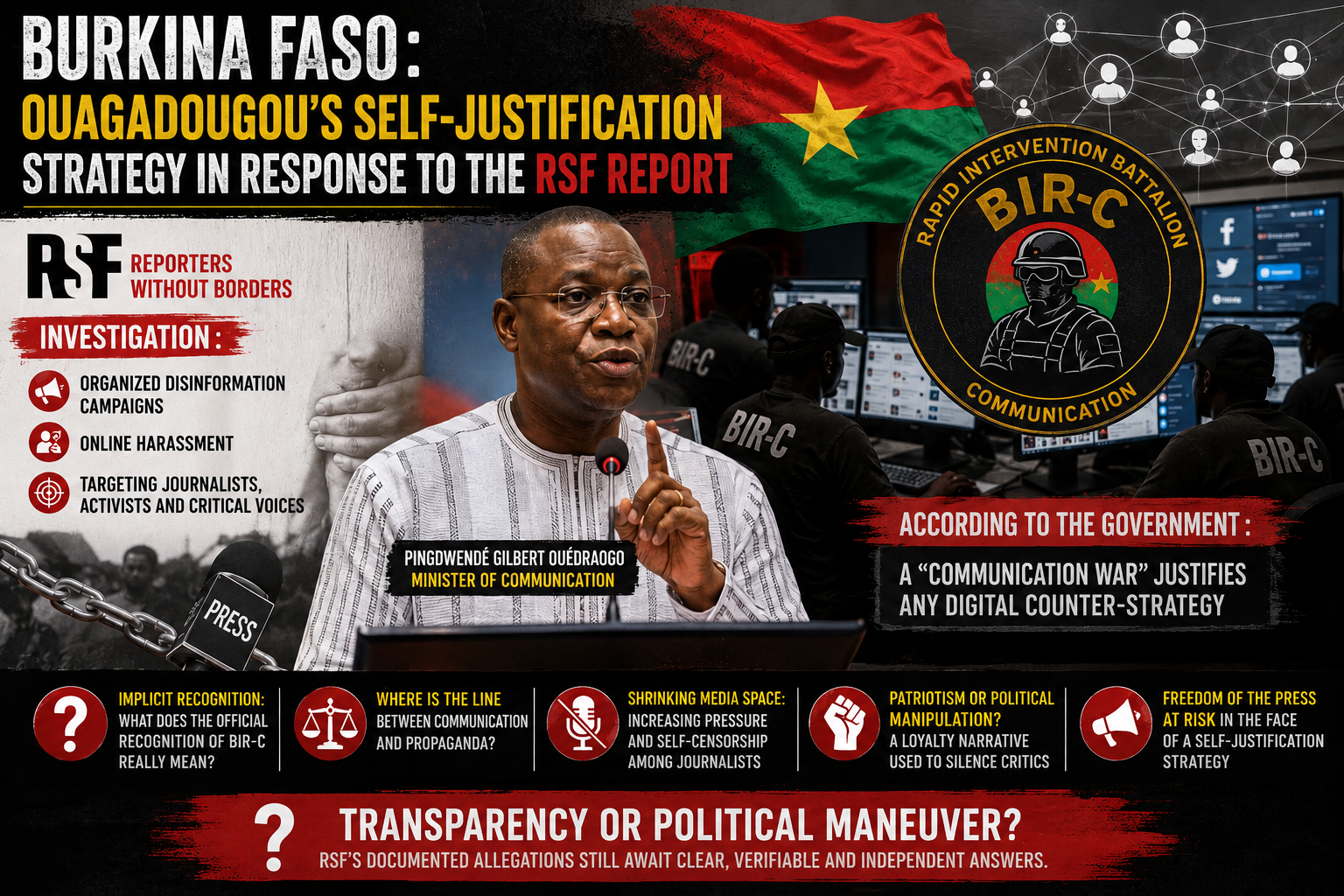
Rather than engaging in transparent dialogue, Burkina Faso’s authorities have adopted a defensive stance following mounting allegations against a controversial security unit operating in the digital sphere. During the August 3 national ceremony, Minister of Communication Pingdwendé Gilbert Ouédraogo addressed claims from Reporters Without Borders (RSF), but his endorsement of the Rapid Intervention Battalion – Communication (BIR-C) only fueled further skepticism rather than quelling concerns.
The government’s decision to publicly acknowledge the BIR-C’s expanding role in Burkina Faso’s digital landscape comes at a critical moment. RSF’s research reveals a coordinated network suspected of launching systematic disinformation campaigns, targeting journalists and activists, and systematically silencing critics of the transitional military government. Rather than launching an independent inquiry or directly disputing the evidence, officials opted to legitimize the BIR-C, thereby deepening doubts about its real objectives and oversight mechanisms.
Coordinated disinformation networks: a growing threat to media freedom
According to RSF’s report, these digital operations function with a high degree of organization. Social media accounts, often operating in unison, amplify specific narratives, undermine opposing viewpoints, and exert relentless pressure on media professionals. Despite these documented findings, Burkina Faso’s leadership has dismissed the accusations without providing tangible evidence to the contrary, leaving the public with little clarity on the matter.
The government frames the situation as Burkina Faso being targeted by a « communication war » allegedly orchestrated by external actors aiming to destabilize the country. In this narrative, any digital initiative aimed at safeguarding state interests is presented as a civic obligation. Yet, this argument raises a pressing question: where does legitimate government communication draw the line between defense against manipulation and the suppression of dissenting voices and factual reporting?
Press freedom under pressure: the fine line between security and censorship
While governments have a legitimate right to combat digital manipulation particularly amid heightened political and security challenges the principles of international press freedom stipulate that such measures cannot be used as a pretext for harassment, defamation, or intimidation of journalists. When dissent is systematically equated with treason, public discourse risks being confined to a narrow, state-sanctioned narrative, stifling pluralism and accountability.
The current controversy unfolds within a broader context marked by the closure of international media outlets, a decline in press freedom, and increasing constraints on independent journalism in Burkina Faso. Analysts caution that such an environment encourages self-censorship among media professionals, further eroding the public’s access to diverse and reliable information. The existence of a structured digital communication entity particularly if its activities extend beyond conventional government messaging raises critical questions about balancing national security imperatives with the protection of fundamental rights and freedoms.
Patriotism as a shield against criticism
The government’s approach to communication appears less focused on openness and more on strategic defense. By emphasizing the patriotism of BIR-C operatives, officials reframe criticism not as a valid inquiry but as an attack on the nation itself. This strategy shifts the debate from factual accuracy to loyalty, thereby undermining the very foundation of democratic scrutiny and accountability.
A functioning democracy, even in the face of existential threats, must demonstrate resilience in the face of scrutiny from both the press and civil society. Responding to serious allegations by publicly endorsing the entity in question offers little reassurance and may instead be interpreted as implicit approval of its role within the state’s broader communication apparatus.
A defining challenge for digital governance
The implications of this dispute transcend the case of the BIR-C. They highlight a fundamental dilemma: how should Burkina Faso regulate digital communication in an era where social media platforms have become battlegrounds for political influence? Any state-sanctioned use of these tools must operate within a framework of transparency that upholds press freedom and human rights, ensuring that digital communication serves the public interest rather than political control.
At its heart, this episode reflects a deliberate political choice: addressing criticism through patriotic mobilization rather than through open dialogue, evidence-based rebuttals, or verifiable responses. Until RSF’s documented accusations are met with precise, independent, and verifiable counterarguments, official statements may be perceived not as denials, but as justifications for a communication structure whose boundaries continue to blur the line between state messaging and propaganda, thereby eroding trust in Burkina Faso’s media landscape.

 theafricantribune
 Boureima Amadou