
 Boureima Amadou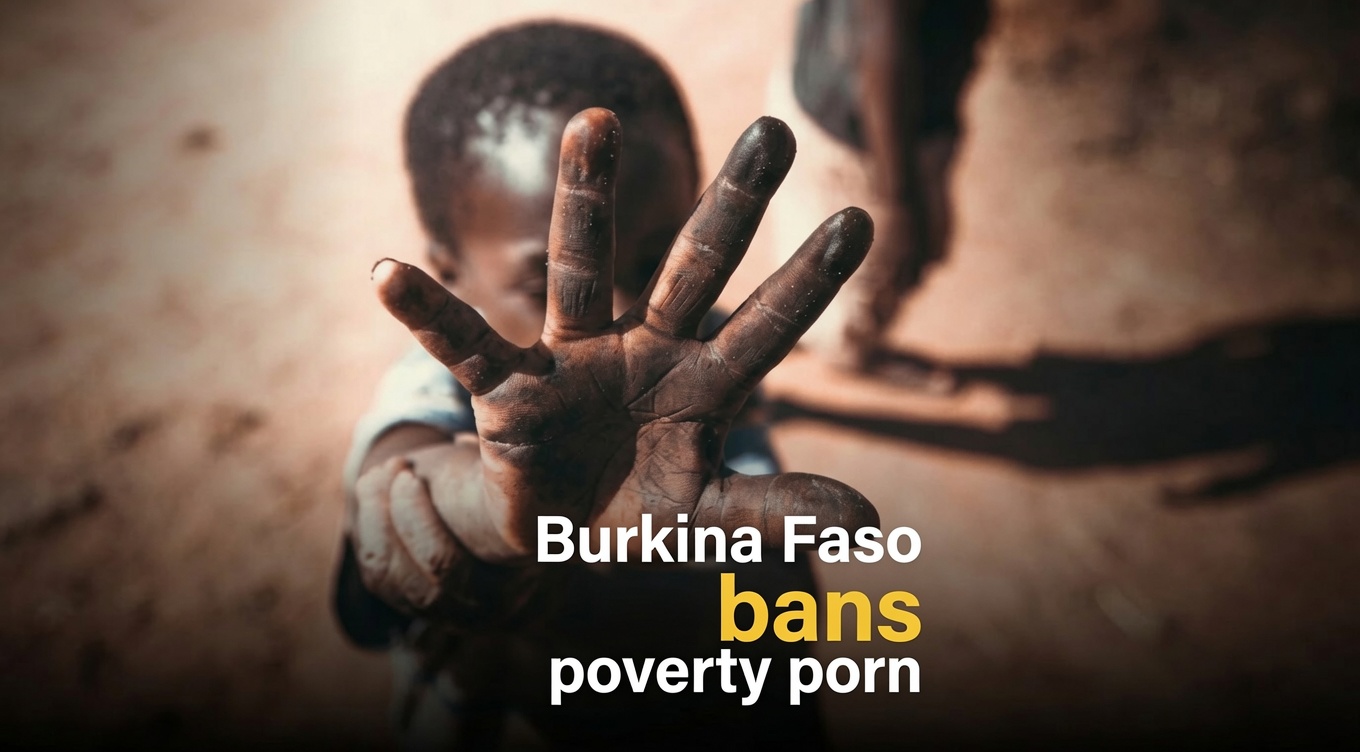
The Government of Burkina Faso has recently enacted stringent legislation to prohibit the practice colloquially referred to as poverty porn—a term used to describe the exploitation of human suffering for emotional or financial gain. This decisive move challenges long-standing norms within media production and humanitarian communications, while reigniting a critical discourse on the preservation of human dignity in visual storytelling.
A shift in ethical standards for content creators
With the proliferation of digital platforms, the commodification of distress has emerged as a troubling trend. The typical narrative unfolds predictably: a creator or organization captures close-up footage of malnourished children, internally displaced families, or communities in dire straits, often seeking to evoke immediate emotional responses or secure funding. While the stated goal may be altruistic, the underlying mechanism transforms genuine suffering into a spectacle, stripping individuals of their agency and reducing complex humanitarian crises to simplistic, exploitative imagery.
Burkina Faso’s authorities have now drawn a clear ethical boundary, recognizing that such portrayals not only violate personal dignity but also perpetuate harmful stereotypes that reduce entire populations to passive objects of pity.
National image and security concerns behind the ban
The prohibition of poverty porn is not merely an ethical stance; it reflects broader strategic considerations. Burkina Faso is navigating a multifaceted crisis, and the unchecked dissemination of imagery depicting the nation solely through the lens of hardship poses significant reputational risks. For the transitional authorities, such portrayals do more than harm dignity—they reinforce a damaging narrative that can be weaponized externally to undermine national confidence or distort international perceptions.
The government’s position is clear: the aim is not to conceal the reality of the crisis but to prevent the country from being reduced to a monolithic image of helplessness. By regulating the visual representation of distress, authorities seek to reclaim control over Burkina Faso’s narrative, ensuring that its story is told with nuance and respect.
The controversy: censorship or protection?
Critics, particularly from civil society and opposition groups, argue that this legislation serves a dual purpose—one that extends beyond ethical concerns. They contend that the ban provides the transitional government, led by Captain Ibrahim Traoré, with a legal instrument to suppress information about the country’s humanitarian emergency. The argument posits that by outlawing footage of suffering, the regime can obscure the scale of displacement, food insecurity, and healthcare shortages affecting millions of Burkinabè.
The reality on the ground remains stark: communities under siege face acute shortages, families flee violence daily, and basic services are increasingly inaccessible. For detractors, this law functions as a smokescreen, allowing the transition to project an image of resilience while silencing the very voices that expose its shortcomings.
Reimagining humanitarian communication
Despite the controversy, the new legislation compels humanitarian organizations and content creators to innovate. The challenge now lies in balancing the need for awareness-raising with ethical storytelling. How can urgent appeals for solidarity be made without resorting to sensationalism, and without violating the new legal framework?
Experts advocate for a shift toward solutions-oriented communication and courageous field journalism. The focus should shift from depicting vulnerability to showcasing resilience, agency, and the collective efforts of communities to overcome adversity. Such an approach not only upholds dignity but also strengthens the integrity of the narrative. It ensures that Burkina Faso’s struggles are not erased but are instead recounted with the respect and complexity they deserve—a nation in crisis, but one that refuses to be defined by its pain alone.








