
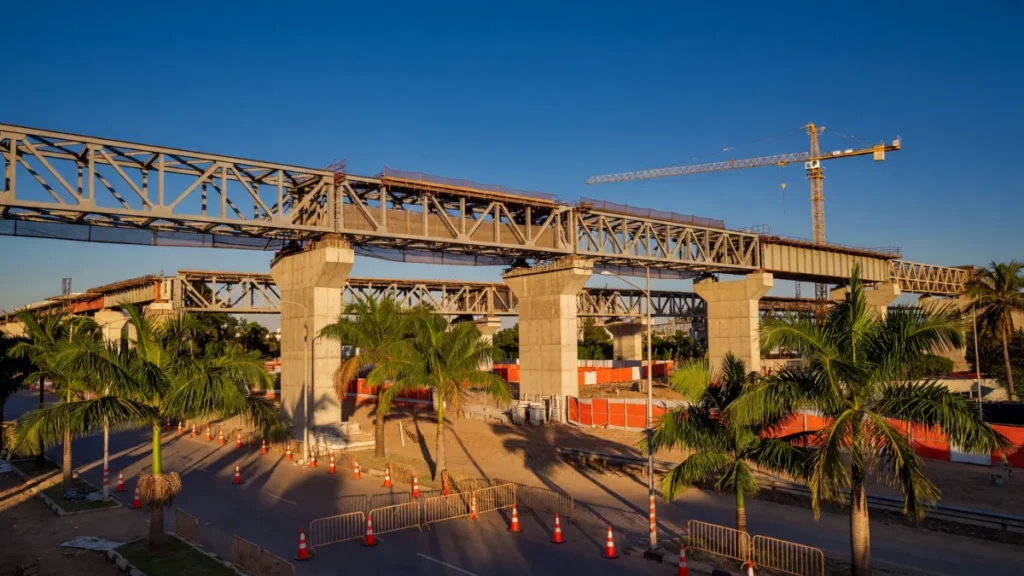
Port-Bouët’s busy Caribbean Street in southern Abidjan has been shut to all traffic since July 15, marking the start of a 10-week closure for essential rail bridge construction. Authorities confirmed the temporary measure, which will remain in place until September 30 to allow completion of the deck for the railway bridge on Abidjan Metro Line 1. Motorists are urged to follow the new traffic plan and observe safety zones around the site.
The closure is part of an aggressive timeline to deliver Côte d’Ivoire’s first elevated metro line, designed to transform urban mobility across the capital region.
37.4-kilometer route set to revolutionize transit
Line 1 will stretch 37.4 kilometers, linking Anyama in the northern outskirts to Port-Bouët’s Félix Houphouët-Boigny International Airport in the south. The route cuts through seven municipalities, offering a high-capacity alternative to the city’s chronically congested roads. Once operational, the fully automated system is expected to carry over 500,000 daily passengers, cutting peak-hour travel time from 50 minutes by car to just six minutes by metro.
The project includes 18 stations, 24 bridges, a lagoon-spanning viaduct, and 34 pedestrian footbridges. Recent updates indicate that civil works on the lagoon crossing are nearly complete, with 12 of the 24 bridge decks already installed. Officials maintain the line will open to the public by the end of 2028.
French-led consortium drives major infrastructure push
The metro is being built by a French-led consortium comprising Bouygues Travaux Publics, Alstom, Colas Rail, and Keolis. Bouygues oversees civil engineering and rolling stock supply, while Keolis will operate the line for 15 years post-delivery. The total investment tops €1.36 billion, largely financed through French development aid and concessional loans from the French Treasury. This makes it one of France’s largest transport infrastructure investments in West Africa.
Abidjan’s growth straining under traffic gridlock
With over 5.5 million residents, Abidjan’s metropolitan area faces severe congestion, particularly in Port-Bouët, a key industrial and air transport hub. The absence of high-capacity public transit has pushed daily commute times to unsustainable levels. The new metro aims to ease road pressure, reduce pollution, and provide a reliable alternative to buses and informal taxis. Local job creation is also anticipated during both construction and operation phases.
Diplomatic and economic stakes for France
From Paris’s perspective, the Abidjan metro reinforces French economic and political influence across Francophone Africa. The project exemplifies France’s strategy of funding critical infrastructure in former colonies, where French firms maintain a competitive edge over rivals from China and Turkey. Success in Côte d’Ivoire could pave the way for similar ventures in Senegal and Guinea, strengthening France’s role as a key partner in regional development.
The Caribbean Street closure signals one of the final critical milestones before track laying and installation of Alstom’s driverless trains across the full route.



More Stories
Niger’s CNSP faces mounting pressure amid base 101 mutiny and JNIM assaults near Niamey
Waly Diouf Bodian hits back at Mary Teuw Niang: ‘we don’t respect those who disrespect Ousmane Sonko’
Cameroun : Samb’a Finances Holding sollicite l’agrément pour sa filiale de micro-assurance