
 Boureima Amadou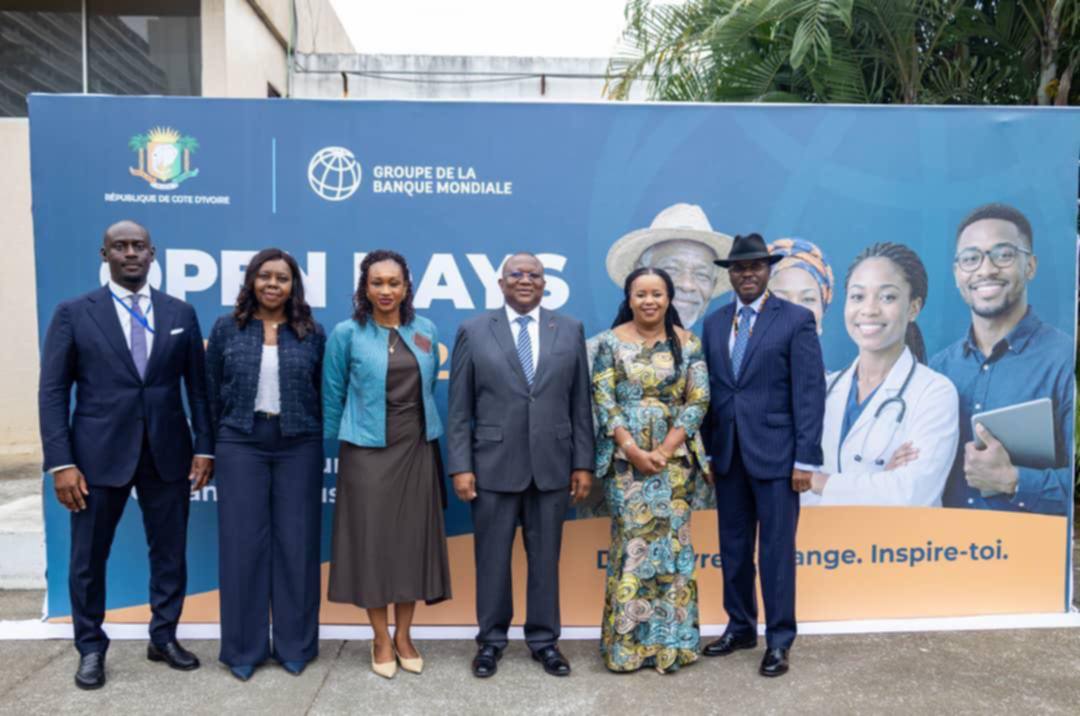
With 25 active projects worth a combined $5.3 billion, the World Bank Group’s footprint in Côte d’Ivoire is now one of the largest in West Africa — and it is already reshaping the daily realities of Ivorian workers, entrepreneurs and families. The figure was placed at the centre of the first-ever World Bank Group Open Days in Abidjan on Monday, September 21, 2026, where Amadou Coulibaly, Minister of Communication and Government Spokesperson, delivered the opening address on behalf of Dr Souleymane Diarrassouba, Minister of Planning and Development and the World Bank Group Governor for Côte d’Ivoire.
The two-day event, held on September 21 and 22 under the theme “Jobs and Opportunities: Building Together for Inclusive Growth,” brought together several members of government alongside Marie-Chantal Uwanyiligira, the World Bank’s Division Director for Côte d’Ivoire, Benin, Guinea and Togo. The choice of theme is far from symbolic: it reflects a partnership increasingly judged on what it delivers in people’s lives.
Where the money goes — and why it matters for ordinary households
For two days, students, recent graduates and project promoters met the teams running projects financed by the institution, covering education, employment, entrepreneurship and infrastructure. Employment quickly emerged as the thread running through every discussion: the National Development Plan (PND) 2026–2030 targets the creation of three million jobs, with young people and women first in line. For a country where the informal sector still absorbs the bulk of new entrants to the labour market, that target is a direct measure of whether the partnership produces real change.
World Bank Group financing stretches across infrastructure, agriculture, energy, education, health and human capital development. The International Finance Corporation (IFC) has invested close to $2.7 billion in Côte d’Ivoire over the past five years, while the Multilateral Investment Guarantee Agency (MIGA) works to shore up investor confidence — a factor that influences the cost and availability of private capital for local businesses.
The next phase: a $17 billion commitment looming over the PND
The current portfolio is distinct from the far larger commitment announced for the coming years. At the Consultative Group for the financing of the 2026–2030 National Development Plan, held in Abidjan on July 8 and 9, 2026, the World Bank Group pledged more than $17 billion: $10 billion from the World Bank, $5 billion from the IFC and $2 billion from MIGA.
If fully delivered, that pipeline would represent a step change in the resources available for infrastructure and job creation — and, by extension, in the expectations placed on public institutions to turn financing into visible results.
Financial innovation: debt swaps and sustainability-linked borrowing
The partnership has also produced financial operations that are firsts for the region. In December 2024, with the Group’s support, Côte d’Ivoire carried out a debt-for-development swap — the first of its kind backed by the institution. Covering nearly €400 million of commercial debt, the operation improves the country’s debt profile while freeing up resources for education.
In 2025, the country concluded West Africa’s first sovereign sustainability-linked loan, worth €433.3 million, supported by a dual guarantee from the International Bank for Reconstruction and Development (IBRD) and MIGA. For businesses and households, such instruments matter because they can lower borrowing costs and tie public financing to measurable development outcomes.
A partnership under constant review
The Abidjan Open Days fit into a closely monitored relationship. On September 10, Dr Souleymane Diarrassouba received Harold Tavares, the World Bank Group’s Executive Director for Africa Group II, in Abidjan. Their discussions focused on the Ivorian portfolio and preparations for the next Country Partnership Framework, which is expected to align with the priorities of the PND 2026–2030.
For citizens, businesses and the economy at large, the message from Abidjan is clear: the scale of the financing is set, and the next test is delivery on the ground.








