Boureima Amadou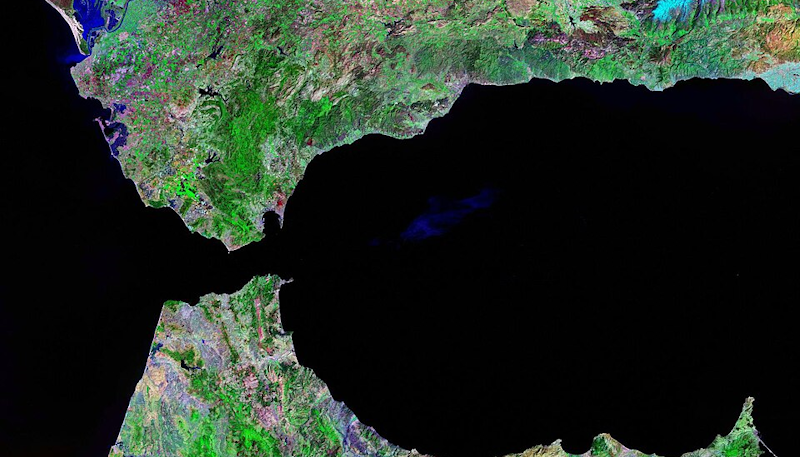
Relations between Morocco and the United States have reached a pivotal moment. Following Washington’s 2020 recognition of Morocco’s sovereignty claim over the Western Sahara, recent signals suggest a growing American alignment with Rabat’s positions on Ceuta and Melilla—a shift that could reshape geopolitical dynamics in the western Mediterranean and place Spain in uncharted territory.
Since late July, multiple signals from Washington have reinforced this trend. From the Western Sahara dossier to economic cooperation, regional security, and now the status of Ceuta and Melilla, the two nations appear to be deepening a partnership that has become indispensable on the global stage.
This alignment follows a recent migration crisis at Ceuta, where thousands of people crossed into the Spanish enclave within 24 hours, straining Madrid’s resources and drawing sharp criticism from the European Union.
Western Sahara remains Morocco’s top diplomatic priority
In December 2020, the Trump administration’s landmark decision recognized Morocco’s sovereignty over the Western Sahara in exchange for normalization with Israel. That move marked a historic turning point in a decades-long standoff between Rabat and the Polisario Front.
Half a decade later, Morocco continues to strengthen its ties with Washington to preserve this critical diplomatic victory. The inauguration of the “Donald J. Trump Highway” connecting Tiznit to Dakhla in the Western Sahara serves as a symbolic gesture aimed at reinforcing American support ahead of sensitive international negotiations on the region’s future.
According to regional analysts, Rabat’s primary objective is ensuring sustained U.S. backing for its autonomy plan—particularly as talks on the Western Sahara conflict enter a delicate phase.
Economic incentives fuel deeper U.S.-Morocco collaboration
Diplomatic engagement is not the only driver. In late July, the U.S. Ambassador to Morocco traveled to Laâyoune, in the heart of the Western Sahara, to finalize an agreement granting American funding for a hydrogen and ammonia production plant. This initiative underscores Washington’s interest in strategic investments that benefit U.S. companies while advancing bilateral cooperation.
The growing partnership between the two nations rests on multiple pillars: political backing for Morocco, lucrative economic ventures, regional security collaboration, and shared strategic interests concerning Israel.
Congress takes aim at the Polisario Front
Another development has raised concerns among Polisario supporters: two U.S. lawmakers introduced a bill proposing the designation of the Polisario Front as a foreign terrorist organization. The proposal also calls for an investigation into alleged ties between the group and Iran.
This initiative reflects a broader regional context dominated by U.S.-Iran tensions and a congressional push to counter perceived Iranian influence across the Middle East and North Africa. While no concrete evidence links Polisario to Iran or Hezbollah, Morocco appears to be leveraging Washington’s anti-Iran stance to reframe the Western Sahara conflict in a way that aligns with U.S. priorities.
“Morocco consistently seeks to connect regional conflicts involving Israel to its own dispute with Polisario,” said one regional analyst. “By doing so, Rabat aims to frame the issue in terms that resonate with current U.S. geopolitical concerns.”
Ceuta and Melilla: a new front in U.S.-Morocco relations
The most striking shift concerns Ceuta and Melilla. Traditionally regarded by Washington as Spanish territories, recent statements from U.S. officials suggest a subtle but significant change in tone.
“American officials have recently indicated that they no longer view Ceuta and Melilla as unambiguously Spanish,” noted the analyst. “This represents a quiet but meaningful shift in U.S. support for Morocco’s territorial claims.”
For decades, Morocco has asserted its sovereignty over the two enclaves, while Spain maintains their status as integral parts of its national territory. An increased U.S. tilt toward Rabat’s position could introduce a new source of tension between Washington and Madrid.
The Ceuta migration surge: spontaneous or orchestrated?
The timing of this shift coincides with a dramatic surge of migration into Ceuta. Within a single day, tens of thousands of people attempted to cross the border, overwhelming Spanish security forces and triggering urgent consultations within the European Union.
While the origins of the crisis remain debated—was it spontaneous or deliberately facilitated by Moroccan authorities?—most analysts reject the idea of a fully manufactured event. Instead, they argue the migration wave was largely organic before being exploited politically by Morocco to send a clear message to Spain.
“The crisis was largely spontaneous but was quickly leveraged to underscore Morocco’s unyielding position on Ceuta,” the analyst explained.
Spain navigates a shifting strategic landscape
In response, Spanish Prime Minister Pedro Sánchez traveled to Algeria, a key Polisario backer, to strengthen bilateral ties—particularly in energy cooperation. While this move may raise eyebrows in Rabat, analysts suggest it does not signal a fundamental Spanish shift on the Western Sahara file, where Madrid continues to support Morocco’s autonomy plan.
The Ceuta crisis, however, is driven by a different dynamic: the long-standing territorial dispute between Madrid and Rabat.
Could U.S. support for Morocco redefine Spain’s security guarantees?
For Spain, the stakes extend beyond its bilateral tensions with Morocco. If Washington were to fully endorse Morocco’s claims on Ceuta and Melilla, it could destabilize the entire strategic framework underpinning Spain’s security architecture—one historically anchored in its alliances with the U.S. and NATO.
While an immediate crisis is unlikely, analysts warn that the current trajectory could, over time, create conditions for a renewed political debate over the status of the two enclaves.
A tense triangle: Washington, Rabat, and Madrid
Beneath the diplomatic maneuvers lies a recalibration of power in North Africa. Morocco seeks to anchor its partnership with Washington in lasting support for its positions on both the Western Sahara and Ceuta. The U.S. appears to prioritize a strategy rooted in strategic and economic interests, while Spain faces a less predictable transatlantic ally.
For Rabat, the current moment may present a rare window of opportunity. For Madrid, it represents an unprecedented strategic challenge.
Once separate issues, the Western Sahara and Ceuta now appear converging at the center of a broader diplomatic battle: the struggle for American influence in the Maghreb and the realignment of alliances across the western Mediterranean.



 Mariama Hamani