Boureima Amadou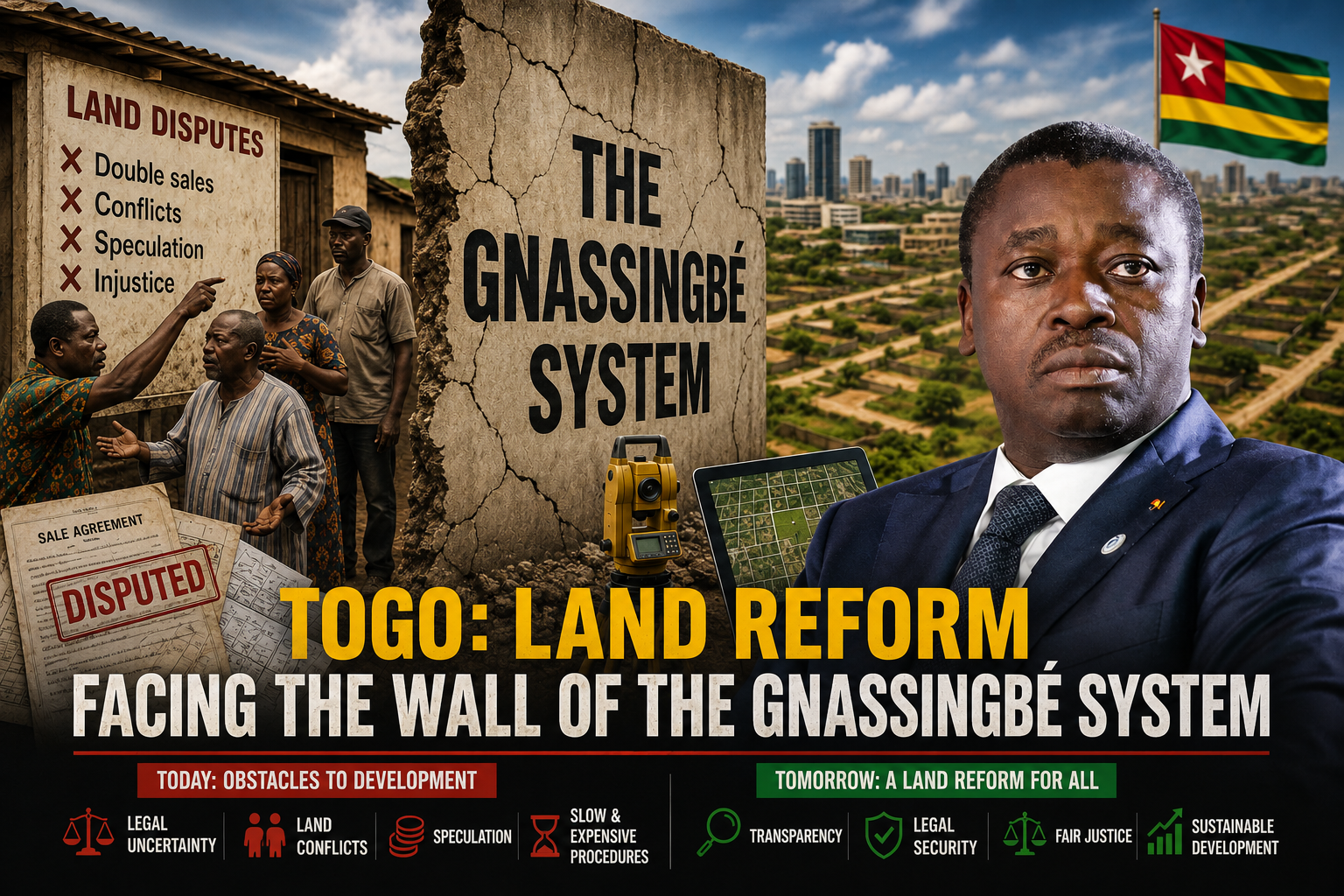
After six decades characterized by frequently erratic land management, the Togolese authorities are now articulating a renewed ambition: to transform the land sector into a significant driver of economic development. While this pledge appears promising in theory, it immediately confronts a far more complex reality on the ground. For many observers, this initiative risks joining the extensive list of previously announced yet uncompleted reforms, unless fundamental structural deviations are addressed comprehensively.
The core of the issue lies in a predicament well-known to Togolese citizens: the proliferation of land disputes. This situation is exacerbated by factors such as multiple sales of the same property, contested ownership claims, inadequate preservation of documentation, and the pervasive opacity surrounding certain transactions. How can a sustainable development strategy be forged when private property rights remain a constant source of legal uncertainty? A simple title deed or sales agreement often proves insufficient to guarantee peace of mind for an acquirer when the same parcel of land can be subject to competing claims. This inherent uncertainty discourages investment, diminishes household savings, and can transform land acquisition into a significant financial hazard.
Administrative hurdles and transparency deficits
Adding to these complexities is the protracted nature of administrative processes. Both individuals and corporations frequently encounter land-related procedures that are lengthy, costly, and difficult to navigate. When access to land information remains restricted and procedural transparency is lacking, those with established connections, financial resources, or a deeper understanding of the system inevitably gain an advantage. Consequently, reform efforts should not solely focus on increasing the volume of land titles issued; they must primarily ensure that every citizen can clearly ascertain the historical background of a parcel before purchase.
The judicial system is similarly impacted. A land conflict that lingers for years represents more than just an administrative inconvenience; it can devastate families, impede inheritances, render land unusable, and obstruct the realization of economic projects. Judicial decisions must be executed promptly and equitably, without the social, political, or financial influence of the parties involved dictating the outcome. Without an accessible, independent, and adequately resourced land justice system, administrative reforms alone cannot yield lasting results.
Political entanglements and vested interests
Beyond technical observations, it is the political dimension that further complicates the equation. In practice, the land system involves a multitude of stakeholders: customary landowners, families, intermediaries, surveyors, administrative bodies, local authorities, and community leaders. When some of these actors maintain close ties with dominant political or economic networks, the potential for conflicts of interest and favoritism becomes particularly alarming. A credible reform should precisely aim to dismantle these ambiguous areas rather than allowing them to re-emerge in new forms.
The issue of speculation also warrants careful consideration. In urban and peri-urban areas, where land values are appreciating rapidly, real estate pressure can foster land grabbing, multiple sales, and manipulative practices concerning parcels. Modest populations often become the primary victims of a market they struggle to comprehend. Land, once a transmissible heritage, progressively transforms into a speculative commodity accessible primarily to those with substantial capital.
Social dimensions and the role of digitization
There is also a frequently underestimated social aspect: land disputes sometimes pit members of the same family, neighboring communities, or multiple generations against each other over a shared inheritance. As long as the safeguarding of customary rights and their integration with modern legal frameworks remain imperfect, tensions will continue to recur. A comprehensive reform should therefore place greater emphasis on mediation, conflict prevention, and public awareness regarding legal procedures.
Digitization offers a potential part of the solution, but it must not be reduced to a mere administrative slogan. A reliable, accessible, and regularly updated land database could significantly reduce the risks of double sales and streamline verification processes prior to any transaction. However, a digital system alone cannot rectify fraudulent practices if the underlying data is incomplete, susceptible to manipulation, or unequally accessible.
Transparency must also extend to the actors responsible for land management. Who allocates parcels? Based on what criteria? Who oversees transactions? How are irregularities sanctioned? What guarantees are in place for citizens who challenge an administrative decision? As long as these questions remain inadequately addressed, distrust will persist, and each new reform will be met with skepticism.
Economic imperatives and the path forward
Finally, the economic stakes must be fully appreciated. Secure land tenure enables individuals to invest, businesses to build, banks to better assess collateral, and the state to effectively plan territorial development. Conversely, land insecurity immobilizes capital, stalls projects, and perpetuates an economy founded on mistrust. The problem thus extends far beyond individual property owners; it directly impacts the nation’s capacity to attract and secure investments.
Therefore, the fundamental question is not whether Togo can adopt another land reform, but whether it is prepared to accept the profound political, administrative, and judicial consequences of a truly binding transformation. A serious reform would necessitate enhanced transparency, effective sanctions against fraudulent practices, a more expeditious justice system, a more rigorously controlled administration, and bolstered protection for the most vulnerable citizens.
Without genuine political will to dismantle entrenched cronyism, reinforce the rule of law, and durably cleanse land justice, any new legislation or reform commission risks being nothing more than a superficial cosmetic adjustment. As long as the protection of particular or partisan interests takes precedence over transparency and equality before the law, land will remain a source of conflict rather than becoming the promised engine of economic progress.


 theafricantribune