Boureima Amadou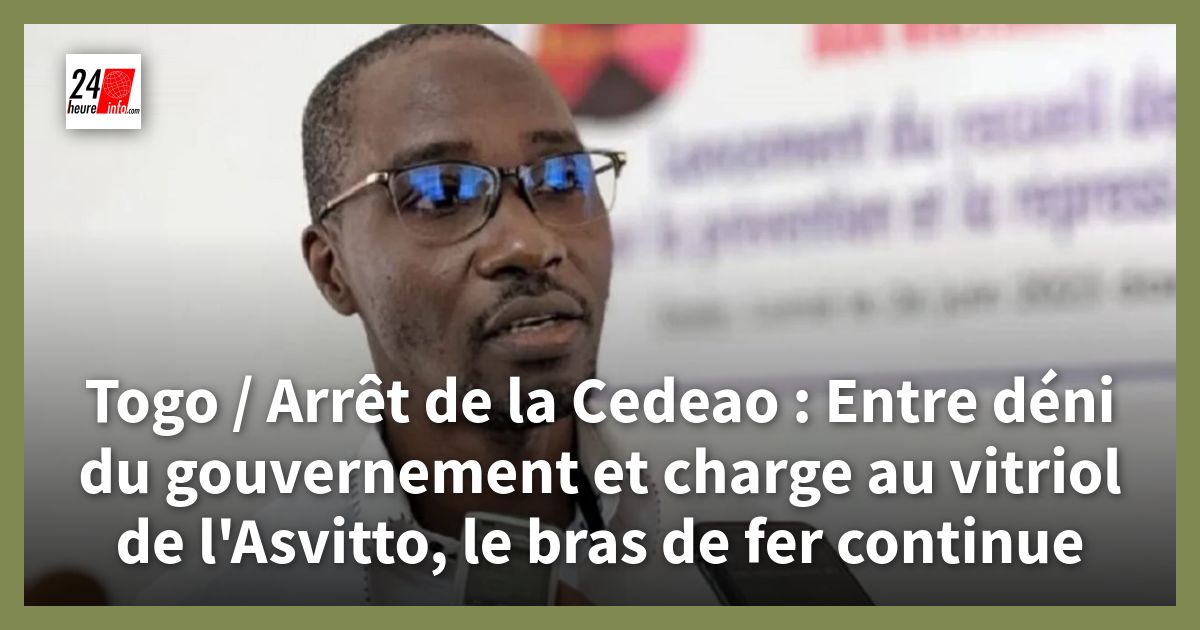
A significant controversy continues to unfold in Lomé following the ECOWAS Court of Justice ruling concerning Togo’s recent constitutional amendments. While the executive branch has legally dismissed the decision, the Association of Victims of Torture in Togo (ASVITTO) has escalated its criticism, condemning the situation as “state gangsterism.”
Lomé asserts court’s lack of jurisdiction
In response to the regional court’s judgment, the Togolese government swiftly presented its legal counter-argument. Authorities in Lomé contend that the ECOWAS Court of Justice possesses “no jurisdiction to review the constitutionality of domestic law, nor any authority to adjudicate a national constituent power.” This assertion aims to strip the ruling of any legal weight within Togo’s national framework.
ASVITTO’s retort: “a denial of the obvious”
This defensive stance has failed to sway civil society. The Association of Victims of Torture in Togo (ASVITTO) reacted sharply on its X (formerly Twitter) account, declaring that this maneuver “will not succeed.”
According to the organization, those behind what it terms a “constitutional coup d’état” are now consumed by “anxiety as they await their fate.” ASVITTO criticized this “attempted denial of the obvious,” drawing attention to a persistent pattern:
“It is a consistent fact that they are known for their attitude of disrespect and disregard for ECOWAS decisions.”
As evidence, ASVITTO points to the plight of political detainees who remain incarcerated in Lomé, despite numerous community court orders demanding their immediate release. This highlights a critical issue in African governance.
A direct appeal to ECOWAS against “state gangsterism”
The association has not ceased its criticism of the Togolese government, directly appealing to regional bodies. It urges ECOWAS to administer “effective therapy against the Togolese pathology” to ensure the enforcement of judgment n° ECW/CCJ/JUD/01/26.
Issued last January, this landmark ruling had already declared the 2024 constitutional reform to be in violation of the African Charter on Democracy, Elections, and Governance. The non-governmental organization’s assessment is unequivocal: “This form of state gangsterism in the sub-region must be brought to an end.” This remains a critical issue in African current affairs.
Political impasse and the detainees’ plight
Currently, the dialogue resembles a stalemate: on one side, a government invoking the regional court’s lack of competence; on the other, an association denouncing the government’s failure to uphold the nation’s international commitments.
Amidst this clash of arguments and social media exchanges, the ECOWAS decision remains unfulfilled, having been rendered but not implemented. This prolonged wait is especially burdensome for the incarcerated detainees who, far from the verbal disputes, hope for a more tangible resolution to their predicament.