Mariama Hamani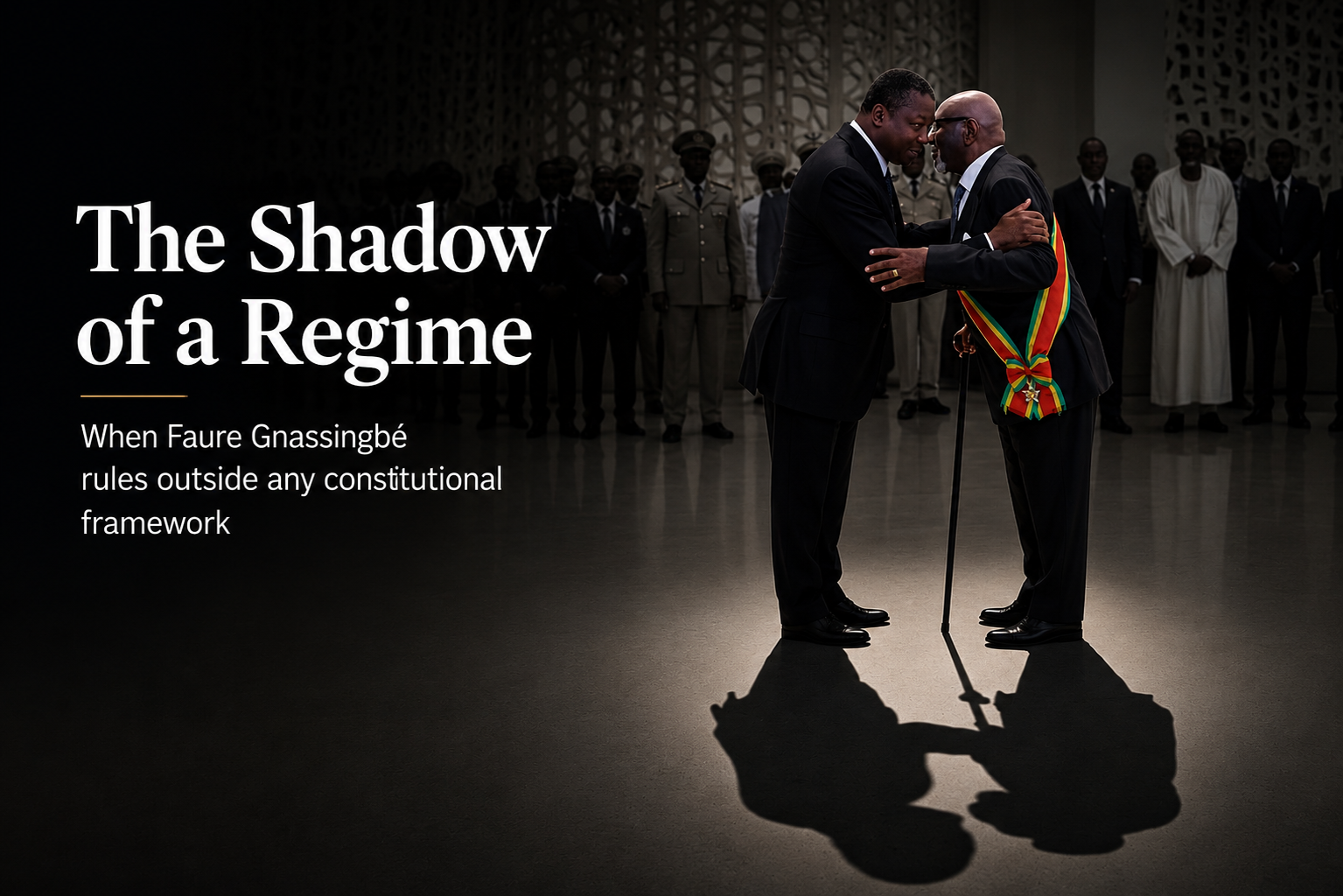
The arrest of two French nationals exposes Togo’s governance failings
An abrupt arrest in northern Togo has cast a glaring light on the country’s deteriorating governance standards.
Two French citizens, recently detained and subsequently charged days later, appear to have been ensnared under orders explicitly linked to Faure Gnassingbé. According to investigations, the President is said to have personally instructed Pacôme Adjourouvi, the Minister of Justice, to « refuse any external influence » regarding the case’s handling. Beyond the immediate diplomatic repercussions, this incident lays bare a far more troubling concern: the erosion of Togo’s governmental legitimacy.
A constitutional farce: rewriting the rules to retain power
Upon closer examination, Faure Gnassingbé no longer conforms to the traditional definition of a head of state. Through a series of legal stratagems, his administration engineered a new Constitution that stripped the presidency of its executive functions, replacing it with a largely ceremonial role. Meanwhile, a newly created position President of the Council was entrusted to Gnassingbé himself. This move mirrors a pattern of institutional « tinkering », where titles and responsibilities are rearranged not to serve democracy, but to consolidate personal authority.
The 2024 reform, railroaded by UNIR, the ruling party controlling 108 of 113 parliamentary seats, transformed the country from a presidential to a quasi-parliamentary system. The new framework eliminates term limits, effectively allowing Gnassingbé to remain in power indefinitely. No public referendum validated this seismic constitutional shift; instead, the process unfolded under a veil of political dominance, with opposition voices sidelined.
The illusion of power separation crumbles
Executive authority including defense command, civil and military appointments, international representation, and regulatory power was transferred to the President of the Council, a role now synonymous with Gnassingbé’s name. The judiciary, too, has been instrumentalized. Magistrates have reportedly received direct directives from the executive, rendering the principle of an independent judiciary obsolete. Sebastien Perez Pezzani and Gaël Mocaër, the two French journalists arrested while producing a documentary for France Télévisions, were not isolated victims. Their detainment follows a pattern of targeted repression, where legal tools are deployed selectively to silence dissent.
A legitimacy crisis and escalating instability
The lack of public consultation on constitutional changes has fueled widespread discontent. Legislative elections in 2024 were widely boycotted by opposition factions, while a third of the Senate’s members are appointed by Gnassingbé himself. This concentration of power under a new title does not disguise its true nature: an unchecked personal rule masquerading as institutional legitimacy.
When arbitrary decisions supersede constitutional law and justice becomes a political instrument, the foundations of governance collapse. Togo is no longer wrestling with a controversial constitutional reform it is grappling with a regime that governs outside any predictable or democratic framework. The central question is no longer who rules?, but how long can such a system persist amid rising internal tensions and public pressure?


 Boureima Amadou