
 Mariama Hamani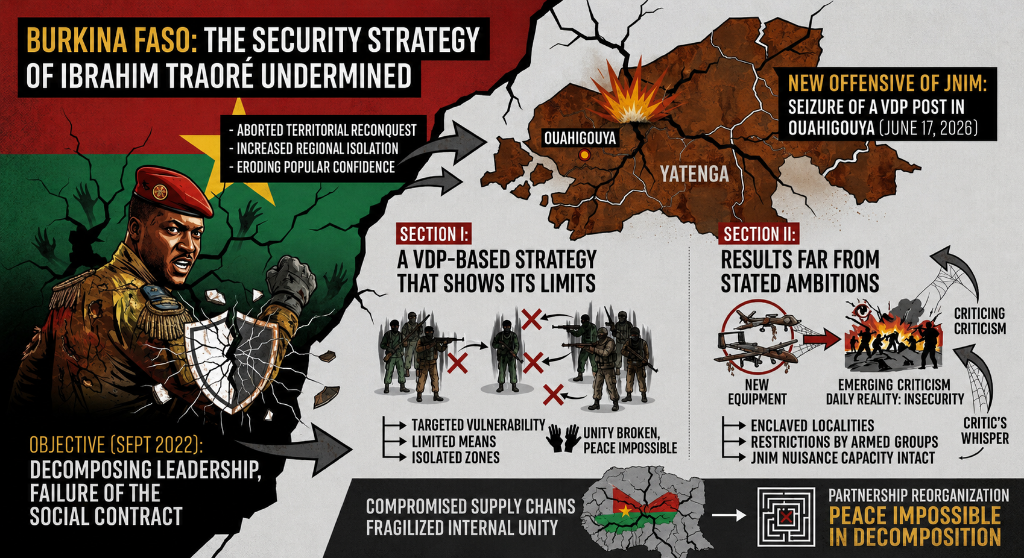
The escalating security crisis in Burkina Faso
The northern region of Burkina Faso has once again become the epicenter of a deepening security crisis. On June 17, 2026, the Group for the Support of Islam and Muslims (JNIM), an affiliate of Al-Qaïda in the Sahel, launched a significant offensive against a Volunteers for the Defense of the Homeland (VDP) outpost in Ouahigouya, the administrative hub of the Yatenga Province. The attack, which the JNIM claimed responsibility for, underscores the persistent vulnerabilities in the nation’s security framework.
Military strategy under scrutiny
Since assuming power in September 2022, Captain Ibrahim Traoré has championed a territorial recovery strategy centered on mobilizing civilian defense forces. However, the recent assault on Ouahigouya raises serious questions about the viability of this approach. The VDP, while providing critical support to regular military units, are often deployed in isolated and resource-scarce areas, rendering them highly susceptible to targeted strikes by armed factions.
Civilian defense forces face mounting challenges
The JNIM’s latest offensive is not an isolated incident but part of a broader pattern of setbacks for Burkina Faso’s security apparatus. In recent months, multiple military positions have proven difficult to secure, despite intensified operations. Analysts monitoring the Sahel region suggest that the JNIM continues to demonstrate remarkable operational mobility and disruptive capacity, particularly in the northern and eastern territories of the country.
Discrepancies between official narratives and ground realities
While government officials frequently highlight progress, including the acquisition of advanced surveillance and combat drones, the daily lives of civilians tell a different story. Numerous communities remain cut off from essential services, with some areas still under the de facto control of armed groups. This disconnect has fueled public skepticism regarding the effectiveness of current security policies.
The 2022 military takeover was justified, in part, by the failure of civilian leadership to protect populations from insurgent threats. Today, the resurgence of attacks in regions like Yatenga has reignited debates about whether the transitional government’s security strategy is adequately addressing the root causes of the conflict.
Regional alliances and future prospects
Burkina Faso is actively strengthening its partnerships within the Alliance of Sahel States (AES) and has announced plans to escalate military operations in 2026. Yet, the attack in Ouahigouya serves as a stark reminder of the challenges inherent in combating an asymmetric insurgency through military means alone. The evolving security landscape demands a more comprehensive approach that integrates both security and socio-economic measures to restore stability.

 theafricantribune
 Boureima Amadou




