
 Boureima Amadou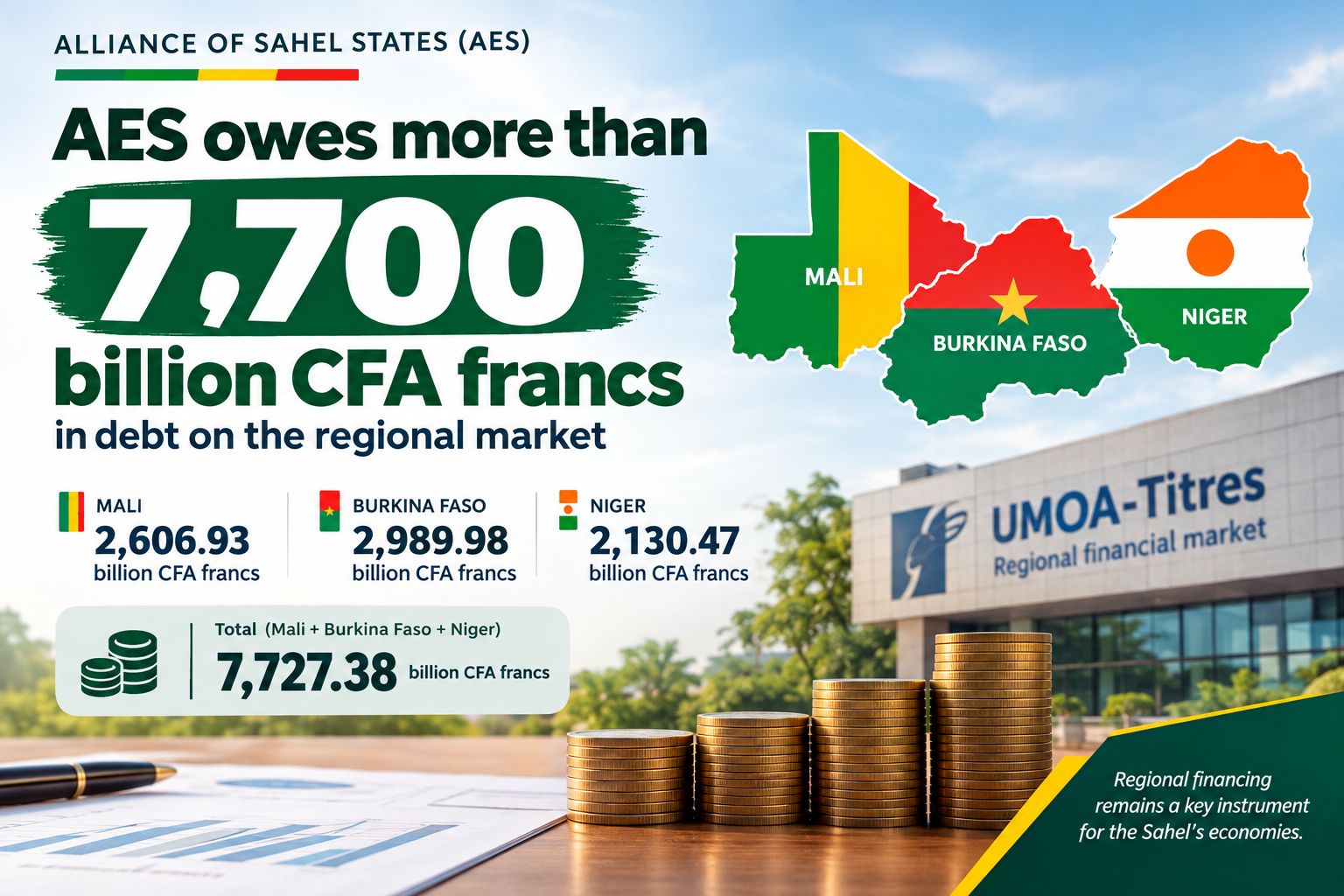
The three member states of the Alliance of Sahel States have not walked away from the regional bond market. The numbers suggest the opposite.
As of 31 July 2026, Mali, Burkina Faso and Niger had brought the combined stock of their outstanding public securities on the West African Monetary Union market to roughly 7,727.38 billion CFA francs — a total that sits uneasily beside a political narrative of financial independence resting on domestic resources alone.
The rhetoric is well rehearsed: sovereignty, a break with old dependencies, budgets financed from national wealth, and a rejection of mechanisms seen as imposed from outside. The market ledger tells a more complicated story.
A market channel that never really closed
One distinction matters from the outset. These amounts are not a debt owed to the monetary union as an institution. They represent securities still in circulation, held by investors who bought the treasury bills and bonds issued by the three governments.
UMOA-Titres, the body that organises the regional market, exists precisely to connect that pool of savings with the financing needs of states. Borrowing there has long been an ordinary way of funding national budgets across the zone — not an outside mechanism forced on anyone.
What the figures show is heavy and sustained use of that channel.
Burkina Faso: just under 3,000 billion outstanding
Burkina Faso’s stock stood at 2,989.98 billion CFA francs at the end of July 2026, equal to about 12.4% of the union-wide total of 24,073.53 billion CFA francs recorded on the same date.
The balance was still climbing, up 2.46% over a single month. Through the opening months of 2026, Ouagadougou kept raising money on the regional market while simultaneously paying down older paper. In May alone it issued 99.50 billion CFA francs in treasury bonds and redeemed 72.04 billion.
Regional financing, in short, did not disappear with the sovereignty speeches. It remains a working instrument for cash management and state funding.
Mali: repaying more than it raised in May
Mali’s outstanding stock reached 2,606.93 billion CFA francs at the end of July, roughly 10.8% of the regional total.
The pattern is not a one-off. By late May 2026, the Malian balance already stood at 2,637.64 billion CFA francs. During that month, Bamako raised 93.50 billion while redemptions came to 110.07 billion.
The country was therefore borrowing and repaying at the same time, in the ordinary logic of debt management. The relevant question is not whether Bamako borrows, but at what pace, at what cost and to fund which expenditures.
Niger: a 388 billion jump in a single month
Niger’s stock came to 2,130.47 billion CFA francs on 31 July 2026, about 8.9% of the union total.
The movement behind that figure is what draws attention. Between April and May 2026, the balance rose from 1,732.05 billion to 2,120.45 billion CFA francs — an increase of close to 388.4 billion in one month.
Large financing and debt reprofiling operations explain the surge. In May 2026, the country raised 567.49 billion CFA francs, including 519.51 billion in treasury bonds and 47.97 billion in bills, while repaying 191.31 billion.
A few days earlier, a broader operation had handled 446.386 billion CFA francs in securities, among them about 59.710 billion of short-term paper bought back to ease immediate pressure on the treasury. Net resources released were estimated at around 327 billion CFA francs.
One third of the regional market
Add the three balances together — 2,989.98 plus 2,606.93 plus 2,130.47 — and the result is 7,727.38 billion CFA francs of public securities from the alliance’s members still circulating on the regional market.
For scale, all the states of the monetary union together carried 24,073.53 billion CFA francs in outstanding securities at that date. The three Sahel countries alone accounted for about 32.1% of the whole.
Investors outside the alliance are stepping back
The paradox has sharpened since Burkina Faso, Mali and Niger withdrew from ECOWAS. Politically, the three have promised an autonomous path. Financially, they continue to draw on the union’s regional market, which rests largely on banks and investors from across West Africa.
By late 2025, the exposure of investors from other union states to alliance debt had narrowed. Their holdings fell from 3,174 billion to 2,801 billion CFA francs, a decline of 373 billion between the fourth quarter of 2024 and the third quarter of 2025. Over the same period, cross-holdings of securities among the three alliance members dropped by 622 billion CFA francs, to around 3,160 billion.
That trend deserves watching. When investors turn cautious, financing becomes more expensive and harder to secure.
The metrics that matter more than the total
A large outstanding balance is not automatically a problem, just as the headline number alone cannot settle the question of sustainability. Other variables carry at least as much weight:
- interest rates;
- maturities;
- the annual volume of redemptions;
- the capacity to raise tax revenue;
- economic growth;
- the share of spending absorbed by security needs;
- the ability to roll over maturing debt.
That is where the risk sits. A state can manage a heavy balance comfortably if its revenues are strong and growth solid. Another can run into serious difficulty with a smaller debt if a large slice of its paper matures at once, or if interest rates climb too high.
Gross issuance versus genuinely new money
Niger’s case illustrates the mechanism clearly. In May 2026, the country raised 567.49 billion CFA francs while redeeming 191.31 billion. A separate operation covered 446.386 billion CFA francs, part of it used to buy back securities approaching maturity.
Some of the resources raised were therefore not fresh money available for projects. They refinanced debt that already existed. That is routine practice on bond markets, but it needs stating plainly: raising several hundred billion francs does not mean the entire sum is added to what a state can spend on development.
Why every announcement needs seven questions
When a government announces an issue of 500 billion CFA francs, several questions follow naturally. How much of it is genuinely new? How much covers old securities? What interest rate applies? What is the duration? What will the total bill be for the taxpayer?
Niger’s May 2026 operation shows why the distinction is indispensable: 446.386 billion CFA francs handled on a gross basis, against roughly 327 billion in net resources. The gap is not an accounting footnote. It changes how the figure should be read politically.
Bottom line: autonomy rhetoric does not erase liabilities
The debate over the alliance should not be reduced to sovereignty versus dependence. The figures describe something messier than either camp acknowledges.
On 31 July 2026, Burkina Faso, Mali and Niger carried 7,727.38 billion CFA francs of outstanding public securities on the regional market. This is not a debt owed to the monetary union as an organisation. It is owed to the investors who subscribed to the securities those states issued.
The conclusion nonetheless stands. Three countries that claim greater financial autonomy continue to lean heavily on regional bond financing to cover their needs.
The question is no longer whether the alliance borrows. It is how far its members can keep borrowing before the price of that financial sovereignty lands, heavily, on their future budgets.








