Boureima Amadou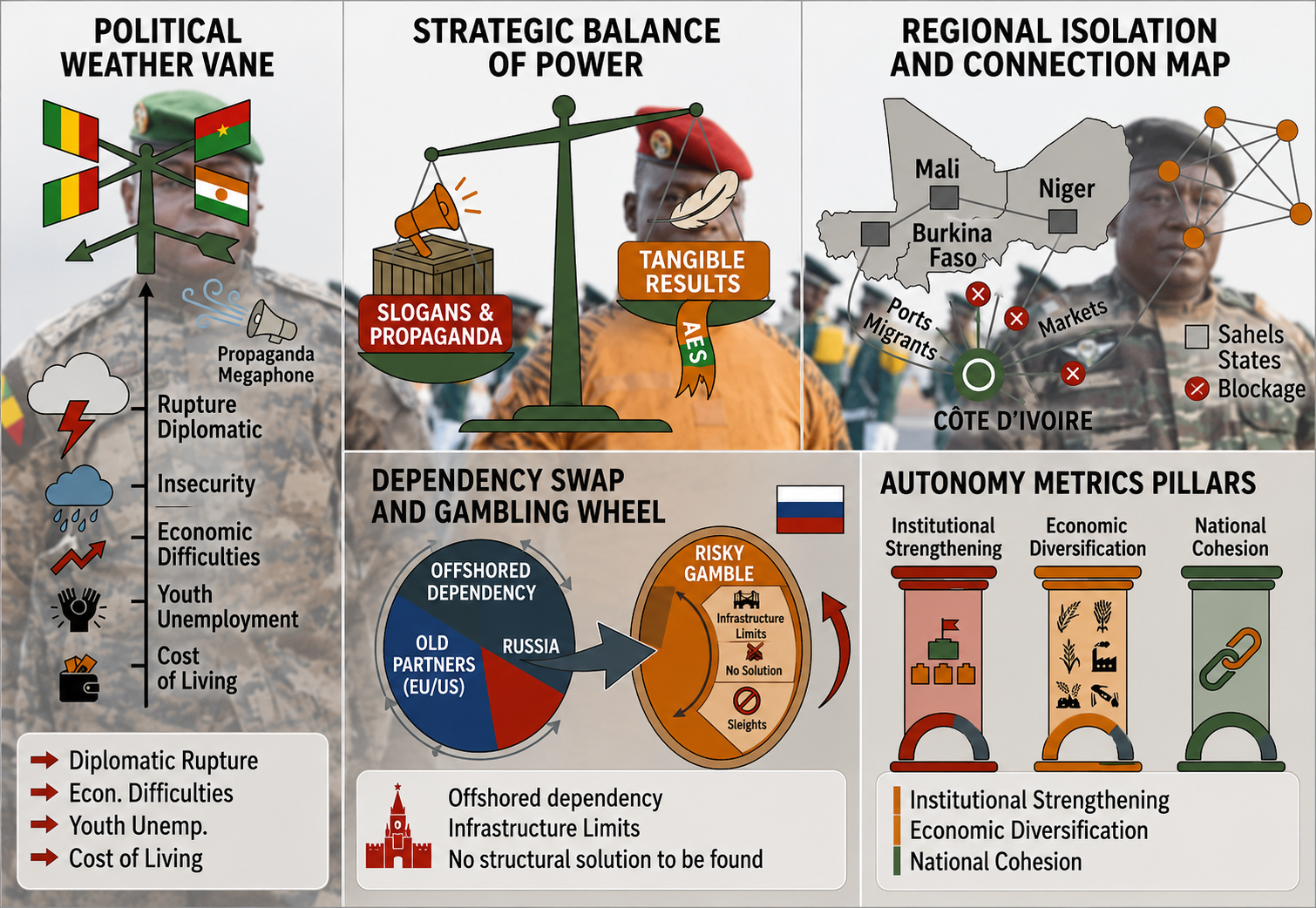
Three years after military takeovers in Mali, Burkina Faso, and Niger, the Alliance of Sahel States (AES) finds itself at a crossroads. While its leaders have built their legitimacy on a radical break with regional conventions and a rejection of traditional partners, the realities on the ground tell a different story. Persistent insecurity, economic strain, and unmet public expectations continue to define the Sahel’s landscape.
Sovereignty as political currency
The AES’s sovereignist narrative has resonated deeply with segments of the Sahelian public. After years of frustration over unrelenting violence and perceived failures in international cooperation, the idea of reclaiming full control over diplomatic and military decisions gained traction. Yet sovereignty extends far beyond rejecting agreements or swapping allies—it demands tangible outcomes: security, economic growth, public services, and improved living standards.
On these fronts, the challenges remain daunting. Despite bold declarations, concrete progress has been elusive, leaving populations skeptical about the alliance’s ability to deliver.
The scapegoating strategy and its limits
When governments struggle to deliver visible results, political messaging often shifts toward external enemies. In the case of the AES, neighboring states and regional bodies frequently bear the brunt of criticism, with Côte d’Ivoire singled out as a hostile actor or a proxy for foreign interests.
This approach offers short-term political dividends by uniting citizens against a common foe. However, it carries significant drawbacks:
- It diverts attention from pressing domestic issues such as unemployment, rising living costs, education gaps, and crumbling infrastructure.
- It risks inflaming unnecessary diplomatic tensions, undermining economic ties that bind Sahelian nations.
- It risks stifling internal debate by equating criticism with disloyalty to the state.
Côte d’Ivoire’s steadfast diplomacy amid regional tensions
Amid escalating rhetoric from AES leaders, Côte d’Ivoire has maintained a consistent stance rooted in dialogue and stability. This policy reflects a long-standing tradition inspired by the legacy of Félix Houphouët-Boigny, emphasizing mediation, economic cooperation, and consensus-building.
Despite occasional verbal attacks, Abidjan has avoided escalation, a choice driven by both diplomatic prudence and economic pragmatism. Côte d’Ivoire serves as a vital commercial hub for Sahelian states, with its port facilitating imports and exports for landlocked neighbors. Trade flows, private investment, and human mobility create a web of interdependence that political posturing cannot easily unravel.
Millions of Malian, Burkinabe, and Nigerien citizens live, work, or do business in Côte d’Ivoire. A sustained deterioration in bilateral relations would inflict human and economic costs far outweighing the fleeting gains of political confrontation.
The hidden costs of diplomatic confrontation
The strategy of confrontation carries an economic price often overlooked in political debates. Regional tensions can deter investment, disrupt trade, inflate logistics costs, and weaken a country’s appeal to foreign investors. In economies already strained by insecurity, repeated diplomatic crises exacerbate funding challenges, slow job creation, and hinder growth.
Uncertainty remains a top concern for businesses operating in volatile environments.
New alliances: a gamble without guarantees
Another pillar of the AES strategy involves diversifying international partnerships, particularly through closer ties with Russia. While sovereign states have the right to seek new alliances, such moves do not automatically translate into economic or security benefits.
History shows that no external partner can single-handedly resolve structural issues like weak institutions, lack of productive investment, rural poverty, or territorial governance failures. The risk lies in replacing one dependency with another without addressing root causes.
True strategic autonomy requires action, not just rhetoric
The AES’s leaders have placed heavy emphasis on sovereignty-themed messaging, portraying resistance and national recovery. While such narratives can bolster patriotism, they cannot substitute for concrete results. Citizens ultimately judge their governments by measurable outcomes:
- Sustained improvements in security.
- Lower living costs.
- Job opportunities for youth.
- Functional schools and healthcare facilities.
- Modern infrastructure.
- Inclusive economic growth.
Long-term credibility will hinge on these benchmarks, not on slogans or propaganda campaigns.
West Africa needs cooperation, not division
The Sahel’s most pressing challenges—terrorism, transnational crime, climate change, food insecurity, and economic development—transcend national borders. No single state can tackle them alone. Regional cooperation remains indispensable, whether through existing organizations or innovative partnerships.
Treating neighbors like Côte d’Ivoire as perpetual adversaries only weakens a region already grappling with multiple crises.
Conclusion: From rupture to results
The AES emerged from a rejection of what its leaders deemed an ineffective model. That sentiment reflects real frustrations among the public. Yet rupture alone does not constitute policy.
The alliance’s future legitimacy will be measured not by anti-Western rhetoric but by its ability to enhance security, revive economies, uphold public freedoms, and foster regional dialogue. The Sahel’s fate depends less on assigning blame to outsiders and more on producing tangible results, restoring citizen trust, and transforming dialogue into a tool for stability rather than perpetual confrontation.