
 Mariama Hamani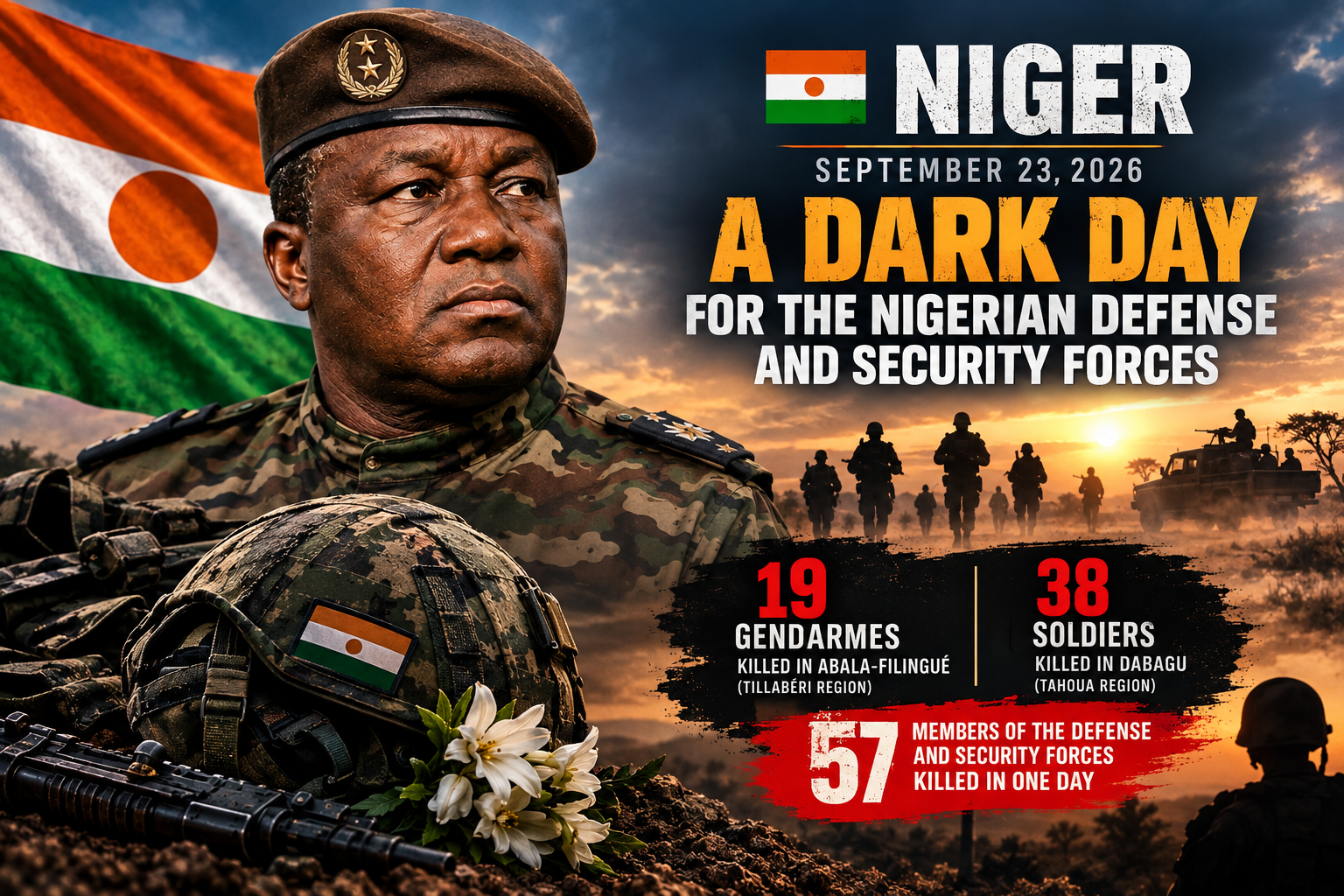
The attacks of September 23, 2026, have left deep scars on Niger’s security landscape. Within a matter of hours, the country’s defence and security forces suffered severe losses in two separate incidents, underscoring the persistent threat posed by armed groups across multiple regions. Beyond the immediate human toll, the events of that day carry far-reaching consequences for the nation’s stability, its economy, and the families of those who serve on the front lines.
Two attacks, one devastating day
In the Tillabéri region, near the Abala-Filingué area, 19 gendarmes were reportedly killed. On the same day, at least 38 soldiers of the Nigerien Armed Forces lost their lives in an assault on a military position in Dabagu, located in the Konni department of the Tahoua region. Several other soldiers are still missing following the second attack. These figures have yet to be officially confirmed by Nigerien authorities.
The human cost: 57 families in mourning
With a provisional toll of 57 members of the defence and security forces killed in a single day, the human impact is staggering. Behind each number is a family shattered by loss. The emotional and economic burden on these households often left without a primary provider adds a painful social dimension to an already grave security crisis. The absence of an official consolidated figure only deepens the uncertainty for the affected families and communities.
Official statements and the fog of war
The Nigerien Ministry of Defence confirmed that its forces, engaged in intercepting a stolen cattle convoy on the morning of September 23, encountered a large column of armed men on motorcycles near Abala. The ministry acknowledged human and material losses but refrained from providing precise numbers. This gap between official accounts and information from local and security sources raises critical questions: How many soldiers and gendarmes were actually killed? How many were wounded or remain missing? What equipment was lost?
A persistent pattern of vulnerability
The attacks expose a troubling reality: units deployed in exposed areas continue to suffer heavy losses despite repeated claims by the Tiani government of enhanced military capabilities. The assailants, mobile and well-organised, demonstrate the ability to concentrate fighters against isolated positions and withdraw before reinforcements arrive. In such conditions, intelligence, mobility, aerial surveillance, communication systems, and the equipment of forward units become decisive factors.
Strategic and political implications
The events of September 23 also raise a broader question about the effectiveness of the security strategy pursued since the CNSP took power in July 2023. Security has been presented as a top priority, yet repeated attacks on defence forces indicate that certain areas particularly Tillabéri remain highly vulnerable. The regime’s emphasis on military mobilisation and announced operations must be weighed against actual results on the ground, especially when dozens of personnel are killed in a single day.
The broader fallout for Niger
Beyond the immediate security concerns, the attacks have ripple effects on the nation’s economy and public confidence. Frequent attacks disrupt economic activity in affected regions, deter investment, and strain already limited state resources. The loss of 57 security personnel in one day not only weakens operational capacity but also erodes public trust in the government’s ability to protect its citizens and its own forces.
Unanswered questions and a call for accountability
After more than three years of CNSP rule, the persistence of such deadly attacks compels a thorough examination of intelligence failures, the protection of forward positions, the equipment of engaged units, and the overall strategy against armed groups. The Tiani government cannot simply highlight mobilised resources and announced operations; it must also account for the results achieved on the ground. When dozens of soldiers and gendarmes fall in a single day, the question is no longer only how many enemies were neutralised, but why so many defenders continue to pay the ultimate price and why, after years of promises, certain areas remain as vulnerable as ever.
By Mariama Hamani — Analyst


 Boureima Amadou





