Mariama Hamani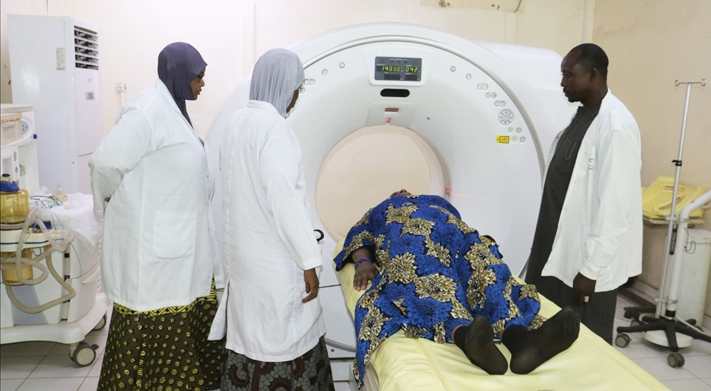
Niger’s healthcare revolution: fewer medical evacuations abroad
Niger is undergoing a profound transformation in its healthcare system, shifting from reliance on costly medical evacuations abroad to building local capacity. Under the leadership of the Minister of Public Health and Hygiene, Colonel-Major Garba Hakimi, the country is investing in cutting-edge medical technology and expanding specialized care to reduce the need for overseas treatment.
Local treatment for complex conditions
The expansion of Niger’s technical infrastructure marks a turning point in healthcare delivery. Recent acquisitions include high-end medical equipment such as 64-slice CT scanners, MRI machines, and linear accelerators for radiotherapy. These tools are now enabling local treatment of conditions that previously required evacuation, including cancer care.
With all three pillars of cancer treatment—surgery, chemotherapy, and radiotherapy—now available in-country, patients no longer face the financial and logistical barriers of foreign care. Cardiovascular surgery has also been introduced locally at significantly lower costs than abroad, making advanced treatment accessible to more Nigeriens.
A shift with social and economic impact
The push toward self-sufficiency in healthcare is driven by more than medical necessity—it is reshaping the country’s social and economic landscape. By reducing dependence on foreign medical care, Niger is cutting down on high evacuation expenses, easing the financial burden on families, and strengthening its medical sovereignty. This transition is also fostering the development of national expertise and improving access to specialized care for all citizens.
Is the end of medical evacuations in sight?
While some highly specialized cases may still require treatment abroad, Niger’s trajectory is clear: the country is steadily building the capacity to care for patients domestically. Through strategic investments in infrastructure and human resources, Niger is not just treating more patients locally—it is redefining its healthcare future.

 Boureima Amadou