Mariama Hamani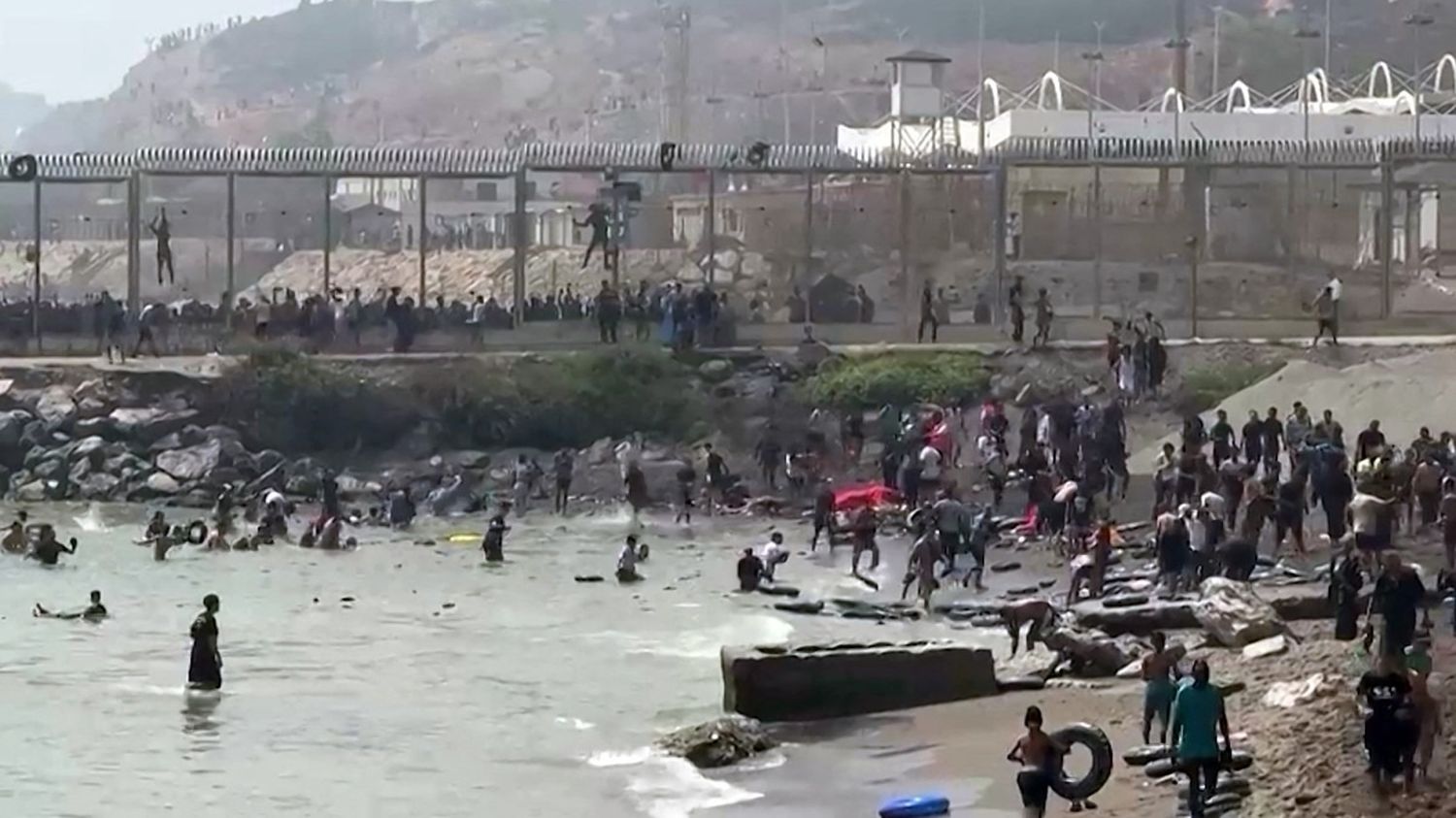
Massive migration wave at Ceuta sparks political tensions between Spain and Morocco
In just 24 hours, nearly 60,000 undocumented migrants crossed into the Spanish enclave of Ceuta, a 20 km² territory bordering Morocco with a population of 85,000. Officials in Madrid are questioning whether Rabat is using this influx as a form of political leverage amid growing diplomatic strain.
Tens of thousands of Moroccan nationals, including families and individuals with reduced mobility, swarmed into Ceuta on Thursday, marking one of the most severe migration crises in the region over the past five years. While Moroccan police had restricted road access, migrants bypassed checkpoints by scaling hills or swimming across the border waters, creating chaos at the frontier with Castilejos – known locally as Fnideq.
The Spanish government has insisted that bilateral relations remain strong, with officials from the Foreign Ministry describing the current cooperation agreement with Morocco as “excellent” and highlighting “intensive” joint efforts to manage the situation. After an initial period of silence, Moroccan authorities confirmed the incident and announced a coordinated plan with Spain to repatriate those who entered Ceuta illegally.
Legal ruling cited as migration tool by traffickers
Uncertainty surrounds the exact causes of this unprecedented movement. Spain’s Interior Ministry attributes the surge to human trafficking networks that allegedly exploit a recent court ruling to facilitate undocumented border crossings. The Supreme Court decision guarantees legal assistance and individual case reviews for all individuals entering Spanish territory, regardless of their entry method.
Ruth Ferrero, a political science professor and researcher at the Complutense Institute of International Studies (ICEI), clarifies that the interpretation of this ruling is misleading. She emphasizes that while the decision upholds international asylum law, it does not imply an “open-door policy” or prevent repatriations to Morocco. Ferrero cautions against blaming the legal framework for the crisis, noting that traffickers likely exploited the situation to promote irregular migration.
Echoes of 2021: A pattern of pressure?
This is not the first time Morocco has responded to diplomatic tensions with Spain by allowing a sudden influx of migrants. In May 2021, nearly 9,000 people crossed into Ceuta in apparent retaliation after Spain hosted Brahim Ghali, leader of the Polisario Front, for COVID-19 treatment. The move was condemned by Moroccan authorities as “deplorable.” Later investigations revealed rumors circulating among sub-Saharan migrant communities that Moroccan security forces had lifted coastal restrictions on that day.
Haizam Amirah Fernández, executive director of the Center for Contemporary Arab Studies (CEARC), points to a “pattern” in these mass entries. He argues that Moroccan authorities often use human mobility as a diplomatic bargaining chip, particularly when their expectations with Madrid remain unmet. However, Ferrero urges caution, stating that not all migration pressure should be interpreted as a deliberate political strategy. She highlights the role of misinformation networks and trafficking gangs in fueling the crisis, adding that current evidence does not conclusively support a coordinated political motive from Rabat.
Police sources from Spain’s EFE agency reported that Moroccan authorities attempted to halt the movement by conducting random checks on public transport and roads. The overwhelming response, however, overwhelmed local security forces, leading to the unprecedented border breach.
A week after Sanchez’s visit to Algeria
The surge into Ceuta occurred just seven days after Spanish Prime Minister Pedro Sánchez’s visit to Algeria, a trip that marked “a new phase” in relations between Spain and the Maghreb nation. During the meeting with Algerian President Abdelmadjid Tebboune and Prime Minister Sifi Ghrieb, discussions focused heavily on gas supply—a critical issue amid Middle Eastern conflicts and the blockade of the Strait of Hormuz.
“I cannot confirm this as a determining factor,” Amirah Fernández admits, “but the timing is striking.” He adds that the historical rivalry between Morocco and Algeria often shapes Spain’s diplomatic engagements in the region. “The current phase is among the worst in decades,” he notes, suggesting that Sánchez’s outreach to Algiers may have been perceived negatively in Rabat. “For Morocco, Spain’s improving ties with Algeria are seen as detrimental to its own interests.”
Amirah Fernández describes the dynamic as a zero-sum game, where Morocco interprets Spain’s engagement with either neighbor as a direct challenge to its position. Ferrero, however, emphasizes that Rabat’s influence stems from Europe’s reliance on external partners for migration control. “This is not a deliberate strategy by Morocco,” she argues, “but rather a consequence of Spain’s security-focused policy that outsources migration management to third countries.”
The unresolved question of Western Sahara
This migration crisis follows years of diplomatic friction between Spain and Morocco, rooted in the unresolved status of Western Sahara. In December 2020, Rabat suspended high-level meetings with Madrid after then-U.S. President Donald Trump recognized Moroccan sovereignty over Western Sahara in exchange for normalizing relations with Israel. A few months later, Spain hosted Brahim Ghali, sparking a border incident that resulted in two fatalities.
“The Spain-Morocco relationship is inherently complex,” Amirah Fernández observes. He describes Morocco’s approach as assertive, with decision-making concentrated among a small group of leaders who favor forceful actions. Since gaining independence in 1956, the two nations have clashed over Western Sahara—a former Spanish colony that Morocco invaded in 1975. Spain relinquished administrative control the following year, leaving 80% of the territory under Moroccan occupation and the remainder under the control of the Polisario Front, founded in 1973 as a Sahrawi liberation movement.
Trump’s 2020 recognition of Moroccan sovereignty over Western Sahara marked a turning point, reigniting tensions and catalyzing the 2021 Ceuta crisis. The situation escalated further in 2022 when Sánchez sent a letter to King Mohammed VI, seemingly endorsing Morocco’s autonomy proposal for Western Sahara—a significant departure from Spain’s historical neutral stance. “This was not a legal recognition of Moroccan sovereignty,” Amirah Fernández clarifies, “but it represented Spain’s first explicit preference for a solution that aligns with Rabat’s position.”
The role of social media in fueling migration
Beyond any potential political motives, social media has played a pivotal role in this crisis. A study by the North African Human Rights Observatory found that 81% of young people surveyed in Tangier, Tetouan, and Al Hoceima believe content on migration portrays irregular migration as a viable solution for improving living conditions. The survey revealed that 78.4% of respondents easily find posts promoting irregular migration, while 74.2% follow pages that provide information or facilitate such journeys.

 Boureima Amadou