Mariama Hamani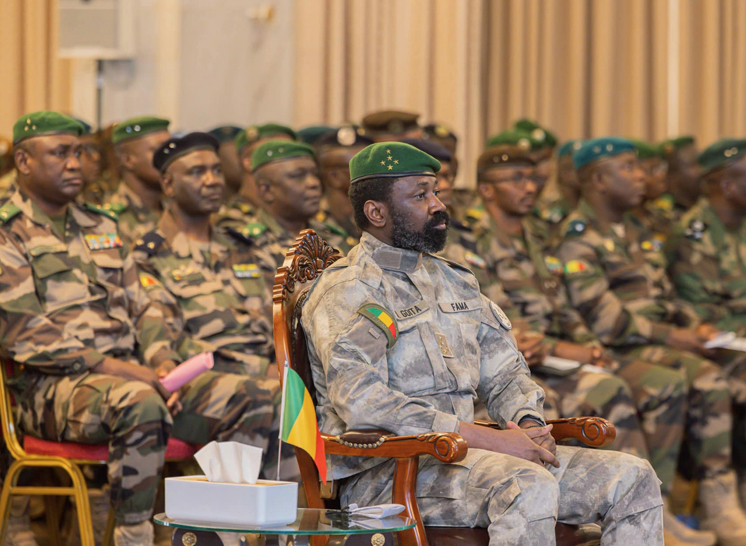
Twenty-two years after its initial Defense law, Mali is set to roll out a groundbreaking reform expanding its security framework to include internal security, cyber defense, and comprehensive crisis management. The National Transitional Council (NTC) has endorsed the new legislation, which redefines strategic decision-making, operational command, and the roles of territorial actors once the text is officially enacted and published.
The Minister of Security and Civil Protection, General Daoud Aly Mohammedine, addressed the NTC members, emphasizing the necessity of this overhaul due to two decades of evolving security challenges. He highlighted that security stakeholders were actively involved in the preparatory stages to ensure an inclusive approach to the reform.
From 2004 framework to 2026 adaptation
The 2004 law, while comprehensive in its time, primarily focused on military structures but already included provisions for internal security, civil defense, and the participation of local governments, civil society, and communities. Under the previous framework, the Chief of the General Staff of the Armed Forces led military operations and, in cases of operational territorial defense, held authority over certain security forces.
Enhancing security with modern components
Rather than introducing entirely new responsibilities, the reform aims to consolidate, clarify, and adapt existing ones to meet today’s threats. Internal security and cyber defense are now explicitly recognized as critical components of national security. The National Security Council and the National Defense Committee replace older structures like the Higher Defense Council and the former Defense Committee to strengthen centralized decision-making under the President’s leadership.
The reform also reinforces the concept of a unified operational command centered around the Chief of the General Staff of the Armed Forces. This ensures faster responses when multiple forces must coordinate against attacks, major crises, or cross-border threats. However, it does not permanently place the National Police, Gendarmerie, National Guard, or Civil Protection under military command.
The updated framework incorporates changes that have taken place since 2022, including the militarization of the National Police and Civil Protection. This shift facilitates their integration into a more cohesive security apparatus while preserving their core missions in public safety and emergency response.
Strengthening territorial governance and community involvement
General Daoud Aly Mohammedine underscored three priorities during the NTC session: bolstering territorial administration, engaging traditional authorities in counter-terrorism efforts, and continuing to recruit and equip forces. These goals align with the expanded role assigned to the Ministry of Territorial Administration and Decentralization, which now oversees civil defense, coordinates decentralized services, involves local governments, and mobilizes communities. The aim is to create an efficient system where alerts flow seamlessly from local communes without turning citizens into auxiliary forces.
Cybersecurity and operational integration
The expansion into cyber defense is accompanied by a separate reform initiative. In June, the government formalized the creation of the National Agency for Information Systems Security (ANSSI), as outlined in the 2026-2030 National Cybersecurity Strategy. This agency is tasked with coordinating responses to cyberattacks and safeguarding critical infrastructure and services. Cyber defense is positioned as a strategic state priority, while cybersecurity extends protection to all administrations, networks, and electronic communications.
Additionally, the Disarmament, Demobilization, and Reintegration Initiative (DDR-I) serves as a real-world test of inter-agency coordination. On August 4, 254 recruits from various armed groups completed training in Soufouroulaye and officially joined the Armed Forces. The program aims to integrate 2,000 former combatants while providing socio-economic support to 1,000 others. Though not legally tied to the new law, this initiative compels the Defense, Security, Reconciliation, and local authorities to collaborate closely.
Implementation and coordination: the keys to success
The true test of this reform will lie in its execution. Critical factors include the development of application texts, intelligence-sharing protocols, the capacity of local governments, cyber expertise, follow-up of integrated personnel, and clearly defined responsibilities. The reform establishes a chain of command where effectiveness will be measured by the speed of decision-making, on-ground coordination, and trust among institutions, security forces, and the public.


 Boureima Amadou