Boureima Amadou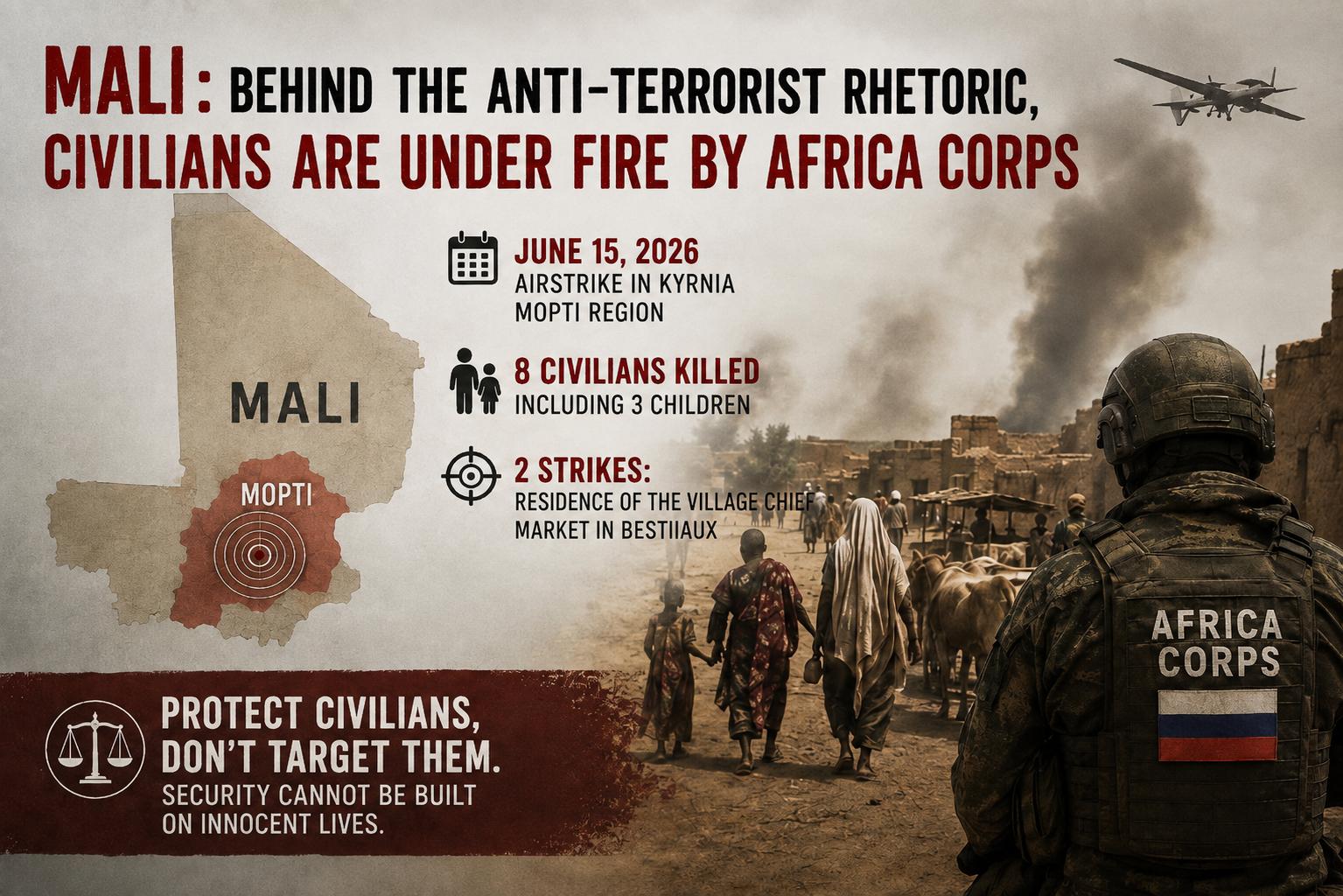
A recent and deeply concerning report from Human Rights Watch (HRW) directly attributes an aerial strike in central Mali, specifically within the Mopti region on June 15, 2026, to Russian forces operating under the Africa Corps banner. This incident is alleged to have resulted in the deaths of eight civilians, including three children. HRW’s investigation suggests that the collected evidence points to this attack as appearing unlawful.
The incident centered on the village of Kyrnia, where two munitions sequentially impacted the vicinity of the village chief’s residence, followed by a small livestock market. According to HRW’s findings, all identified victims were civilians, with no Islamist combatants among those killed. The organization states it conducted interviews with 19 individuals, analyzed satellite imagery, reviewed a video released by Africa Corps, and examined photographs related to the strikes.
This situation compels a critical inquiry: In the context of a conflict against armed groups, what are the permissible limits of counter-terrorism efforts when the very civilian populations meant to be protected become casualties of these operations?
A security approach at an impasse
This tragic occurrence underscores the potential pitfalls inherent in the military doctrine championed by the administration of Assimi Goïta. By deepening its military alliance with Russia and relying on Africa Corps, which superseded the Wagner contingent in Mali, the junta has opted for a security partnership whose efficacy must now be evaluated not solely through the lens of military achievements, but also by its tangible protection of civilians. Africa Corps operates under the direct command of the Russian government.
- Systematic conflation: In numerous rural areas, the close proximity between civilian populations and armed groups renders any inadequately informed operation particularly perilous. HRW reiterates that certain communities, notably the Fulani, have previously faced accusations of collaborating with Islamist groups and have subsequently endured abuses during counter-insurgency campaigns.
- Intelligence and target identification: The Kyrnia incident raises profound questions regarding the quality of intelligence preceding the strike. HRW indicates that witnesses observed a drone surveying the village on the eve of the attack and that combatants from JNIM were indeed present in the locality. However, the presumed presence of combatants does not absolve engaged forces of their duty to differentiate between military and civilian targets and to implement all feasible precautions to avert civilian casualties.
- Disproportion between military objective and human cost: The mere presence of members of an armed group within a locality does not automatically convert the entire area into a military objective. In Kyrnia’s case, HRW reports that the strikes notably impacted the village chief’s home and a livestock market, leading to eight civilian fatalities. This scenario directly challenges the proportionality and the precautionary measures undertaken during the operation.
- Military communication contradicted by evidence: Africa Corps had characterized the operation as a successful strike against a “gathering point for terrorist groups” and asserted the elimination of several commanders. Yet, HRW’s investigation maintains that the identified victims were civilians. This disparity between official statements and observed outcomes on the ground necessitates an independent clarification.
- Security not solely measured by strike numbers: An increase in military operations does not inherently equate to a security victory. An effective strategy must also encompass preventing armed groups from recruiting, safeguarding populations, preserving community trust, and ensuring victims receive justice.
- The risk of exacerbating the cycle of violence: When a population perceives itself as unjustly targeted, anger, fear, and distrust towards security forces can intensify. In an environment already marked by communal tensions, such abuses risk deepening social divisions that armed groups can subsequently exploit.
- Responsibility extending beyond direct executors: The issue transcends merely the military personnel on the ground. When an operation is conducted by allied or partner forces, the authorities that authorize and facilitate their presence are equally obligated to guarantee adherence to international humanitarian law. HRW specifically emphasizes that the Malian government could be held accountable for atrocities committed by its allied forces if it fails to implement necessary corrective actions.
A population left vulnerable
While authorities pledged the restoration of sovereignty and the return of peace, the reality on the ground remains profoundly troubling for residents of the Mopti region. Civilian populations find themselves caught between multiple threats: assaults from Islamist armed groups, operations conducted by government forces, and violence attributed to allied forces.
HRW additionally highlights that abuses are not confined to a single faction. Armed Islamist groups have also perpetrated grave violations against civilians. However, the fact that the forces tasked with combating these groups are themselves accused of abuses presents a significant dilemma: those entrusted with protecting the populace must adhere to exceptionally stringent requirements concerning civilian protection.
The situation in Mopti thus illustrates a profound paradox. The struggle against terrorism may be legitimate and essential, but it loses much of its meaning when the methods employed generate new civilian casualties, erode community trust, and are not accompanied by a credible accountability mechanism.
Impunity as a secondary threat
One of the most pressing concerns remains the issue of justice. Human Rights Watch asserts it has documented numerous abuses committed by Malian forces, their Russian allies, and various armed groups, while noting extremely limited access to justice for victims. The organization also condemns the insufficient prosecution of those responsible for serious violations.
This absence of accountability can foster a dangerous perception of impunity. When victims are unable to secure independent investigations, reparations, or sanctions against perpetrators, populations may progressively lose faith in the institutions responsible for ensuring their security.
Sovereignty, therefore, should not be synonymous with a lack of oversight. On the contrary, it should reinforce the state’s responsibility towards its own citizens. The choice of foreign military partners cannot absolve national authorities of their duty to protect populations and to investigate violations committed within their territory.
A strategy requiring reassessment
The Kyrnia incident should thus compel Malian authorities to re-evaluate the methodologies employed in counter-insurgency operations. The fight against JNIM and other armed groups cannot solely rely on firepower.
It also necessitates dependable intelligence, rigorous target identification, enhanced precautions around inhabited areas, the protection of communities, and, crucially, independent investigations whenever civilians are killed.
For behind military statistics lie families. In Kyrnia, eight individuals lost their lives, according to HRW, including three children. For their loved ones, this was neither a successful operation nor a mere targeting error; these were human lives tragically cut short.
The fundamental question now facing Mali is therefore less about the sheer number of operations conducted than about their capacity to sustainably restore security without sacrificing the very populations they purport to protect.
This analysis offers a detailed examination of Human Rights Watch’s findings concerning Africa Corps’ actions in central Mali, highlighting persistent questions regarding civilian protection, the conduct of military operations, and the accountability of authorities.