Boureima Amadou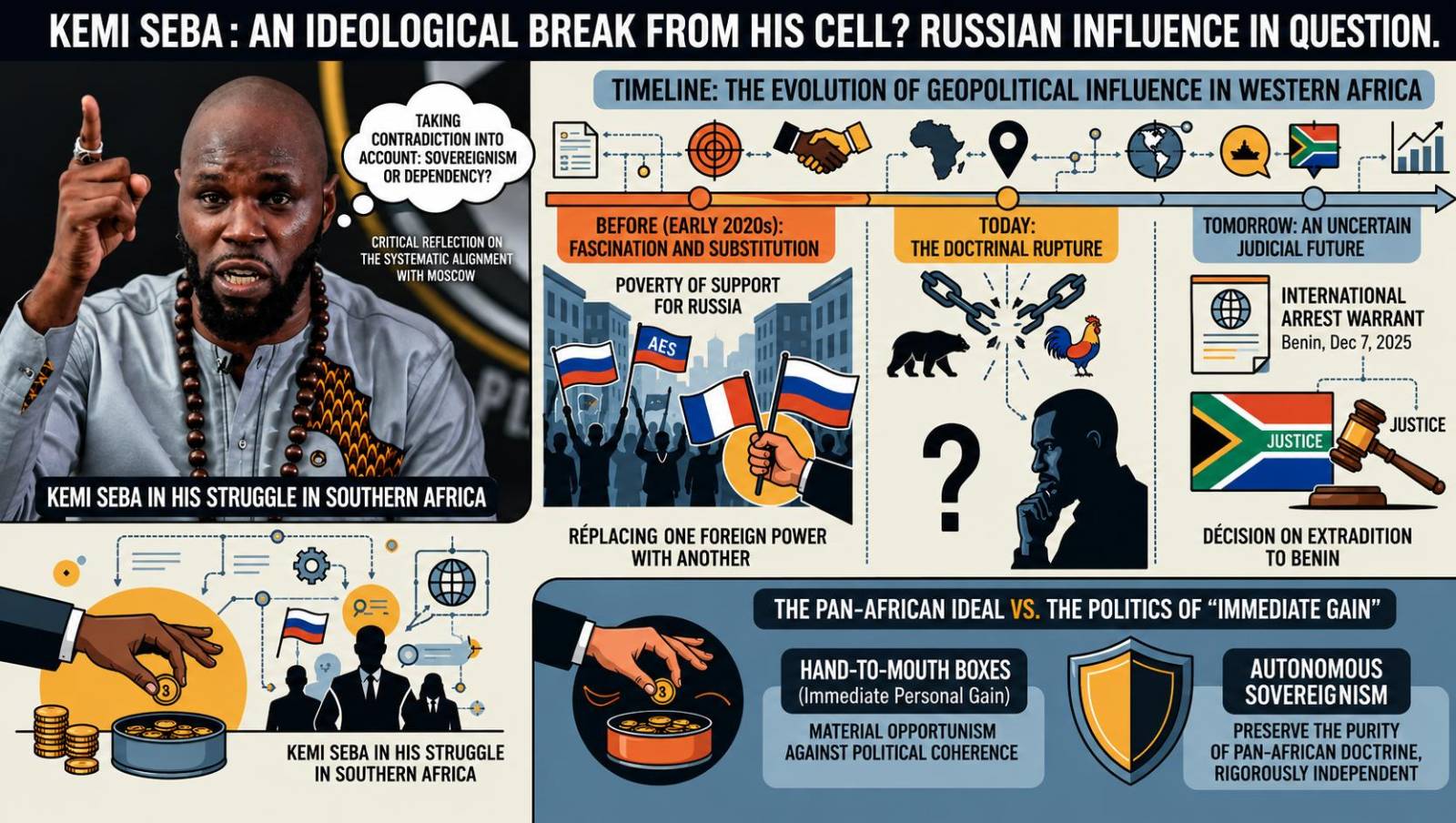
The geopolitical landscape across Africa’s Sahel region has undergone a striking transformation in recent years, particularly within the member states of the Alliance of Sahel States (AES). Public demonstrations championing sovereignty have become increasingly common, with crowds waving Russian flags and chanting slogans in favor of Moscow. For a vocal segment of activists, Russia is now framed as the indispensable alternative to long-standing Western powers, presenting itself as the solution to historical dependencies.
Yet beneath the surface of these symbolic displays lies a growing unease. Even among movements that advocate for absolute independence, questions are being raised about the true nature of this newfound alignment. Now, from the confines of a prison cell in South Africa, one of the most prominent voices of contemporary Pan-Africanism, Kemi Seba, appears to be undergoing a significant ideological shift—one that challenges the very foundations of this pro-Russian sentiment.
The paradox of sovereignty: replacing one dependency with another
While the pursuit of new international alliances is a legitimate diplomatic endeavor, the temptation to simply swap one foreign influence for another risks undermining the core principles of sovereignty. Observers argue that substituting France’s historical influence with that of Russia does not signify true emancipation but rather a mere shift in the locus of dependence. This critique gains particular resonance in light of Kemi Seba’s recent reevaluation of his stance on Moscow.
Seba’s evolving perspective suggests a deeper reckoning with the limitations of an uncritical alignment with Russia. The Pan-African ideologue has begun to question whether this approach truly serves the long-term interests of Africa or merely replaces one form of external control with another—albeit one that is framed as anti-Western.
Pan-African ideals versus the politics of immediate gain
The divergence in views among sovereignist movements has widened. While some enthusiastically embrace Russia in pursuit of a genuine geopolitical rupture, others are driven by more pragmatic motivations. Seba firmly rejects this opportunism, which he critiques through the vivid metaphor of the ‘ragout box’—a reference to the pursuit of short-term personal or material gain at the expense of coherent, long-term political principles.
By distancing himself from this mercenary approach to ideology, Seba seeks to uphold the integrity of a Pan-Africanism that prioritizes autonomy and doctrinal purity. His stance underscores a commitment to a vision of Africa free from all forms of foreign domination, whether Western or otherwise.
A suspended political and judicial future in Pretoria
Seba’s introspection on these matters coincides with a critical juncture in his personal life. The activist, who faces an international arrest warrant issued by the government of Benin following the alleged coup attempt of December 7, 2025, remains incarcerated in South Africa. The outcome of his legal battle now hinges on the Pretoria judiciary, which must soon rule on Benin’s extradition request.
The impending judicial decision will determine not only Seba’s immediate fate but also the trajectory of the movements he has inspired. Will this period of confinement mark a definitive break with previous ideological alignments, or will it merely reshape the discourse of Pan-Africanism without altering its substance? The coming weeks will be pivotal in shaping both Seba’s political future and the broader direction of the movements he represents.

 Mariama Hamani