Mariama Hamani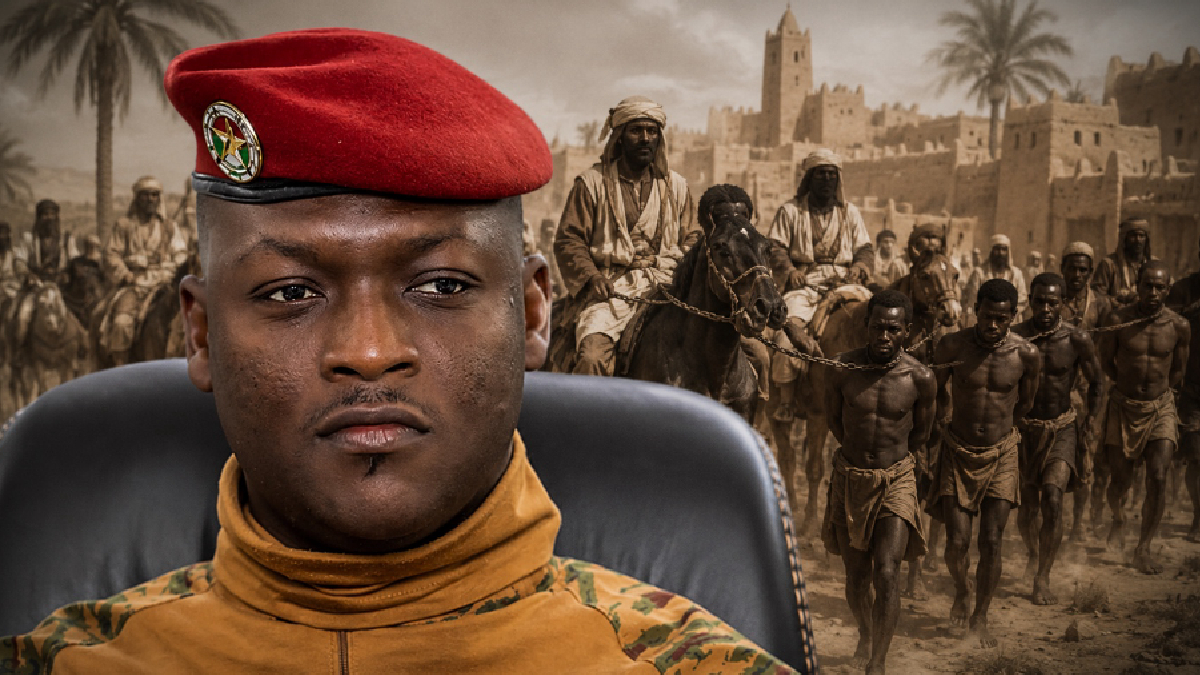
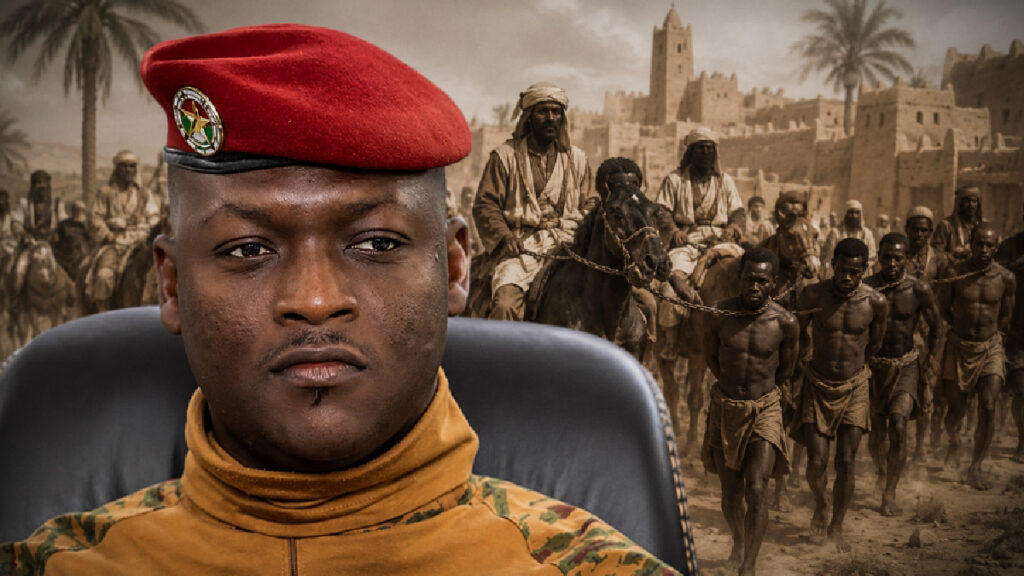
When Captain Ibrahim Traoré publicly addressed Arab slavery and its lasting impact on contemporary radical Islam, the Burkinabè leader shattered a long-standing taboo. His statements are not mere provocations; they highlight a critical blind spot in African historiography, often overlooked by Gulf powers and certain Western intellectuals. This political intervention sheds light on profound historical tensions across the continent.
The burden of a thousand-year silence
Africa carries certain truths like invisible burdens. Captain Ibrahim Traoré’s recent declaration in Ouagadougou perfectly exemplifies this. Addressing an assembly of dignitaries, the head of Burkina Faso’s transitional government dared to articulate what his predecessors, both civilian and military, had carefully avoided: an explicit connection between the Arab-Muslim slave trade and the devastating jihadist violence plaguing the Sahel.
For thirteen centuries, caravans transported millions of Black individuals, forcibly taken from regions around Lake Chad, to markets in Cairo, Tripoli, and Zanzibar. Historical records acknowledge this grim reality, yet official narratives have largely suppressed it. Why this pervasive silence? The eastern slave trade, unlike its Atlantic counterpart, does not fit neatly into prevailing narratives in Western chanceries. Furthermore, it inconveniently reveals that political Islam, frequently presented as an anti-colonial liberation ideology, historically also served as a vehicle for racial exploitation.
Historiography confronts political realities
The foundational research of historian Olivier Pétré-Grenouilleau had already laid bare this uncomfortable truth. Accounts from Ibn Battuta, archives from Sahelian sultanates, and Timbuktu manuscripts are replete with evidence detailing the systematic organization of this trade. Despite this, no truth commission has ever convened in Agadez or Timbuktu. No national museum in Sahelian capitals dedicates space to this history. Post-colonial elites, indoctrinated with the notion of unity against former colonizers, chose historical amnesia over confrontation.
In doing so, these elites inadvertently granted jihadist groups a monopoly on historical interpretation. By portraying their struggle as a revolt against a neo-colonial order, these groups skillfully erased their ideological connection to a conquering force that, since the Almoravids, has justified violence through spiritual superiority. Traoré, acting more as a soldier than an intellectual, has effectively dismantled this constructed narrative.
A double-edged memory strategy
From a tactical standpoint, the captain’s pronouncement demonstrates remarkable shrewdness. By nationalizing the fight against terrorism, he strips it of its transnational character, re-establishing its historical and racial dimensions. The enemy is no longer an imported faction but rather the heir to a foreign enterprise of domination over Black lands. Through this approach, he hopes to rally rural communities, who are the primary victims of jihadism and often marginalized by urban elites influenced by Qatari or Saudi funding. This move could reshape African current affairs and regional security dynamics.
However, this strategy presents significant risks. By invoking the specter of Arab slavery, Traoré exposes his nation to dual diplomatic isolation. On one hand, he risks alienating traditional Gulf allies, whose Quranic schools have permeated the Sahel’s religious landscape for four decades. On the other, he displeases a segment of the West African intelligentsia, who perceive this historical evocation as an attempt to divide the Black front against the former white colonizer. The comparative history of slave trades is a minefield; the captain treads it with the light steps of a soldier, not the careful deliberation of a diplomat.
The silences of Western repentance
What makes this statement particularly unsettling for Western chanceries is its exposure of contradictions within Western memorial politics. UNESCO, NGOs, and social science faculties have become adept at a selective form of repentance: acknowledging the transatlantic slave trade, but rarely the Arab one. This selective memory is particularly evident in France, where diversity is celebrated while any critique of radical Islam is often stifled by accusations of “Islamophobia.”
Ibrahim Traoré, however, seeks neither financial reparations nor apologies from France. He simply urges his people to confront their own history, even if it proves uncomfortable for Gulf allies. This memorial independence, however blunt, is perhaps what most disturbs Parisian circles. It serves as a potent reminder that Africa is now capable of conducting its own historical inquiry, free from the distorting lens of former metropolises. This shift underscores evolving African governance and continent news perspectives.
A lesson for the Old World
What can be gleaned from this Sahelian intervention? Firstly, competing historical narratives will not be appeased by subsidies or UN resolutions; they will clash over foundational myths. Secondly, political Islam, far from being a mere Middle Eastern import, has roots in a centuries-old history of conquest and subjugation that Africans themselves have too long preferred to silence.
Traoré has chosen his stance. The question remains whether his people, exhausted by a decade of asymmetric warfare, will possess the strength to support this historical reckoning, risking the reopening of wounds believed to be healed by oblivion. Historians might argue he has oversimplified a complex tragedy. Politicians might claim he lacked nuance. Yet, the captain reminds us with military bluntness: in Africa, as elsewhere, peoples who do not shape their own history are condemned to endure it.
While Parisian editorialists ponder repentance and intersectionality, a calloused Sahelian soldier starkly reminds them of history’s true order. Truth liberates, it is said, but in the Sahel, it is a lion that must be tamed. Ibrahim Traoré has just opened its cage. We can only hope he has the fortitude and broad shoulders to bear this burden, for the guardians of political correctness will not forgive him.