Mariama Hamani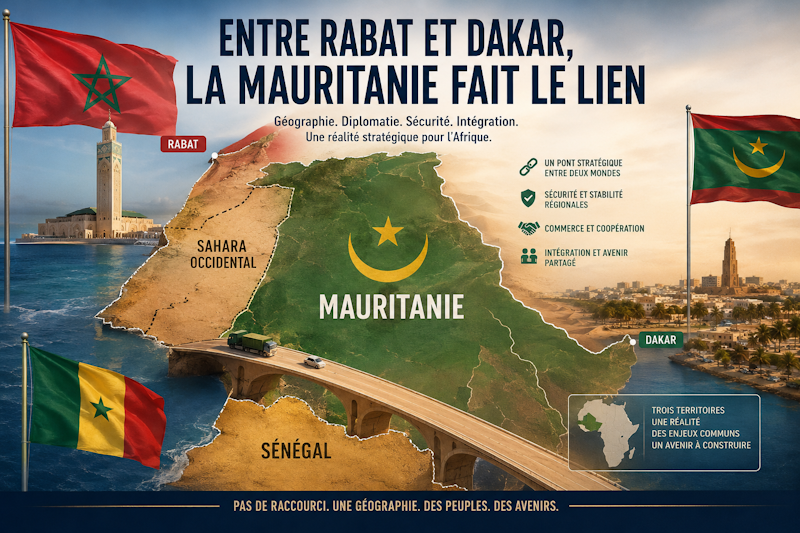

Between Morocco and Senegal lies not just a stretch of land, but a complex geopolitical reality—one that begins with the Western Sahara and is fundamentally shaped by Mauritania. This is the observation made by Mauritanian journalist Ahmed Ould Bettar, who highlights the often-overlooked role of Nouakchott in the region’s dynamics.
Why Mauritania is the missing link in Maghreb-West Africa relations
When analyzing connections between Morocco and Senegal, it’s impossible to skip over Mauritania without distorting the broader picture. Geographically, economically, and politically, this nation serves as a critical junction between North Africa and West Africa.
The temptation to bypass Mauritania in regional assessments stems from simplistic mappings or hasty diplomatic narratives. Yet such oversights ignore Mauritania’s sovereignty, its active diplomatic engagements, and its pivotal contributions to regional stability—particularly in security, trade, and economic integration.
To reduce this vast stretch of land to mere transit space or a blank space on a map is to misunderstand the very essence of continental and subregional relations. Mauritania is neither a footnote nor a detour; it is a full-fledged player in its own right.
The Western Sahara: a disputed territory that shapes regional dynamics
At the heart of this geopolitical equation lies the Western Sahara, a territory whose legal status remains unresolved and internationally contested. Its unresolved nature creates ripple effects across neighboring states, influencing decision-making in Rabat, Dakar, and Nouakchott alike.
The implications are far-reaching. From trade routes to military cooperation, from energy partnerships to migration flows, the status of the Western Sahara cannot be treated as peripheral—it is a central factor in how these nations interact, negotiate, and strategize.
Diplomatic nuance matters: why shortcuts fail in geopolitical analysis
Simplified narratives—whether in media, policy circles, or academic discourse—tend to favor direct routes over the realities of geography and sovereignty. Yet when it comes to geopolitics, what appears as a shortcut on a map often translates into missed opportunities or misinformed strategies.
Mauritania, with its unique positioning and active role, cannot be omitted without consequence. Ignoring its presence or minimizing its significance distorts the entire picture of relations between the Maghreb and West Africa.
In the end, geography is not just a backdrop for politics—it is the foundation upon which stability, cooperation, and mutual respect are built. And in this intricate web, Mauritania stands as a pillar that holds the structure together.

 Boureima Amadou