
 Mariama Hamani
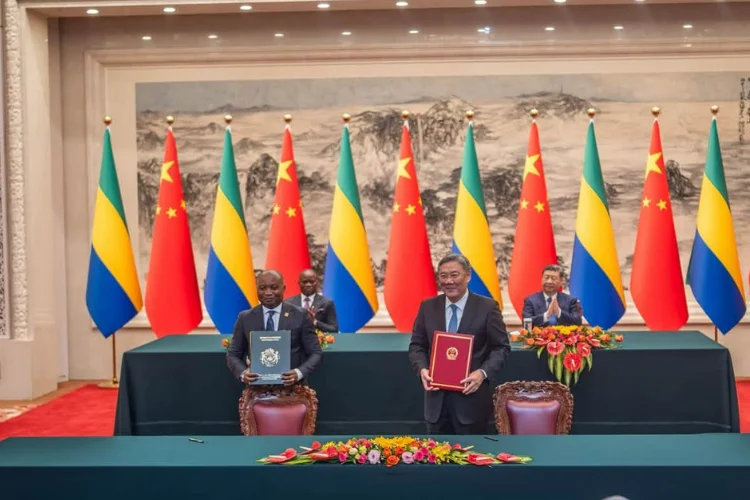
The Gabon-China partnership reached a decisive turning point on November 5 in Shanghai, where a series of groundbreaking agreements were signed to accelerate the country’s industrial and technological transformation. This new phase marks a significant shift in Gabon’s economic strategy, focusing on local processing of raw materials, digital modernization, and infrastructure development through strategic Chinese investments.
The collaboration spans multiple critical sectors, including advanced technologies, public security systems, higher education, artificial intelligence, energy, and industrial infrastructure. The overarching goal is to position Gabon as a regional leader in industrialization while creating new economic opportunities for its citizens.
Cutting-edge technological collaborations with Huawei
Three landmark agreements were sealed with China’s tech giant Huawei, signaling a major leap forward in Gabon’s digital and educational landscape. The first initiative focuses on enhancing public safety through smart technology deployments, including surveillance systems, emergency response networks, and data-driven policing solutions.
The second agreement centers on the digital transformation of Gabon’s public universities, upgrading infrastructure to support high-speed connectivity, cloud computing capabilities, and e-learning platforms. The third initiative is particularly transformative, as Huawei will equip the Brice Clotaire Oligui Nguema University with state-of-the-art artificial intelligence tools and educational resources. These efforts aim to prepare Gabon’s youth for the growing demands of the digital economy while fostering innovation in specialized fields.
The Bélinga iron ore project: a game-changer for industrial development
The landmark Bélinga iron ore project took center stage in the negotiations, with agreements signed to develop critical supporting infrastructure. Chinese partners, including specialized subsidiaries of PowerChina, will contribute expertise in rail infrastructure, rolling stock manufacturing, and energy generation—essential components for extracting and processing the site’s vast mineral deposits.
These developments are expected to unlock new opportunities for Gabon’s mining sector while boosting local employment and technological expertise. The project also includes provisions for sustainable mining practices, ensuring environmental responsibility alongside economic growth.
Energy and industrial integration: a collaborative vision
A memorandum of understanding was formalized between the Gabonese government, Eramet Comilog, and Sinohydro—a subsidiary of PowerChina—to strengthen energy infrastructure and industrial capacity. This partnership focuses on expanding renewable energy sources, modernizing existing power grids, and supporting the development of high-value industrial zones.
The agreements lay the groundwork for increased foreign direct investment, technology transfer, and skills development programs. By leveraging China’s industrial expertise and financial resources, Gabon aims to accelerate its industrialization agenda, create high-quality jobs, and reduce dependence on raw material exports.
From agreements to action: the path forward
While the November 5 accords represent a historic milestone, the true test will be their implementation. The coming months will determine how effectively these commitments translate into tangible outcomes, including:
- Job creation across industrial sectors, particularly in mining, manufacturing, and technology;
- Transfer of critical technologies, enabling Gabonese professionals to acquire advanced skills;
- Economic diversification beyond traditional sectors, fostering new industries and services;
- Strengthening of public-private partnerships to sustain long-term growth.
As Gabon embarks on this ambitious industrial journey, the Gabon-China collaboration sets the stage for a new era of economic resilience and innovation. The successful execution of these initiatives could redefine the country’s industrial landscape and position it as a key player in Central Africa’s economic transformation.






