Boureima Amadou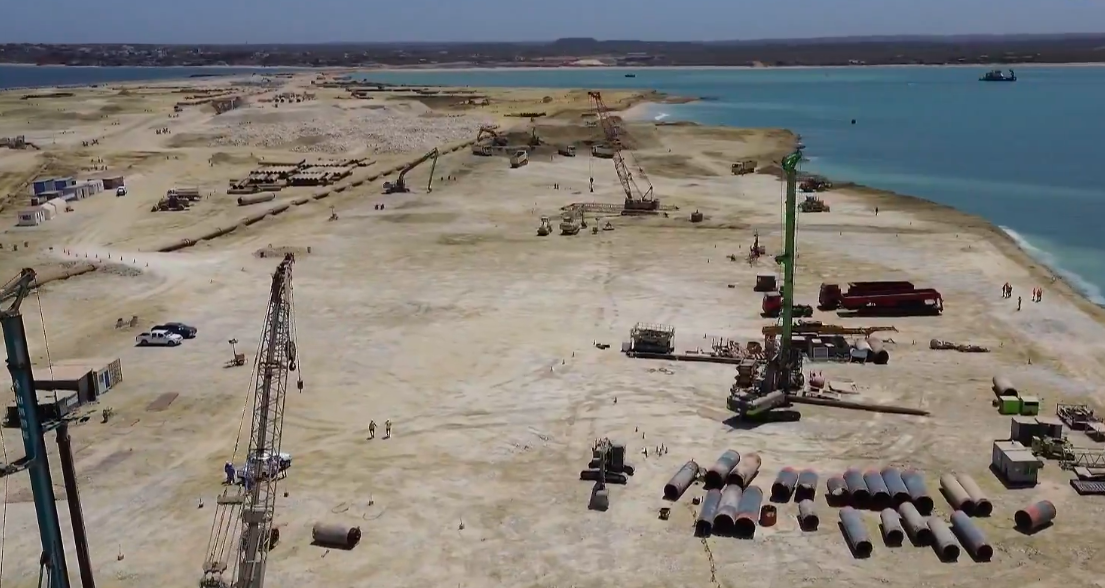
how chinese companies reshaped Senegal’s infrastructure landscape
For two decades, the Senegalese government has increasingly turned to Chinese firms for its most ambitious public projects. Once dominated by French multinational corporations, major contracts in ports, stadiums, industrial zones, and urban development are now primarily awarded to Chinese, Turkish, Emirati, and Tunisian companies. This shift reflects a broader transformation in Senegal’s economic partnerships.
At the heart of this change is the deep-water port of Ndayane, a $2 billion project south of Dakar designed to handle the largest container ships in the Atlantic. While the project is led by DP World (an Emirati company), construction is being carried out by an international consortium where Chinese firms play a pivotal role. “We had companies from around the world competing, including many French firms, but in the end, they didn’t win,” explains David Gruar, DP World’s site director. According to industry reports, the French-led consortium Eiffage was about 20% more expensive than the winning bid, which included significant Chinese involvement.
The port’s completion is expected to revolutionize Senegal’s logistics, job market, and connectivity, positioning the country as a key player in regional trade. Clarence Rodrigues, CEO of DP World Dakar, emphasizes its transformative potential: “This project will absolutely change everything for Senegal in terms of logistics, job creation, and connectivity, propelling the country into the future.”
diamniadio’s new city: a case study in shifting alliances
Just a few dozen kilometers away, the new city of Diamniadio is taking shape to alleviate congestion in Dakar. Here, Turkish companies have secured the majority of contracts for the stadium, railway station, hotels, and residential buildings. A dedicated industrial platform, designed to attract foreign investors, is also under development—with Tunisian and Chinese firms leading the way. “Over there, you’ll see a Tunisian company. To your right, a Chinese one,” notes Bohoum Sow, Secretary-General of the APROSI (Association for the Promotion of Senegalese Industries), in an interview with local media. He adds, “I don’t know of any French companies operating in this industrial zone.”
why chinese firms are winning in Senegal
Bohoum Sow attributes China’s success to its ability to align with Senegal’s needs. He highlights a Chinese-built cardboard packaging plant where local employees are trained by Chinese technicians—a model he praises for its adaptability and responsiveness to specific market demands. “This type of industry didn’t exist here before. They’re meeting real needs, and they’re doing it flexibly,” he says.
China’s strategy in Africa over the past 20 years has been clear: invest heavily in infrastructure to strengthen its economic diplomacy. The result? “You can see their flag flying everywhere,” observes local analysts. While French groups once dominated 30% of Senegal’s public contracts, they now account for just 5%. In contrast, Chinese firms hold over 30% of these deals, with Turkish, Emirati, and Tunisian companies also gaining ground.
Sow acknowledges this shift: “It’s a win-win situation because it’s real. Senegal needs infrastructure, and China understands that. The times have changed, and so have our partners.”
can french companies adapt to stay competitive?
Despite their declining influence, French firms are not entirely sidelined. Some are winning contracts by adopting new strategies—localizing operations, transferring expertise, and forming partnerships. For example, Ragni Group, a French family-owned business specializing in public lighting, secured a 70 million euro contract to deploy 36,000 next-generation solar streetlights in Senegal. The project, partly financed by France’s Development Bank, required Ragni to establish a local subsidiary managed by Senegalese executives rather than expatriates.
“The key was flexibility, quality, and cost. That combination worked, along with creating local jobs,” explains Birama Diop, Director of Ragni’s Senegalese subsidiary. Caroline Richard, Head of Proparco’s Senegal office, adds: “French companies still have opportunities, especially as project requirements grow. They excel when standards are high, and there’s significant potential for growth in labor-intensive markets.”
The solar streetlights lighting up Senegalese cities today symbolize a new model: French groups must become more agile, forge local partnerships, and prove their cost-competitiveness against entrenched Chinese, Turkish, and Emirati competitors.


 Mariama Hamani