
 Mariama Hamani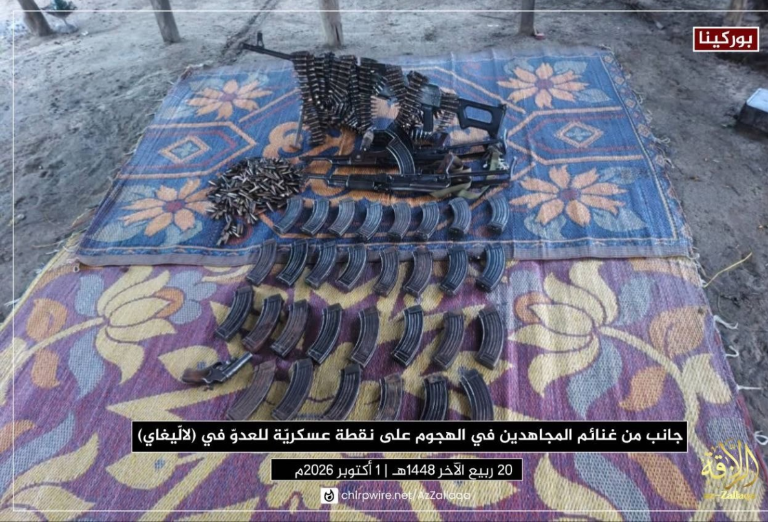
A coordinated wave of jihadist violence struck Burkina Faso on Saturday, September 26, leaving a Burkinabè soldier dead in the Centre-Est region and destroying heavy military equipment in the north. The attacks, claimed four days later by the Group for the Support of Islam and Muslims (JNIM), are not just battlefield statistics. They carry immediate consequences for civilians, local commerce, and the state’s ability to protect its citizens.
What happened in Lalgaye: a military post overrun and a soldier killed
In the Koulpélogo province, about twenty kilometres from Ouargaye, the town of Lalgaye became the target of a direct assault on a Burkinabè army checkpoint. Heavily armed attackers overwhelmed the position, and despite a fierce response from defence forces, the assailants’ superior numbers and surprise allowed them to breach the compound.
One soldier was killed in combat. Before retreating into nearby forested areas, the attackers looted the post, seizing a substantial cache of light weapons, ammunition, and individual equipment. This pattern, repeated across the region, does more than weaken local security coverage — it directly fuels terrorist columns with military-grade logistics, prolonging the conflict and endangering civilians who rely on that security presence.
Ouahigouya under siege: armoured vehicle destroyed as northern pressure mounts
At the same time as the Centre-Est attack, the north of the country faced similar offensives. Around the strategic city of Ouahigouya — capital of the Nord region and Yatenga province — two positions held by the army and its civilian auxiliaries came under fire.
While the human toll in the north remains partial, material losses are confirmed: at least one light armoured military vehicle was destroyed by heavy weapons fire or an improvised explosive device (IED). The fact that these strikes were carried out on the same day, hundreds of kilometres apart, reveals the JNIM’s retained capacity for operational planning — a direct threat to the safety of citizens across multiple regions.
The economic and social fallout: harassment tactics and the civilian cost
The Lalgaye attack fits into a particularly complex security context in Koulpélogo. This province, which borders Togo and Ghana, serves as a strategic corridor for JNIM, which seeks to establish transit zones and rear bases between eastern Burkina Faso and the Gulf of Guinea countries.
For specialists of the Sahel conflict, the storming of isolated posts is part of a tactical harassment strategy. By multiplying targeted raids against small detachments, jihadist groups pursue a triple objective — each with real-world consequences for ordinary people:
- Material attrition: Capturing weapons, vehicles, and communication equipment without relying on heavy external logistics. This feeds the cycle of violence that displaces families and disrupts markets.
- Territorial isolation: Forcing government forces to pull back to major urban centres (Tenkodogo or Ouargaye for the Centre-Est, Ouahigouya for the North), creating security “black holes” in rural areas. The result: farmers cannot access fields, traders cannot move goods, and essential services disappear.
- Psychological warfare: Using delayed claims — like the one published on October 1 — to sustain a permanent sense of insecurity and contradict official communications. This erodes public confidence and makes daily life unpredictable for citizens and businesses alike.
How defence forces are responding — and what it means for the ground
In response to the renewed tension, the Burkinabè Armed Forces (FAB) and the Volunteers for the Defence of the Homeland (VDP) immediately launched tracking and pursuit operations. Air assets were deployed in the Koulpélogo region and the Yatenga sector to locate fleeing enemy columns.
In Ouagadougou, transitional authorities regularly reaffirm their determination to reclaim territory. Yet these recent events highlight the logistical and human challenges facing units on the ground, often confronted with asymmetric attacks and widespread use of explosive devices on road axes. For local populations, every such attack means another day of restricted movement, another market day lost, and another reason to flee.
Residents of the Lalgaye area, meanwhile, live under the threat of repeated incursions. As security operations continue in Koulpélogo, the price paid by armed forces reminds us of the daily struggle to restore Burkina Faso’s territorial integrity — and the heavy toll that struggle takes on the civilians and local economies caught in the middle.


 Boureima Amadou





