
 Mariama Hamani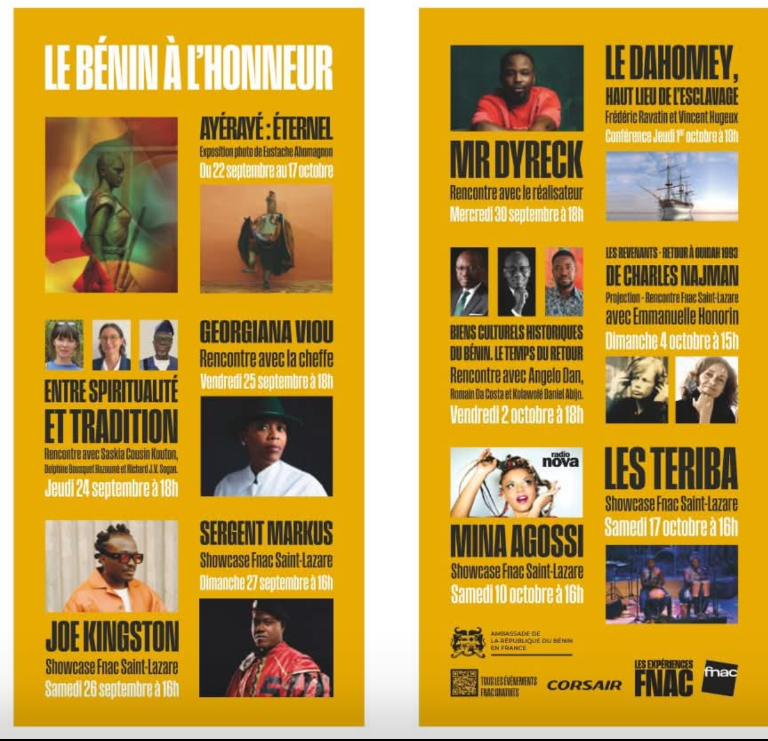
Paris has spent close to four weeks talking about Benin, and the conversation shows no sign of cooling down. From 22 September to 17 October 2026, the Fnac Paris Saint-Lazare has handed its third-floor forum over to a dense cultural programme devoted to the West African country, with several events staged with backing from the Embassy of the Republic of Benin in France. What began as a bookstore residency has turned into something closer to a public discussion about memory, identity and what France and Benin owe each other.
Why this programme is generating more than polite applause
The line-up deliberately avoids the folkloric shortcut. Rather than a colourful showcase, it walks through the country’s spiritual traditions, its royal past under the kingdom of Dahomey, the history of the slave trade, the thorny question of returning cultural property, and a contemporary creative scene spanning literature, gastronomy and current music. That mixture is exactly what has kept audiences arguing well after each session ends.
An opening exhibition that frames the whole debate
Everything started on 22 September with “Ayérayé: Eternal”, a photographic exhibition devoted to the Benin-born photographer and designer Eustache Ahomagnon. Running until 17 October, it sits at the meeting point of photography and textile creation.
Egungun, ancestors and contemporary forms
The artist works through memory, spirituality and present-day creation via the world of the Egungun, figures tied to ancestor worship among the Yoruba. His images answer back to fabrics shaped by the forms, materials and movement attached to those traditions. The result sets the tone for the whole month: a Benin deeply rooted in its inheritances and just as firmly committed to what its artists are making now.
Spirituality, publishing and a chef’s Michelin journey
On 24 September, sociologist and author Saskia Cousin Kouton, journalist Delphine Bousquet Hazoumè and researcher Richard J.V. Sogan took part in a conversation on spirituality, traditions and a set of books dedicated to Benin’s heritage.
The following day, chef Georgiana Viou took the floor. Born in Benin, she recounted her career and introduced her book “Oui cheffe ! From Benin to a Michelin star”, the story of a fighter. Her path also opened a broader discussion about food as a vehicle for cultural transmission, since Benin’s ingredients and flavours still shape a cooking style built between several influences.
When music answers the historical questions
Music took over on 26 September with a showcase by Benin artist Joe Kingston, whose “Afro futur vibes” universe brings hip-hop together with contemporary African sounds. The next day, poet and slam performer Sergent Markus presented “Vodun Gospel”, a project drawing heavily on musical references rooted in vodun culture.
The most sensitive pages: Dahomey, the slave trade and restitution
The programme also confronted the hardest chapters of Benin’s past. On 1 October, a session examined Dahomey and the history of slavery, with writer and journalist Vincent Hugeux in conversation with Frédéric Ravatin, an engineer and scientific scenographer, notably about the work carried out around the “Boat of Memory” in Ouidah, conceived as a memorial device dedicated to the slave trade.
The next day, the return of cultural property between France and Benin moved to centre stage. Ambassador Angelo Dan, Romain Da Costa and heritage curator Kolawodé Daniel Abidjo revisited a historic process that has left a deep mark on cultural relations between the two countries.
Those choices give the whole event a strongly historical and memorial dimension. The point is no longer simply to display works or introduce artists, but to ask how a nation narrates its past, preserves its heritage and defines its place in the world.
Cinema as the link between yesterday and today
On 4 October, the spotlight moved to film with a screening of “Return to Ouidah 1993: The Revenants”, Charles Najman’s documentary about the return to Ouidah, a city bound up both with the history of vodun and with the African diaspora created by the slave trade. Journalist, producer and programmer Emmanuelle Honorin led the discussion that followed.
Made in the context of the Ouidah 92 Festival, the film sets up a dialogue between images from the past and today’s questions about memory, identity and the ties between Benin and its diaspora.
The contemporary scene pushes back
Living creation was not overlooked. On 30 September, director, co-producer and cinematographer Mr DYRECK received a carte blanche. His work, produced between Benin and France, reflects a new generation of artists using the moving image to tell West Africa’s story differently.
Music returned on 10 October with singer and jazz artist Mina Agossi, invited to present her album “Dynamic. Tribute to Dinah Washington”.
The closing date, 17 October, was given over to a showcase by Teriba, described as Benin’s first women’s music group. Formed in 2002, the collective built its reputation on a cappella singing and a determination to champion Benin’s cultural heritage.
What comes after 17 October?
The broader effect is that, for nearly a month, a Parisian retail space has operated as a genuine window onto Benin. From photography to gastronomy, from slam to jazz, from cinema to history, the programme sketches a plural portrait of a country whose heritage keeps feeding contemporary creation.
It also pushes back against the idea of Benin culture as something frozen in a display case. It is passed on, reinvented and argued over. Between vodun traditions, the memory of Dahomey, the history of the slave trade, restitution debates and fresh artistic voices, an entire narrative about Benin has moved into the heart of Paris.
Every event announced is free of charge, subject to available seating. The questions raised during those weeks, however, are unlikely to be settled by a closing night.


 Boureima Amadou





