
 Boureima Amadou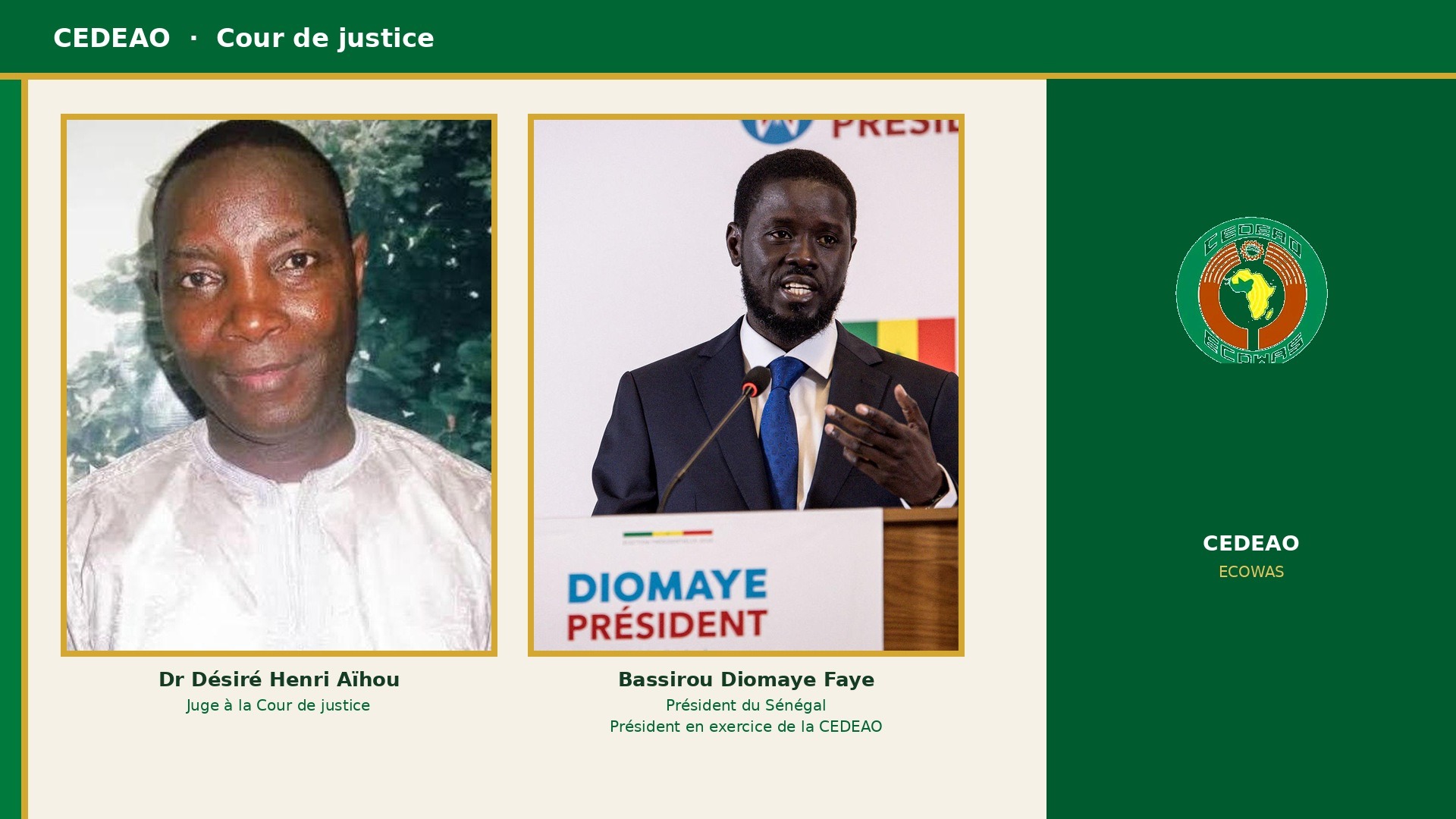
The swearing-in ceremony in Abuja on October 6, 2026, marked a pivotal moment for West African justice. Doctor Désiré Henri Aihou took the oath as Benin’s judge on the ECOWAS Court of Justice, bringing a four-year, non-renewable mandate to the bench. This appointment arrives at a time when regional judicial institutions face mounting pressure to reinforce rule of law, uphold fundamental rights, and restore public faith in community-wide legal systems.
The bench welcomes Benin’s newest ECOWAS judge
In a ceremony held at the ECOWAS Commission headquarters in Abuja, five judges were sworn in on October 6, 2026, under the authority of Bassirou Diomaye Faye, Senegal’s president and ECOWAS’s current chair. Désiré Henri Aihou joins Awa Bah (Gambia), Charlyne M. Brumskine (Liberia), Henrietta Uzoamaka Didigu (Nigeria), and Yaouza Ouro-Sama (Togo) in taking up their roles. All five were appointed during the 69th Ordinary Session of ECOWAS heads of state and government in Lungi, Sierra Leone, in July 2026. Each serves a single, non-renewable four-year term, ensuring a fresh wave of judicial independence and expertise across the community.
Why the ECOWAS Court matters now
The ECOWAS Court of Justice is more than a symbolic institution. Rooted in the revised ECOWAS treaty, it has evolved into a decisive judicial body that interprets and applies community law with authority. Its expanded mandate now includes human rights oversight and the resolution of disputes between member states and even between individuals and governments. In a region facing recurring governance crises, constitutional erosion, and institutional fragility, this court serves as a critical check on power and a guardian of shared legal principles.
From political declarations to legal enforceability
One of the court’s greatest challenges has been ensuring that its rulings are not just declared but enforced. In 2024, ECOWAS’s judicial council identified execution mechanisms as a key area for improvement, signaling growing recognition that legal credibility depends on tangible outcomes. Désiré Henri Aihou’s appointment comes at this crucial juncture, when the court must balance independence with real-world effectiveness.
Benin’s democratic roots meet regional justice
The Benin–Abuja connection runs deeper than geography. In February 1990, the historic National Conference of Living Forces in Cotonou marked the birth of Benin’s democratic rebirth. Over nine days, delegates from across political, civil, and religious spectrums reaffirmed their commitment to democracy, human rights, and the separation of powers—values later enshrined in the December 11, 1990 Constitution. The creation of the Constitutional Court in 1993 cemented this commitment, transforming Benin into a model of post-crisis institutional rebuilding in West Africa.
Replicating constitutional discipline regionally
Thirty-six years after the Cotonou conference, Benin’s judicial tradition finds new expression in the ECOWAS Court. The principle of checks and balances—once a national breakthrough—is now a regional necessity. The court’s structure mirrors that of ECOWAS itself: executive, legislative, and judicial branches. In this architecture, the judiciary acts as both interpreter and enforcer of community law, ensuring that states remain accountable not just to their people, but to shared legal commitments.
Accountability over influence
Désiré Henri Aihou’s role is not to represent Benin politically, but to uphold the law impartially. His position underscores a critical lesson from Benin’s constitutional experience: power must be bounded by legal discipline. This is especially vital in West Africa, where political transitions and governance crises frequently test the resilience of democratic institutions. A strong, credible regional court can offer citizens and businesses a reliable forum to challenge state overreach and demand adherence to human rights standards.
Testing legality in turbulent times
The court’s ability to deliver on its promise will be measured not by the strength of its judges alone, but by the impact of its rulings. Will decisions be respected? Will member states comply? These questions loom over ECOWAS as it navigates internal divisions and intensifying regional tensions. Yet, the appointment of judges like Désiré Henri Aihou—rooted in a culture of legal accountability—offers a glimmer of hope for a justice system that can rise above political interference and truly serve the people.
The October 6 ceremony in Abuja was more than a formal event—it was a statement. In a region where democratic backsliding and institutional erosion are constant risks, Benin’s contribution reshapes the conversation about what regional justice can achieve. The next four years will reveal whether the ECOWAS Court can move from symbolic authority to practical protection, one verdict at a time.



 Mariama Hamani


