Boureima Amadou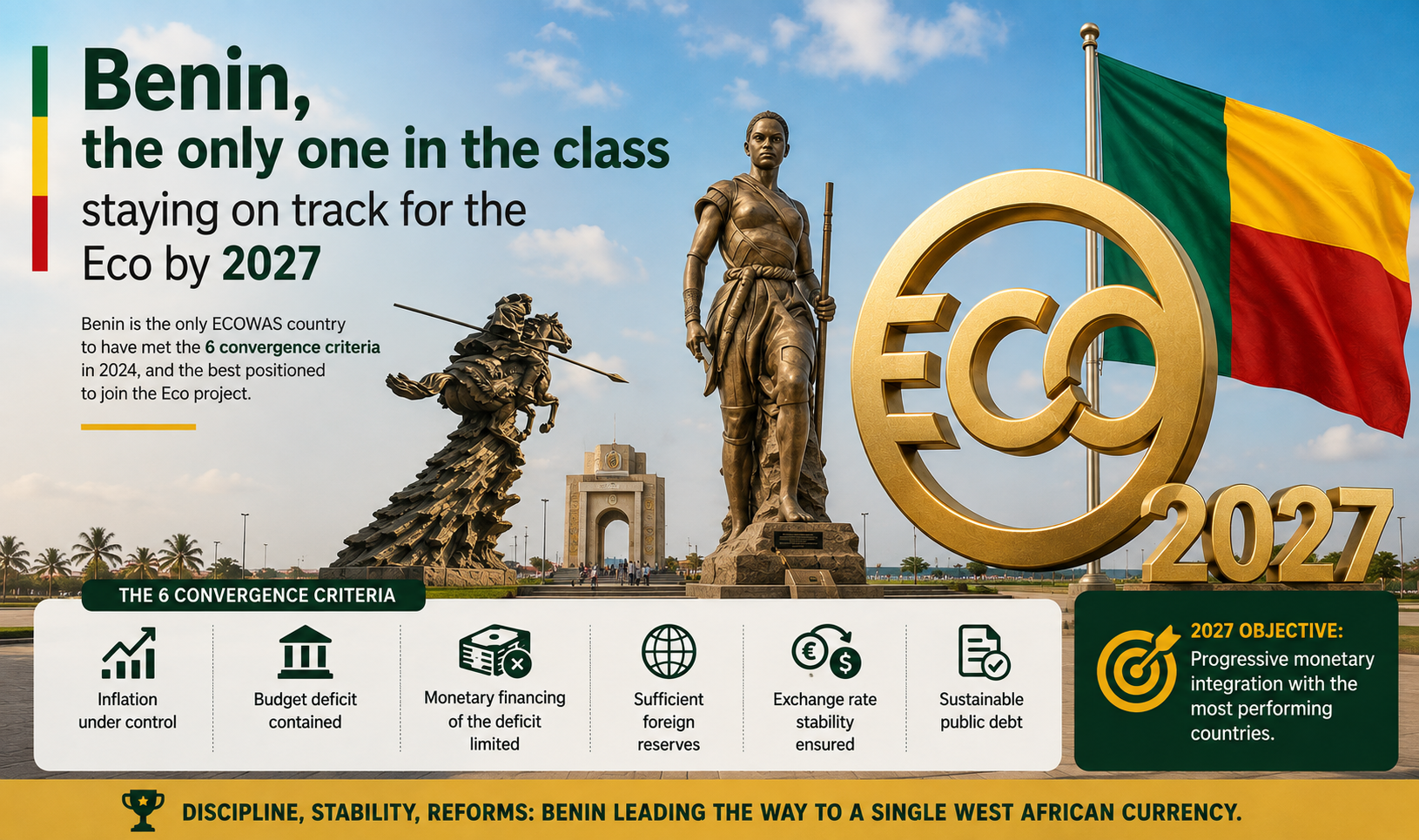
The West African Economic and Monetary Union (WAEMU) continues to pursue its ambitious goal of launching the Eco, a single currency, by 2027. However, economic disparities across member states suggest that not all countries will progress at the same pace. In this evolving landscape, the Republic of Benin stands out as a frontrunner in meeting the stringent criteria required for early participation in the monetary integration initiative.
Economic Convergence: A Complex Puzzle
The Eco project has long been a cornerstone of regional economic integration, yet the path to its realization remains fraught with challenges. Inflationary pressures, fiscal deficits, public debt levels, foreign reserves, exchange rate stability, and divergent national economic policies all pose significant hurdles. In response, a phased approach may emerge, allowing the most prepared nations to adopt the Eco first, while others continue working toward convergence.
A Model of Fiscal Discipline
Benin’s economic performance in recent years has positioned it as a standout within the Economic Community of West African States (ECOWAS). In 2024, it became the sole member state to meet all six primary convergence criteria established for the Eco. These benchmarks are not mere numerical targets; they reflect a holistic assessment of a nation’s economic health, including inflation control, fiscal responsibility, sustainable debt levels, and resilient foreign exchange reserves.
The country’s adherence to these criteria underscores a disciplined macroeconomic framework. For Cotonou, this is not a fleeting achievement but a sustained commitment to economic stability a prerequisite for any successful currency union. The challenge now lies in maintaining this trajectory over time, ensuring that short-term compliance evolves into long-term resilience.
The Six Pillars of Convergence
The foundational criteria for the Eco are designed to prevent the new currency from being undermined by inconsistent national policies. These include:
Inflation control: Keeping price increases within acceptable limits to protect purchasing power and monetary stability.
Fiscal deficit limits: Ensuring government spending does not outpace revenue beyond agreed thresholds.
Monetary financing restrictions: Preventing excessive money supply growth to cover public deficits.
Foreign reserve adequacy: Maintaining reserves sufficient to cover several months of imports.
Exchange rate stability: Preserving a steady nominal exchange rate to foster investor confidence.
Debt sustainability: Keeping public debt at levels deemed manageable for long-term economic health.
These standards aim to create a baseline of economic alignment before nations share a common currency a system that cannot thrive if some members indulge in fiscal recklessness while others maintain prudence.
A Deliberate Path to Progress
Benin’s current standing is the result of deliberate policy reforms implemented over several years. The government has prioritized revenue mobilization, improved public financial management, and significant investments in infrastructure and public services. However, these advancements required strategic trade-offs, particularly in balancing fiscal discipline with development financing a balancing act that remains a hallmark of Benin’s economic strategy.
The next critical phase will involve sustaining this performance. While meeting the criteria in a single year sends a strong signal, consistency over multiple years will be essential to cement Benin’s reputation as a reliable partner in the Eco framework.
Asymmetric Progress: A Pragmatic Approach
The primary obstacle to the Eco’s success is the stark economic heterogeneity among ECOWAS member states. Variations in debt burdens, fiscal flexibility, inflation rates, and exposure to external shocks such as security crises and geopolitical tensions complicate uniform progress. A staggered implementation could offer a more viable solution than a synchronized transition, allowing better-prepared economies to take the lead.
In such a scenario, Benin is well-positioned to be among the first adopters, provided its economic fundamentals remain robust. This early inclusion would not only validate Benin’s reforms but also enhance its influence in shaping regional economic policies, trade agreements, and financial governance frameworks.
Beyond 2027: Uncertainty and Opportunity
Despite Benin’s progress, the 2027 launch date is not guaranteed. Success hinges on collective political will, robust institutional frameworks, and the resolution of regional dynamics, including the evolving alliances among Sahelian states. The governance structure of the Eco, its monetary policy mechanisms, and the mechanisms for solidarity among members will all play decisive roles in determining the currency’s viability.
Benin’s current advantage its compliance with convergence criteria must be actively preserved. The immediate priorities include sustaining macroeconomic stability, curbing public debt growth, controlling inflation, and advancing structural reforms without compromising essential development projects. The long-term goal is not merely to lead the class in 2027 but to remain at the forefront as the Eco transitions from a political aspiration to an economic reality.
If the Eco is adopted incrementally, Benin could emerge as a key beneficiary, having already cleared many of the technical and fiscal obstacles that could hinder others. This position would not only bolster its economic credibility but also strengthen its role in West Africa’s evolving financial and trade landscape.