
 Mariama Hamani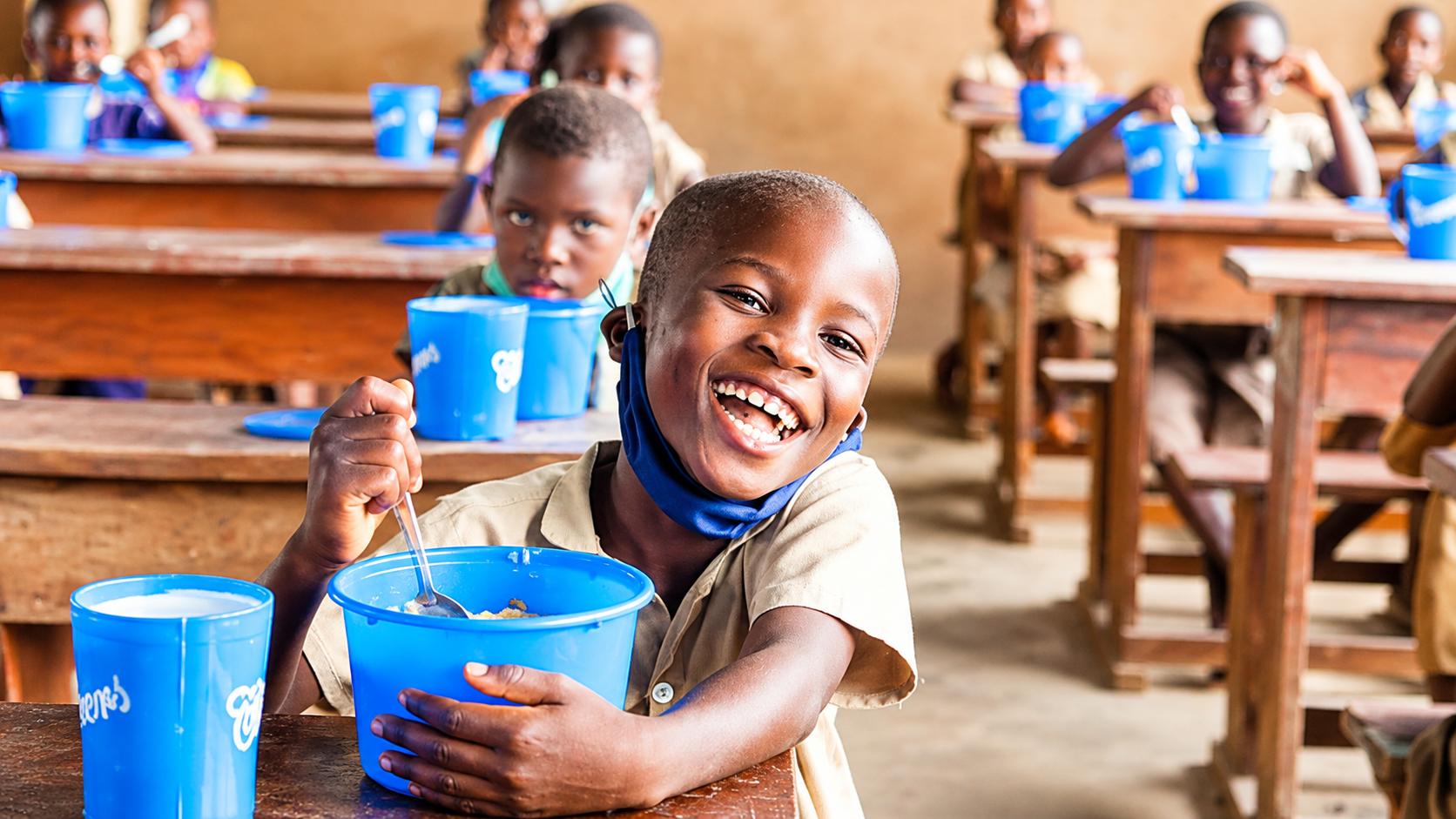
Benin’s school canteen programme has just changed scale. From the start of the 2026-2027 academic year, roughly 1.9 million pupils are receiving a warm meal on every day of class, compared with 1.4 million during the previous year. That jump of about 500,000 children in twelve months confirms a deliberate choice by the authorities: turning school meals into a tool that fights hunger, relieves households and energises the local economy.
Benin’s school canteen scheme crosses the 1.9 million mark
The figures speak for themselves. A year ago, 1.4 million children sat down to a school lunch. Today the programme counts 1.9 million beneficiaries, an expansion that says less about statistics than about the steady widening of a national food policy.
Half a million more children at the table in one year
Behind the headline number lies a simple reality: some 500,000 additional pupils now eat a hot dish during each school day. For many of them, this is not a detail in their timetable but a decisive element of their school week.
How the coverage rate climbed year after year
To understand the scale of the shift, it helps to look back. In 2016, only 30% of schools were covered by the canteen system. By 2022, that share had risen to 75%, with more than 1.1 million children already enrolled in the scheme. The growth recorded in recent years therefore continues a long, uninterrupted push.
For the Benin authorities, a school canteen is far more than a charitable gesture. It is treated as an investment in education, nutrition and the country’s future workforce.
Billions of FCFA mobilised for school meals
Such an extension does not come cheap. The budget allocated to school canteens climbed from 1.5 billion FCFA in 2016 to 48.7 billion FCFA in 2022, a rise that illustrates how much weight this public policy has gained over time.
More than 29 billion FCFA planned under the 2025 finance law
For 2025, the finance law provides more than 29 billion FCFA to keep the canteen programme running. These sums are best understood as long-term social spending: by paying for children’s meals, the state acts at the same time on several fronts that shape a pupil’s school career and wellbeing.
Serving dishes is only part of the objective. The aim is to build the conditions in which children stay in school, learn in better circumstances and prepare for what comes next.
Local farmers become partners of the programme
The other strength of the scheme is economic. School canteens generate a large and predictable demand for food products, and part of the money spent can flow back to local producers and suppliers.
By drawing on national agricultural output, the programme opens outlets for farmers. Public spending on pupils’ meals thus helps support producers’ incomes, stimulate rural activity and strengthen local commercial circuits.
Purchases from producers passed 13 billion FCFA in 2024
Government figures show that food bought directly from local producers has grown, exceeding 13 billion FCFA in 2024. The mechanism feeds a virtuous circle: children eat, families breathe more easily, and farmers gain additional markets for their harvests.
A meal that eases the burden on families
For households, the first effect is social. In many homes, providing a daily lunch for a child in school represents a heavy expense. When the school takes charge of the midday meal, part of that weight disappears.
More room in the household budget
Parents can then redirect their income towards other essential needs. School supplies, clothing, medical care or food for the rest of the family: every franc saved can improve living conditions at home.
Better concentration in class
For the children themselves, the stakes are just as high. A pupil who has eaten a warm meal copes better with the school day. The canteen reduces hunger during lessons and creates more favourable conditions for concentration, participation and learning.
The rise in the number of beneficiaries is therefore a direct answer to a central concern: allowing children, especially those from the most vulnerable families, to study in better conditions.
What Benin is really building
With 1.9 million beneficiaries for the 2026-2027 school year, the programme has reached a new stage. The 500,000 additional children counted in a single year give a concrete measure of how far the system has spread.
This momentum also reinforces the ambition of ever broader coverage of public schools. The authorities intend to keep pushing so that school meals become a lasting pillar of Benin’s education and social policy.
The canteen now appears as a multi-purpose instrument. It fights hunger, supports parents, favours better learning conditions and creates outlets for local agriculture.
By investing heavily in this programme, the state is not merely funding meals. It is putting money into today’s children, into families and into the local economy, and above all into the human capital that will form the wealth of tomorrow’s Benin.


 Boureima Amadou





