
 Mariama Hamani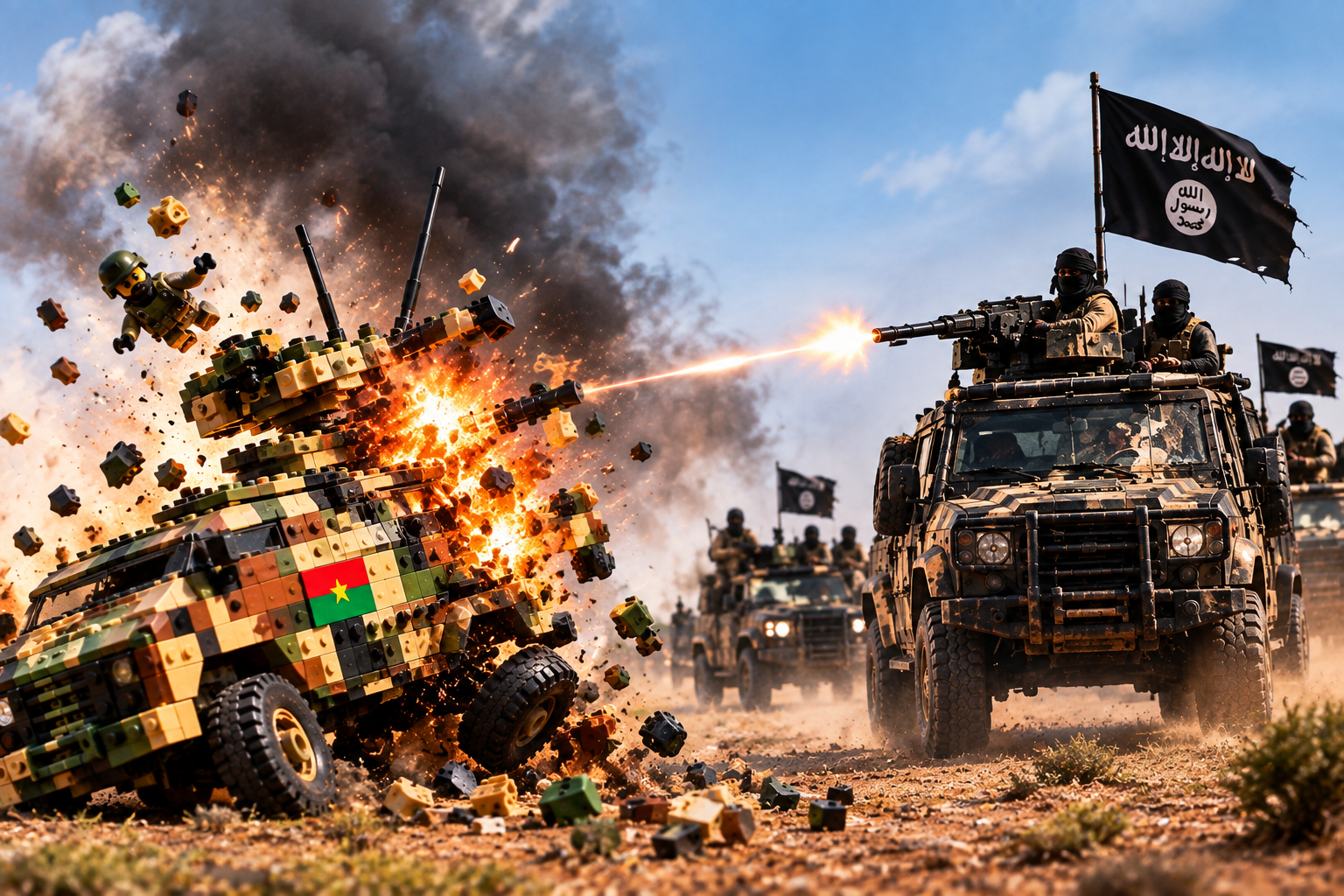
A claim that reopens the argument
On the morning of Wednesday, September 16, 2026, the Group for Support of Islam and Muslims (JNIM) said it had seized two positions held by Volunteers for the Defense of the Homeland (VDP) at Mahlou and Winten, in Bam province. The assertion has not been matched by independent confirmation that the two sites are effectively under the group’s control a distinction that matters as much as the claim itself.
That is where the argument starts, and it will not be settled quickly.
An industrial story measured against a battlefield
For months, Ibrahim Traoré’s government has placed the growth of Burkina Faso’s military industry at the centre of its messaging: equipment produced or assembled at home, national manufacturing, and a deliberate move away from total dependence on foreign suppliers. Industrialisation is presented in official communications as one of the pillars of state policy.
Armored vehicles, however, are not judged by the applause they collect at a presentation.
They are judged by whether they absorb hits, shield the people inside, keep running under fire and, above all, help hold ground.
A quip that conceals a serious question
After the unveilings and the carefully framed imagery, the hardware is now expected to move from the display stand to the frontline. Some observers have reached for a mocking image: vehicles put together like Lego bricks assembled, presented, applauded, then left to the terrain to decide whether the pieces truly hold together.
The joke is unkind. The question beneath it is entirely serious: what do these vehicles actually deliver when they meet the operational conditions of northern Burkina Faso?
The record offers little comfort
A multiplying list of attacked positions points to something far less flattering than the industrial slogans: owning equipment, even equipment made at home, does not translate automatically into lasting control of territory.
On August 19, JNIM had already claimed the capture of several VDP positions, including at Séguénéga and Bourzanga. Holding ground over time remains a persistent difficulty for Burkinabè forces, even in areas that had been retaken or declared secure.
Reactions: patience is wearing thin
The reflex has long been to answer criticism with announcements. That approach is now running into a more impatient audience, one that measures success in defended positions, in kilometres genuinely controlled and in soldiers brought home alive.
Supporters of the industrial drive insist that any domestic programme needs time and that early setbacks are part of building capacity. Critics counter that a vehicle showcased as a symbol of sovereignty carries a heavier burden: it is expected to perform the first time, under real fire, in the places where state authority is most contested.
What comes next
Should the claim over Mahlou and Winten be confirmed, the message from the ground would be an uncomfortable one: building an armored vehicle, displaying it and proving its operational worth are three different things, separated by a wide distance.
That distance will not be closed by speeches. It will be closed or exposed by territory held, positions kept and lives spared.


 Boureima Amadou





