
 Boureima Amadou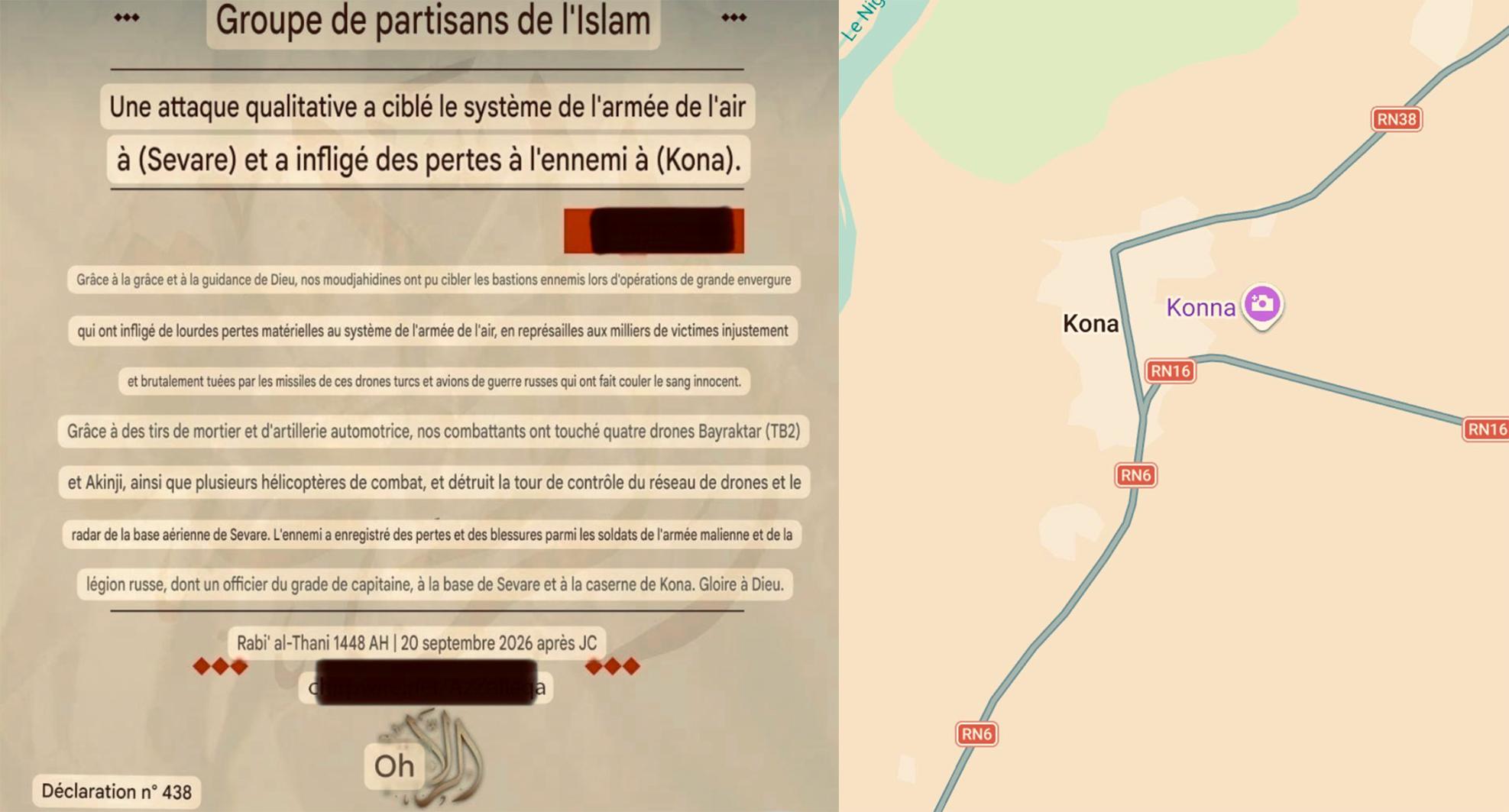
The assault on the Sévaré airbase and the Konna military camp, claimed by the al-Qaeda-linked Group for the Support of Islam and Muslims (JNIM), has exposed the true cost of Mali’s security strategy. Beyond the military losses, the attack disrupts the lives of ordinary citizens, undermines local businesses, and casts a long shadow over the country’s economic stability.
What the attack means for daily life in central Mali
For the people of Sévaré and surrounding areas, the strike is not just a distant military setback. It translates into closed markets, interrupted trade routes, and a pervasive sense of insecurity. The JNIM claims to have destroyed four Bayraktar TB2 and Akıncı drones, several helicopters, a radar, and a control tower, while also causing casualties among Malian soldiers and Russian fighters. Each of these losses reverberates through the local economy, as military bases are often key employers and consumers of local goods and services.
The economic ripple effects of a security failure
When a strategic base like Sévaré is hit, the consequences extend far beyond the perimeter. Transport companies avoid the area, farmers struggle to bring goods to market, and small businesses lose customers. The attack highlights a fundamental flaw: despite heavy investment in military hardware, the state cannot guarantee the safety of its own installations, let alone the economic lifelines that sustain communities.
How the junta’s security gamble backfires on civilians
Since the 2020 and 2021 coups, Mali’s military leaders have pivoted away from Western partners, notably France, and embraced Russia as their main security ally. This realignment was sold as a assertion of sovereignty, but the reality on the ground is far more complex. The arrival of Turkish drones and Russian personnel from the Africa Corps has not eliminated the jihadist threat. Instead, attacks like the one in Sévaré demonstrate that armed groups retain significant capacity to strike at the heart of the state’s military infrastructure.
Why advanced technology isn’t enough
The Malian army has acquired sophisticated drones for surveillance and precision strikes, but these assets are vulnerable when concentrated at fixed, identifiable bases. The JNIM’s claims, if verified, would represent a major symbolic blow, showing that high-tech investments can be neutralized in a single operation. Countering a deeply rooted insurgency requires more than equipment: it demands human intelligence, mobile forces, protection of logistical routes, and a permanent state presence in remote areas.
The political price for Bamako
For the junta, the stakes go beyond military matters. Its legitimacy rests on promises of national sovereignty and defeating terrorism. Every successful attack on a strategic position exposes the gap between rhetoric and results. The shift from French to Russian partners is now being judged not by political declarations but by the safety of Malian citizens and the security of their livelihoods.
Beyond the bases: what Malians really need
For ordinary Malians, debates about France, Russia, Wagner, or Turkish drones are secondary. Their priority is simple: safe villages, open roads, functioning markets, and a state that protects them. The success of any security policy is measured not by parades of weapons but by the neutralization of threats and the restoration of normal life.
The Sévaré attack confirms the depth of Mali’s security crisis. The junta has changed allies, boosted its arsenal, and vowed to take back the initiative. Yet military might alone cannot defeat the JNIM. The real challenge is to convert firepower into lasting security. As long as strategic bases remain vulnerable, supply routes are cut, and jihadist groups set the tempo of violence, the junta’s security model will continue to face a critical test. In Sévaré, the government is now judged solely on results on the ground.








