
 Mariama Hamani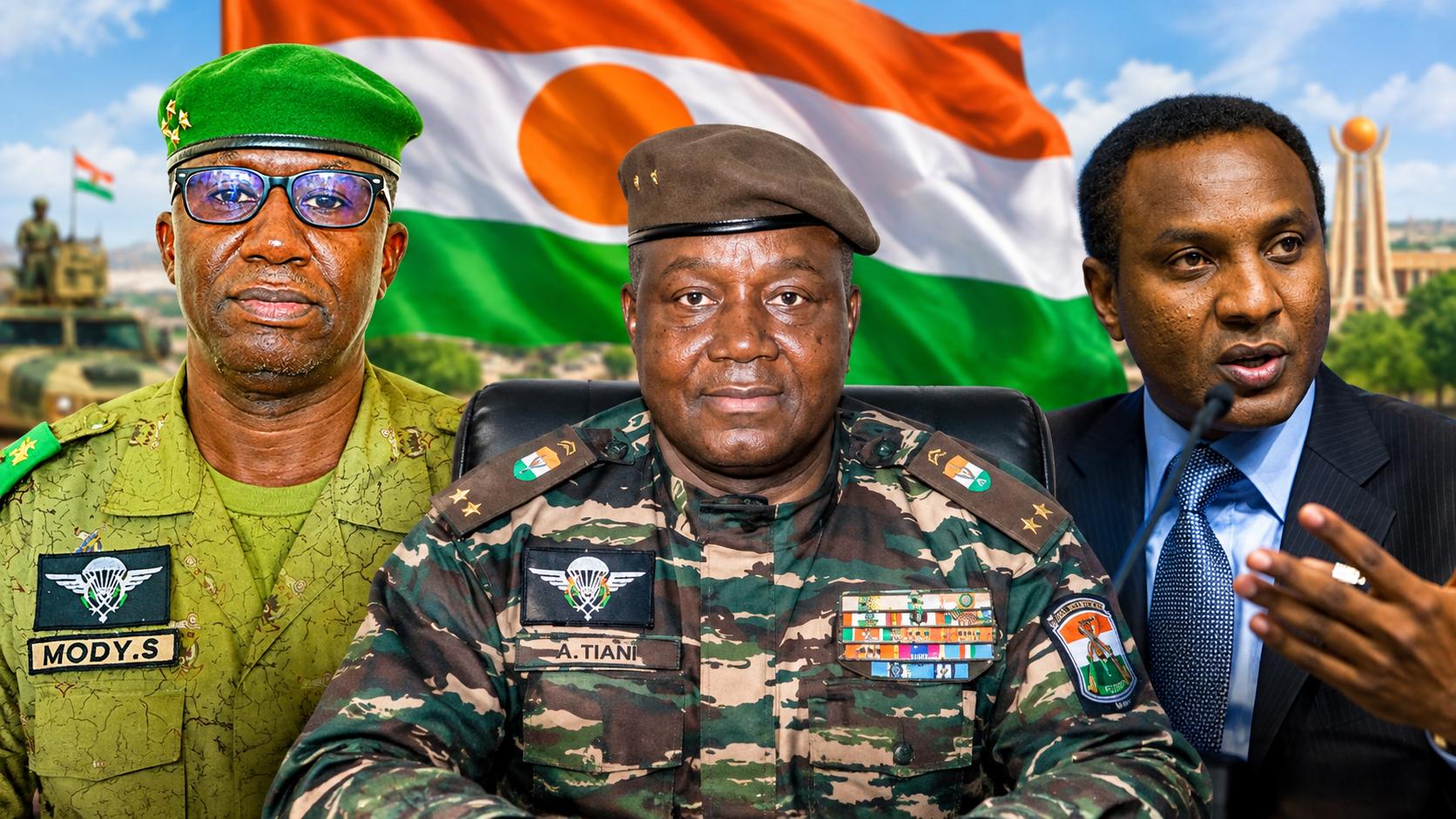
When a monthly financial flow of 1.8 billion FCFA becomes the object of a quiet struggle at the very top of the state, the consequences do not stay locked inside ministries. In Niger, the fight over the Commandement des Forces de Protection et de Développement (CFPD) is already producing tangible effects on the economy, on citizens, and on the companies that operate in the country’s most strategic sectors. At the centre of the standoff: General Salifou Mody, the head of the CNSP, Abdourahamane Tiani, the former Finance Minister and Prime Minister Lamine Zeine, and a monthly envelope of 1.8 billion FCFA.
What the CFPD was designed to do
On 9 May 2024, General Abdourahamane Tiani signed decree no. 2024-309/P/CNSP/MDN, which established the Commandement des Forces de Protection et de Développement. The stated purpose of the structure is to guard Niger’s strategic assets: mining and oil installations, transport corridors and pipelines. The Ministry of Defence confirmed the creation of this body, which is tasked with securing key sites and supply routes. In parallel, the recruitment of 10,000 young people in 2024 was meant to strengthen the ranks of the Nigerien armed forces. The project was presented as a security response, and it accompanied the broader build-up of the military apparatus.
The 1.8 billion FCFA figure and what it means for the economy
Article 28 of the decree sets a Prime Unique d’Astreinte (PUA) of at least 12,000 FCFA per man per day, while requiring companies covered by the protection scheme to make a financial contribution.
For a force of 5,000 men, the arithmetic is straightforward:
- Per day: 5,000 men × 12,000 FCFA = 60 million FCFA.
- Per month (30 days): 1.8 billion FCFA.
- Per year: 21.9 billion FCFA.
These amounts are not theoretical. They are anchored in contracts signed with firms, in sums actually paid, and in the number of personnel deployed. That is precisely why the dispute matters far beyond the presidential palace: it determines who can direct a steady flow of money towards specific companies, regions and armed units.
Why a blocked fund hurts businesses and citizens
The CFPD was created, but its financial provisions were frozen. General Salifou Mody pushed for the scheme to be implemented, and General Tiani signed the decree under direct pressure from his defence minister. After the signature, the CNSP leader instructed Finance Minister Lamine Zeine to block the financial clauses of the CFPD. The result is a structure with a legal existence but no means to operate — a deadlock with real-world effects.
For the companies that were supposed to contribute, the uncertainty translates into stalled negotiations, unanswered invoices and unpredictable costs. For the communities near mining sites, pipelines and corridors, the promised protection remains incomplete, leaving strategic infrastructure more exposed. And for the soldiers meant to staff the force, the freeze means unpaid or delayed allowances.
The Mody-Zeine clash and its consequences for governance
Lamine Zeine became the central point of friction. The Ministry of Finance deliberately blocked the budgetary translation of the military scheme. By January 2026, Zeine was simultaneously Prime Minister and Minister of Economy and Finance, while Salifou Mody served as Minister of State for Defence. Mody secured the removal of the finance portfolio from Zeine, then pushed for his departure from the Prime Minister’s office. The conflict over the CFPD destroyed trust between the pillars of the regime, and the fallout was felt across the administration.
A new power configuration at the top
The reshuffle at the summit of the state went through Zeine’s exit. General Mody took the head of government and imposed his own condition: holding both the Prime Minister’s post and the Defence Ministry. He thus concentrated political, military and administrative levers in his own hands — a shift that changes how decisions are made and how resources are allocated across the country.
Damolleydi: the second front and its local impact
Faced with the CFPD blockage, the regime launched the general mobilisation known as “Damolleydi” to rally volunteers and existing structures. General Mody took charge of the committee steering this mobilisation, sidelining General Mohamed Toumba, the Interior Minister. Yet Mody deliberately slowed the implementation of Damolleydi. The programme lost visibility, overtaken by autonomous local structures — a development that affects how security is organised at the community level and how public funds are directed.
The three levers of control — and who pays the price
This affair locks the state apparatus around three axes:
- Command: control over personnel assigned to strategic sites.
- Missions: the power to designate which infrastructure is protected and to set priorities.
- Money: control over contributing companies and the management of the financial flows they generate.
Article 28 of the decree governs this financial mechanism of 1.8 billion FCFA per month. Whoever controls it also controls which regions benefit from protection, which firms win contracts, and which units receive funding — decisions with direct economic consequences.
The wider stakes for Niger
The 1.8 billion FCFA is the direct financial stake of the scheme. It confirms the political dimension of the CFPD, sitting at the crossroads of strategic resources, contributing companies and the chain of command. Beyond the rivalry between Tiani, Mody and Zeine, the winner of this confrontation holds exclusive control over Niger’s men, missions and resources. Behind the personal quarrels, it is total mastery of the state apparatus that is being locked down — and the economic and social effects of that lock-down will be felt far beyond the corridors of power.


 Boureima Amadou





