
 Boureima Amadou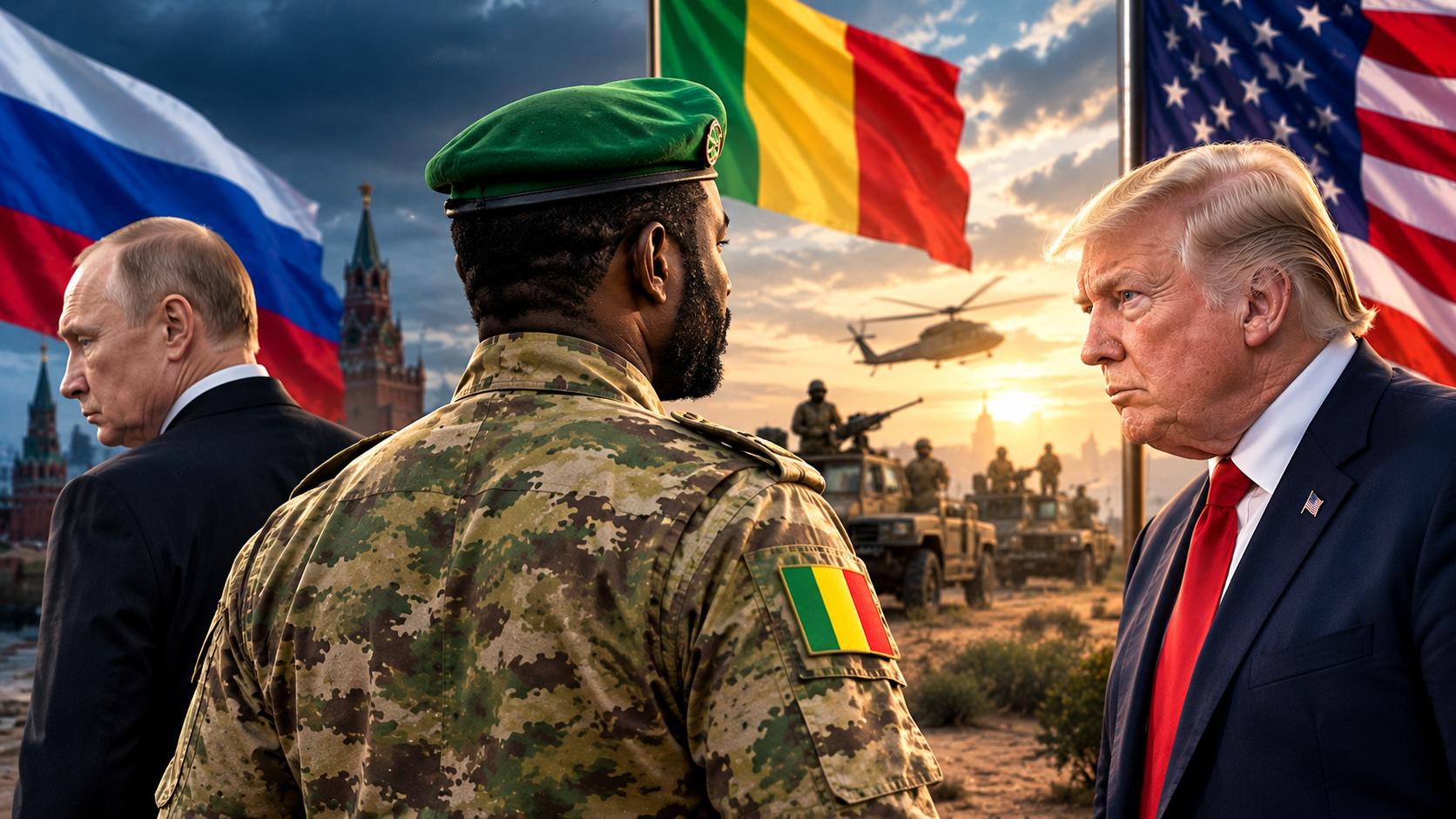
Few developments in the Sahel have stirred as much argument this year as Mali’s discreet reopening of the American channel. Word that Bamako and Washington are edging back toward security and intelligence cooperation has revived a question many assumed was settled: was the break with the West ever really permanent, and what does it mean for the Russian partnership that was meant to replace it? Inside Mali, the reaction so far is cautious rather than celebratory — a mix of relief that fresh options exist and wariness about how Moscow will read the signal.
The backdrop is familiar. After pushing out French and European forces, Mali under General Assimi Goïta turned Moscow into its foremost security ally, hosting Wagner fighters and later the Africa Corps, while steadily loosening ties with Western capitals. That chapter has not closed. Yet in 2026 it looks less like a doctrine and more like one option among several. Intelligence sharing is back on the table, flights by American surveillance aircraft are under discussion, and sanctions on senior Malian figures have been eased — all signs that Bamako is rebalancing rather than simply switching camps.
How the news is landing in Bamako
Much of the discussion now turns on credibility. A junta that built its legitimacy on restoring sovereignty and cutting dependence on former colonial powers suddenly finds itself negotiating with the very capital it once accused of meddling. Supporters frame the move as realism; detractors call it an admission that the Russian bet has not delivered. Either way, the questions circulating in markets, on radio phone-ins and in neighbourhoods far from the capital are practical ones: will new surveillance flights actually reduce attacks on villages, and who answers for the failures if they do not?
- Those who back the opening argue that no single partner can meet Mali’s security needs alone.
- Sceptics warn that re-engaging Washington weakens the sovereignty narrative that brought the current leadership to power.
- Families in the affected regions are less interested in geopolitics than in whether convoys, roads and markets become safer.
An intelligence opening that changed the conversation
By March 2026, Washington and Bamako were close to an agreement that would let American aircraft and drones fly surveillance missions over Malian territory, tracking jihadist networks — first among them JNIM, the al-Qaeda affiliate. The talks followed a February decision in Washington to lift sanctions targeting Mali’s defence minister and several senior officials.
The shift is anything but trivial. During the years of friction with Western governments, Bamako marketed Russia as the partner capable of filling the space left by departing Western powers. Today, Malian authorities are again willing to discuss capabilities they plainly need: intelligence, surveillance and reconnaissance. American intelligence had already been shared with Malian authorities in the past, and some of it is said to have fed into an operation against JNIM figures. Washington now wants that cooperation put on a more formal footing.
The paradox is striking. A country that turned its back on the West to embrace Moscow may be rediscovering the strategic value of Washington.
A security record that keeps undermining the official line
Why now? Part of the answer sits in the security balance sheet of recent years. Precision matters here: Wagner’s arrival did not create Mali’s insurgency. The country was already facing a jihadist revolt before French forces left, and armed groups enjoy deep local roots, along with political, social, economic and geographic advantages that long predate any foreign deployment.
Even so, the statistics are hard to argue with: swapping Western partners for Russian forces did not durably curb the violence.
The American terrorism assessment for 2022 recorded that attacks had grown in both number and lethality. That was the year France completed its withdrawal, with the last French soldier leaving on 15 August 2022, while Malian troops, backed by Wagner, moved into former French positions. The same assessment labelled 2022 the deadliest year in Mali’s history measured by terrorist violence and counter-terror operations. The following year did not reverse the pattern: the 2023 edition again logged more attacks and greater intensity, and again described that year as the deadliest on record once jihadist attacks and operations by Malian forces alongside Wagner were counted together.
For a narrative that sold the Russian partnership as the answer to Mali’s security crisis, the finding is uncomfortable.
Wagner, the Africa Corps and the setback in Kidal
Announcing Russia’s exit would still be premature. Wagner has gradually given way to the Africa Corps, which answers directly to the Russian defence ministry, and Moscow keeps a significant military and political footprint in the country. It has backed mining and energy projects and continues to present itself as a committed ally of Bamako.
That presence has taken blows of its own. In April 2026, an offensive by JNIM and Tuareg fighters inflicted serious losses on Malian forces and their Russian allies. Defence minister Sadio Camara, who was trained in Russia, was killed in an attack. The Africa Corps was also forced to withdraw from Kidal, the strategic northern city it had helped retake in 2023. Those reverses badly dented Russia’s image as a guarantor of security, and analysts tracking the campaign argued that JNIM’s successive offensives, the fuel blockade and the recent losses amounted to a failed intervention.
Civilian deaths and the numbers feeding the doubt
Figures compiled during 2025 sharpen the unease. Conflict-monitoring tallies link Malian forces and the Russian paramilitary groups Wagner and the Africa Corps to 918 civilian deaths in Mali in 2025, against 232 attributed to JNIM and Islamic State in the Sahel. These are documented fatalities and should be read with caution, but they convey the scale of the violence and the scrutiny now falling on government forces and their Russian allies.
Meanwhile, the jihadists kept gaining ground. JNIM disrupted the country’s supply routes and applied heavy pressure on Bamako. In March 2026, Malian authorities released around 200 people detained over suspected jihadist links, part of an arrangement aimed at securing a truce on attacks against fuel convoys. For a junta that came to power promising sovereignty and security, the symbolism is heavy.
Moscow’s remaining cards: gold, lithium and energy
Russia is far from out of the picture. Its interests in Mali stretch well beyond the battlefield, spanning gold, lithium and energy, and it has continued to champion joint projects while insisting on its commitment to Bamako. Any suggestion of a clean rupture misreads the situation.
What is changing is the logic. After making Moscow its main security recourse once French forces departed, Bamako appears to accept that Russia alone cannot cover the full range of its military and intelligence requirements. That is where Washington comes back in, offering what Moscow does not necessarily supply on the same terms: airborne and satellite intelligence, considerable technological reach and detailed knowledge of jihadist networks.
The outlook: a foreign policy built on balance
The rapprochement with America may therefore look less like an ideological conversion than a pragmatic conclusion: Mali needs more than one partner to confront a threat its Russian alliance has not managed to eliminate.
Recent history is turning once more. Yesterday, Bamako denounced French and European deployments and presented Russia as the sovereign alternative. Today, talks with Washington have resumed at a level that would have seemed implausible only a few years ago. Russia remains in Mali, but its security record is contested, its forces have suffered reversals and the jihadists keep threatening the country.
Against that backdrop, the American opening is far more than a diplomatic episode. It could mark the start of a new foreign policy for Bamako: no longer replacing one partner with another, but playing the rivalry between great powers to obtain from each what Mali needs. The country has not abandoned Russia — yet the Russian monopoly on Mali’s security partnership may already belong to the past.








