
 Mariama Hamani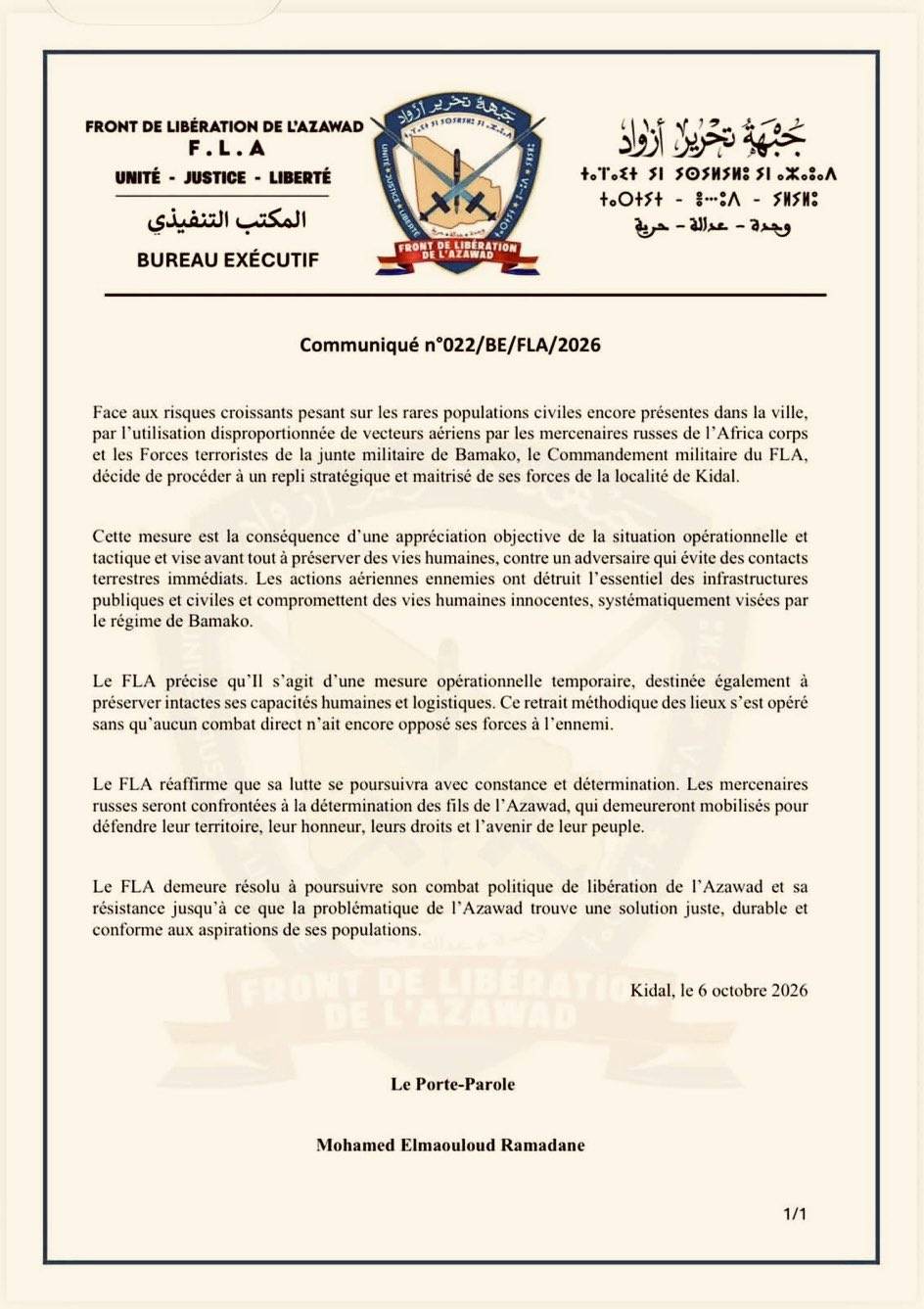
Mali’s shifting frontlines: FLA completes Kidal withdrawal in carefully staged operation
The National Liberation Front of Azawad (FLA) has formally withdrawn its combat units from Kidal, northern Mali, describing the move as a deliberate and controlled repositioning rather than a retreat. According to military observers, the operation involved no direct ground engagements and was executed without immediate civilian displacement, reinforcing the group’s assertion that this is a tactical rather than definitive departure.
Why Kidal remains central to Mali’s decade-long conflict
Kidal is not just another urban center in northern Mali—it is a fulcrum of resistance for Tuareg separatists since the 1990s. Control of the city has repeatedly shifted between armed groups and state forces, each victory carrying both military and symbolic weight. Its fall to Malian troops in November 2023, with support from Wagner-affiliated units, was hailed by Bamako as a breakthrough toward restoring national sovereignty across the Azawad region.
The FLA’s sudden return to Kidal in April 2026, after a coordinated offensive across multiple northern fronts, forced the withdrawal of Africa Corps (the renamed Wagner successor) under armed escort. Reports indicate the evacuation of over 400 Russian-linked paramilitaries to Tessalit, underscoring the city’s strategic importance.
Is the FLA’s withdrawal a setback or a strategic reset?
FLA spokespersons frame the withdrawal as a temporary maneuver to avoid direct confrontation while preserving fighting capacity. This narrative echoes similar retreats in 2023, when separatist groups claimed they were regrouping ahead of future operations rather than acknowledging defeat.
The Sahel’s vast desert terrain provides ideal conditions for such tactics: mobility, local knowledge, and dispersed operations allow armed factions to regroup quickly and launch surprise attacks. Analysts caution that historical precedence suggests Kidal’s abandonment does not equate to strategic capitulation.
Fighting for Kidal: a history of heavy losses and shifting outcomes
The city has been contested repeatedly—most infamously in May 2014 when a Malian offensive failed spectacularly against Tuareg rebels. Official military tolls claimed 20 killed and 30 wounded, but UN peacekeepers later confirmed at least 33 Malian soldiers and eight civilians died. Unofficial estimates placed rebel losses even higher.
A decade later, the November 2023 recapture of Kidal by Malian forces—backed by Wagner’s Africa Corps—was presented as a turning point. Yet within months, separatist offensives reversed key gains. The July 2024 battle at Tinzaouatène, near the Algerian border, became a devastating stalemate. Wagner-linked units suffered significant casualties when ambushed amid a sandstorm, with rebel groups claiming over 130 enemy deaths, though neither Bamako nor Moscow released official figures.
From Wagner to Africa Corps: lessons unlearned in the Sahara
Despite the rebranding from Wagner to Africa Corps, Russian-linked support continues to face operational challenges in Mali’s northern theaters. Technological superiority and heavy weaponry offer only limited advantage in a war dominated by mobility, ground intelligence, and desert terrain mastery.
The April 2026 Kidal withdrawal marked a symbolic blow to Africa Corps’ presence in the region. Months later, government forces reclaimed Anéfis in July 2026 after fierce clashes, yet separatists retained control over key supply corridors, illustrating how fluid frontlines remain.
What’s next for Kidal after the FLA pullout?
Military analysts warn against interpreting the FLA’s withdrawal as an endgame. In the Sahel, cities frequently change hands without resolving the broader conflict. The key questions now focus on FLA’s next moves: Is this a temporary lull? A regrouping for a larger offensive? Or a shift to guerrilla warfare deeper in the Azawad?
For Bamako and its allies, the loss of Kidal risks strengthening separatist propaganda and undermining the narrative of government restoration. For the FLA, the city remains both a strategic asset and a political symbol—one that may be relinquished today but reclaimed tomorrow. In this unrelenting cycle of advance and retreat, Kidal is not conquered—it is merely contested once again.


 Boureima Amadou



