
 Mariama Hamani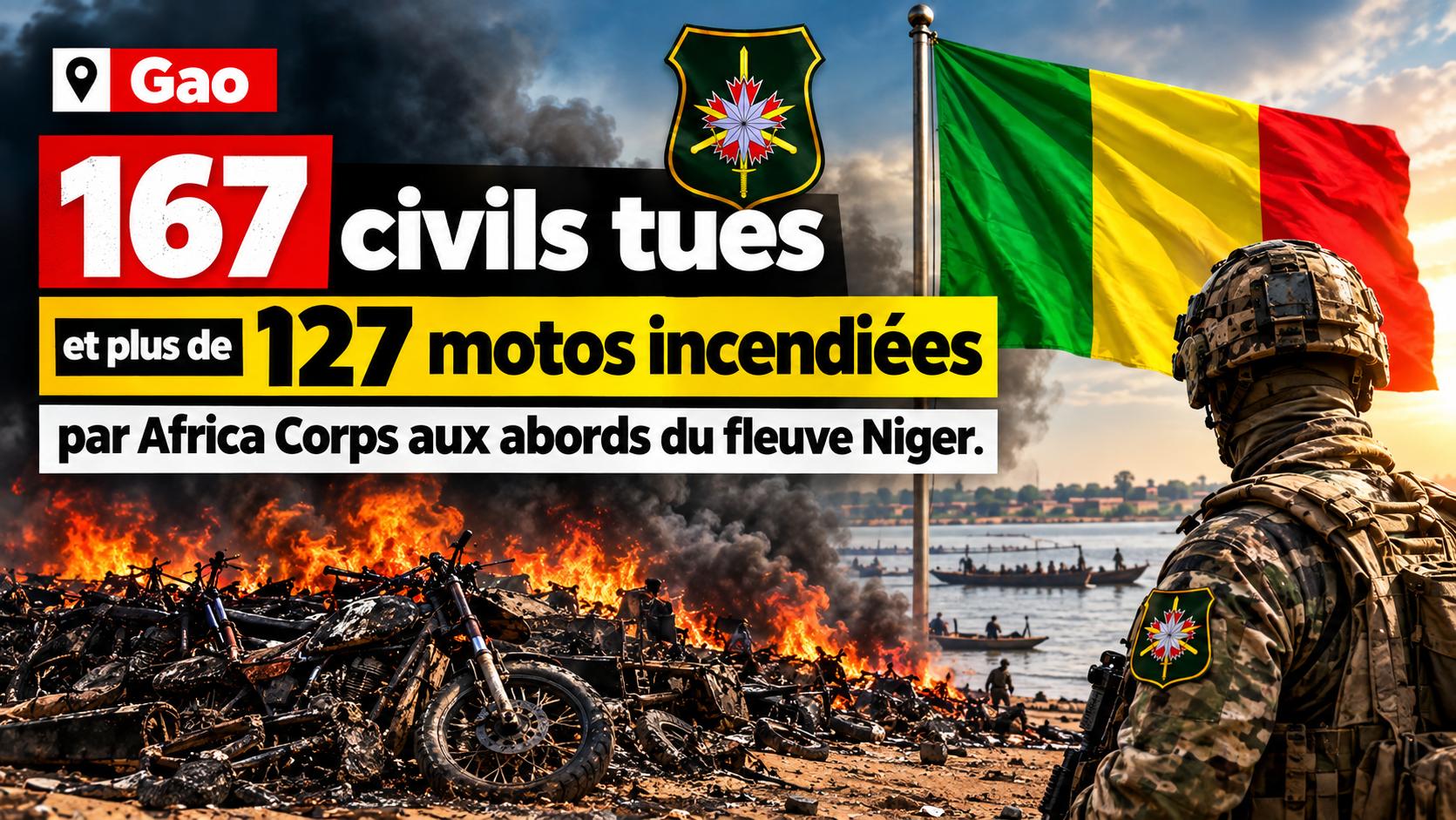
A riverside morning turns into a killing ground
It was barely past sunrise on Tuesday 15 September 2026 when the rattle of automatic fire and thick black smoke drifted across the Niger river on the edge of Gao. What should have been an ordinary working morning became the scene of one of the deadliest single episodes this city has endured.
Gunmen from Africa Corps, the private force that has taken over the role once played by Wagner on the continent, swept into a stretch of riverbank that local families depend on for their daily survival. They opened fire on unarmed civilians who had no means of defending themselves.
A toll of 167 lives and 127 burnt motorbikes
The figures are staggering. 167 civilians were executed on the spot, and more than 127 motorbikes were first gathered together and then set alight. The victims were not fighters. They were market gardeners, fishermen and small traders who had simply begun their day early.
What the attackers left behind was a landscape of ash and grief. Families who watched their relatives die and their tools of work disappear are now trying to comprehend an act of violence that appears designed to erase not only people but the very possibility of earning a living.
Why destroying a motorbike means destroying a household
In Gao, a motorbike is far more than a convenience. It is the essential instrument of a whole generation of young workers, the only practical way to move goods from the river to the markets, and the financial backbone of extended family networks that survive on daily earnings.
The engine that keeps the informal economy alive
Wipe out the motorbikes and the supply of fresh produce stops almost instantly. The city now faces the prospect of a serious food crisis, while hundreds of households slide toward outright destitution.
“They shot without any warning and then piled up our vehicles and set them on fire. My brother was among the dead. Without my motorbike and without him, there is nothing left to live on and nothing to feed the children tonight,” a survivor said, speaking anonymously, his voice breaking with grief.
The failed bargain with the military authorities
The bloodshed at Gao exposes the disastrous trajectory of the security partnerships that military regimes across the region have signed. In Niamey and Bamako alike, the alignment between General Abdourahamane Tiani’s junta, its allies in the Alliance of Sahel States (AES) and Moscow was presented as a sovereign answer to years of disorder.
On the ground, that narrative collapses. The arrival of Africa Corps has not dismantled the armed groups it was meant to defeat. Instead it has inserted a predatory, unaccountable force that turns its weapons on the very civilians it claims to protect.
Operating with total impunity, these fighters behave less like partners and more like an occupying army, inflicting indiscriminate violence on the populations of the states they are supposedly assisting.
Reliance on foreign guns erodes the state itself
This dependence on private combatants corrodes social cohesion and hollows out state authority. By remaining silent about the killing of 167 civilians, the junta and its partners in effect become complicit in abuses that demolish their own rhetoric of emancipation and security.
Terror settles along the riverbanks
Shock in Gao is giving way to a bitter sense of abandonment. Residents see at close range how promises of order and stability translate into armed men answerable to no national chain of command, trampling international humanitarian law without consequence.
Fear of another raid now paralyses life along the Niger river. Survivors hesitate to return to their plots and stalls, abandoning the riverbanks rather than risk meeting the death squads again.
What the people of Gao are asking for
The transitional authorities cannot fall back on their usual silence. The people of Gao are not calling for geopolitical slogans; they are demanding the most basic rights to life and dignity, rights that Africa Corps continues to trample in blood.


 Boureima Amadou





