Boureima Amadou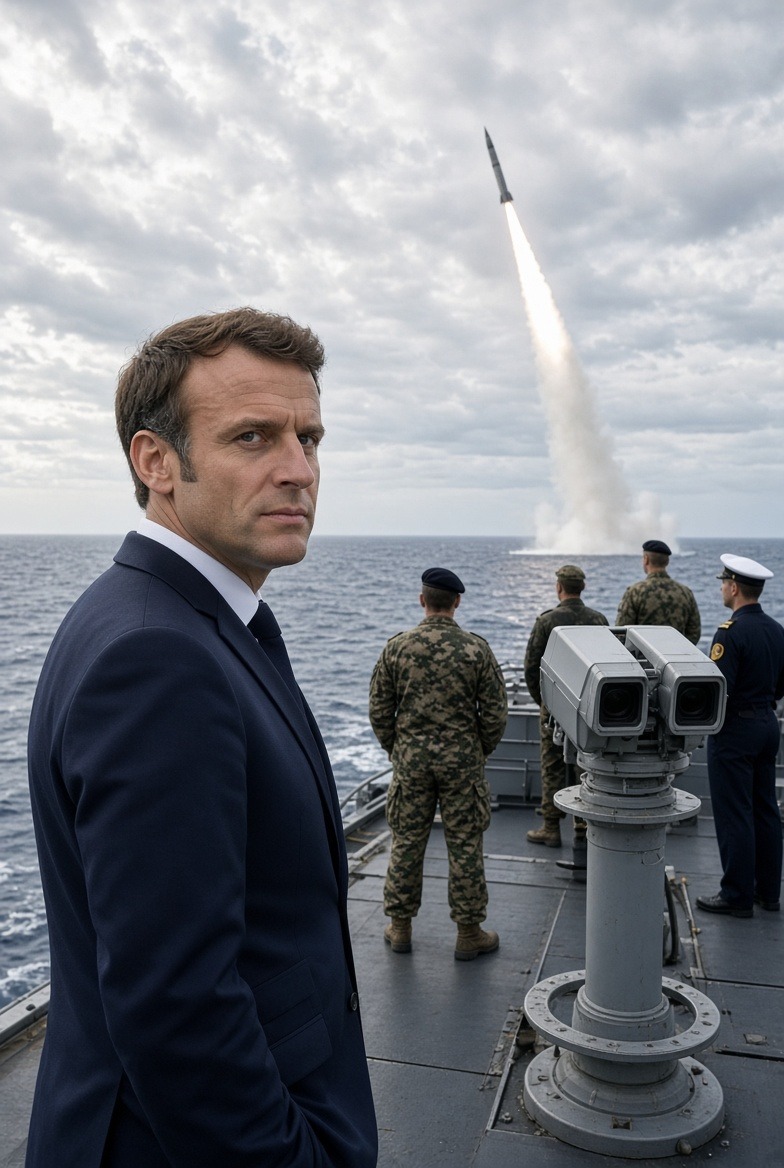
The M51.3 test: a strategic move in Europe’s tense security landscape
President Emmanuel Macron personally observed the inaugural acceptance test of the M51.3 ballistic missile, launched from the nuclear-powered submarine Le Vigilant on October 6, 2026. Conducted off the coast of Finistère, the missile demonstration—monitored by the Direction générale de l’armement’s testing fleet—marked a critical validation of France’s upgraded nuclear deterrent in an increasingly volatile European security environment.
The M51.3, operational since October 2025, is designed to enhance the range, precision, and penetration capability of France’s submarine-launched ballistic missile (SLBM) fleet. Unlike its predecessors, this version incorporates advanced countermeasures to counter evolving anti-missile defenses, reinforcing the credibility of France’s nuclear deterrence.
Europe’s security environment: a backdrop of heightened tensions
Since Russia’s full-scale invasion of Ukraine in 2022, Europe’s military and strategic calculus has shifted dramatically. NATO reports a surge in hostile incidents, including airspace violations, drone incursions, and cyberattacks, many of which have been attributed to Moscow. In recent months, NATO allies have documented unauthorized flights over Poland and Romania, as well as drone incursions near Lithuania and the Baltic Sea—where Swedish and Finnish fighter jets intercepted Russian military aircraft operating in international airspace.
NATO’s Eastern flank: a shifting defense posture
In response, NATO has accelerated its deterrence measures. Launched in 2025, the Eastern Sentry operation integrates combat aircraft, air defense systems, surveillance platforms, and naval assets to monitor and respond to a wide spectrum of threats—from ballistic missiles to unmanned aerial vehicles (UAVs). While NATO Secretary General Mark Rutte has stated there is no immediate threat to member territories, he emphasized that any aggressive action against a NATO country would be preceded by visible military preparations.
The alliance’s evolving posture reflects a broader reality: the nature of threat in Europe is no longer confined to traditional military assets. Modern conflicts increasingly involve drones, cyber warfare, sabotage, and hybrid operations, as evidenced by recent maritime incidents in the Black Sea. In October 2026, a Togolese-flagged merchant vessel sank off Bulgaria’s coast following a suspected drone attack, compounding earlier incidents in the region—incidents widely suspected to originate from Russian operatives.
France’s nuclear deterrent: autonomy and credibility
Against this backdrop, Macron’s endorsement of the M51.3 test underscores a central tenet of French doctrine: deterrence relies on credible, enduring military capabilities. The president framed the test as emblematic of France’s commitment to maintaining an autonomous nuclear deterrent, designed to protect the nation’s vital interests without dependence on conventional forces or allied guarantees alone.
France’s nuclear arsenal operates on a dual-component strategy: submarine-launched ballistic missiles (SLBMs) and airborne nuclear-capable delivery systems. The Le Triomphant-class submarines, including Le Vigilant, form the backbone of the oceanic component, ensuring a survivable second-strike capability thanks to their stealth and mobility.
Modernization on multiple fronts
Over the past decade, France has doubled its defense budget, with significant investments in next-generation systems. In addition to the M51.3, the Ministry of Armed Forces is advancing programs for a new class of SNLEs (nuclear-powered ballistic missile submarines) and a hypersonic, maneuverable strategic missile for the air component. These upgrades are part of a broader modernization effort initiated in 2023, aimed at adapting France’s nuclear posture to 21st-century threats.
Macron has repeatedly framed this investment as essential to national sovereignty. “To remain free, we must be feared. To be feared, we must remain powerful,” he stated in a recent address, echoing a long-standing principle of deterrence theory: the assurance that aggression against vital interests would result in unacceptable consequences for any adversary.
Beyond nuclear deterrence: a broader strategic vision
The M51.3 test is not merely an industrial achievement; it symbolizes France’s broader vision of European security. In an era where threats manifest across multiple domains—from maritime chokepoints to cyber networks—Paris seeks to balance conventional military strength, European cooperation, and strategic autonomy. The submarine’s deployment sends a clear signal: France intends to preserve decision-making independence and ensure its ability to act decisively in a rapidly changing security environment.
As Europe braces for potential spillover from the Ukraine conflict and faces the risk of escalation in the Black Sea or Baltic regions, the message is unambiguous. The test on October 6 was not just about validating a new missile—it was a declaration of intent: France will remain a pillar of stability, deterrence, and strategic foresight in an increasingly unpredictable world.


 Mariama Hamani