
 Boureima Amadou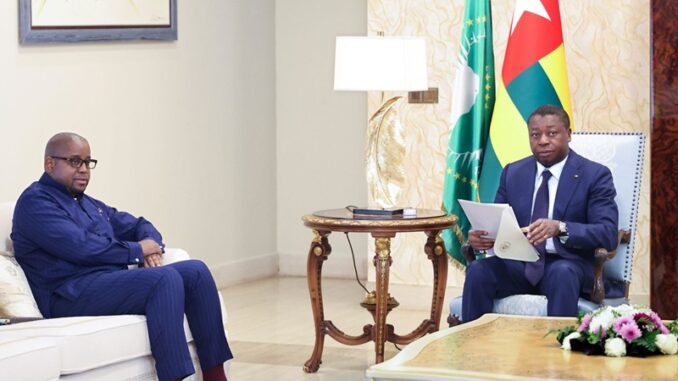
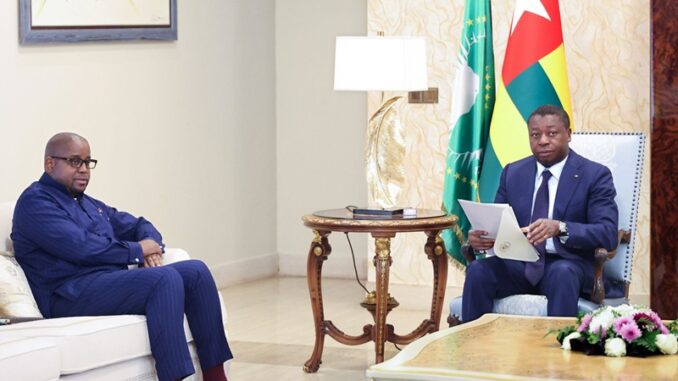
What does it take to restart a peace process that has been grinding forward without a breakthrough for months? That is the question hanging over Lomé after Togo’s head of state, Faure Essozimna Gnassingbé, received a written message from Congolese President Félix-Antoine Tshisekedi Tshilombo on Tuesday, September 29. The letter was hand-delivered by Floribert Anzuluni, the Democratic Republic of Congo’s minister of regional integration, during an audience at the Togolese presidency.
Anzuluni explained that he and his delegation had been dispatched to the Togolese capital to pass on a special communication from Kinshasa concerning the peace process in eastern DRC — a file in which Gnassingbé is directly engaged as the African Union’s mediator.
The message behind the handshake in Lomé
According to Anzuluni, the purpose of the mission was straightforward: to convey President Tshisekedi’s latest position to the Togolese leader, who chairs the AU’s mediation effort. The written message is the most recent in a series of official exchanges between Kinshasa and Lomé aimed at keeping the diplomatic channel active.
Beyond delivering the letter, the Congolese envoys used the meeting to brief Gnassingbé on progress made by Congolese authorities in demobilising armed movements — a step Kinshasa sees as essential to consolidating peace in the east. The region has seen renewed military activity and rising tensions since late 2021.
Why Gnassingbé’s role matters in this mediation
Gnassingbé has led the African Union’s mediation mission since April 2025, taking over from Angolan mediators. His mandate covers the security crisis in eastern DRC and the broader Great Lakes region — a file that has frustrated peacemakers for years.
Two objectives dominate the agenda: securing a lasting ceasefire and achieving long-term stabilisation across the Great Lakes. These goals remain unmet, despite parallel diplomatic tracks in Doha under Qatari mediation and in Washington under American mediation.
A process under pressure, a letter under scrutiny
The timing of Tshisekedi’s latest message raises a strategic question: does Kinshasa believe the AU track can still deliver results, or is the letter a way of keeping options open while other mediation channels advance? For now, the audience in Lomé signals that the Congolese presidency wants to keep Gnassingbé’s engagement alive and visible.
What happens next will depend on whether the message translates into concrete movement — on the ground in eastern DRC, and around the negotiating tables that have so far failed to produce a durable ceasefire. Until then, the question of whether this diplomatic round can break the deadlock remains open.








