
 theafricantribune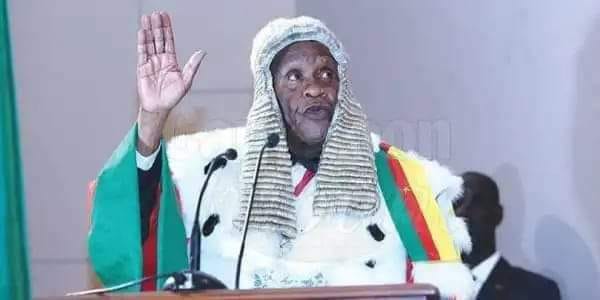
Eight years at the helm of Cameroon’s constitutional council come to an end
Clément Atangana, the first president of Cameroon’s constitutional council, has died at 84 in Paris after a long illness. His passing on October 4, 2026, closes a chapter that shaped how electoral disputes have been handled in the country for nearly a decade.
For ordinary citizens and political parties alike, the vacancy at the top of the institution raises immediate questions about who will steer the body responsible for validating presidential elections. The council’s decisions have directly affected the outcome of contested votes, and any change in leadership could influence how future electoral complaints are treated.
How Atangana’s tenure shaped electoral justice
Appointed on February 7, 2018, just months before that year’s presidential election, Atangana presided over a jurisdiction that became known for its swift dismissal of opposition petitions. His deep voice and repeated use of the word “inadmissible” left a lasting impression on Cameroonians who followed the legal battles that followed major elections.
Under his leadership, the council ruled on disputes arising from two presidential elections: the 2018 poll and the 2025 poll. In both cases, the official results were challenged—by Maurice Kamto of the MRC and his supporters in 2018, and by Issa Tchiroma Bakary and his backers in 2025. Neither challenge succeeded.
A video that circulated on social media after the 2025 results showed Atangana expressing satisfaction: “I am happy that you are rejoicing both for your candidate’s victory and for the work done by your father.” The remark fueled perceptions that the council operated in step with the ruling regime. Since its establishment in 2018, no petition from the opposition has ever been upheld.
A long career in Cameroon’s judiciary
Born on December 20, 1941, in Ekoumeyeck near Ngomedzap, in the Nyong and So’o division, Atangana joined the magistracy on December 20, 1968, after training at ENAM and the International Institute of Public Administration in Paris. He rose through the ranks as a senior magistrate, serving as an examining magistrate in Nkongsamba, president of courts in Eséka, Bafia, Sangmélima, and Mora, and prosecutor general in Maroua.
He later presided over the Center Court of Appeal, served as a counselor at the Supreme Court, and chaired the administrative chamber of the Supreme Court. He retired from that court in 2014 and was called back four years later to lead the constitutional council.
What the vacancy means for the country
The death of Atangana leaves the presidency of Cameroon’s highest electoral jurisdiction vacant. Under the constitution, the president of the Republic appoints the new head of the council by decree. Until that happens, the institution remains without its top figure—a situation that could affect the handling of any electoral disputes that arise in the interim.
For political parties and voters, the appointment of a successor will be closely watched. The council’s role in validating election results means its leadership directly impacts the credibility of the electoral process and, by extension, the stability of the country’s political landscape.


 Boureima Amadou
 Mariama Hamani


